
Carbide Grades Decoded: Grain Size, Cobalt and the Truth About TRS
Carbide grades are a headache — submicron, ultra-fine, 6/8/10/12% cobalt, brazed or solid — and the datasheet numbers look comparable but are not. The key to reading them is to look at cobalt % and grain size together, then understand the practical differences in quality and in brazed tooling.
1. Two dimensions make it clear: cobalt % × grain size
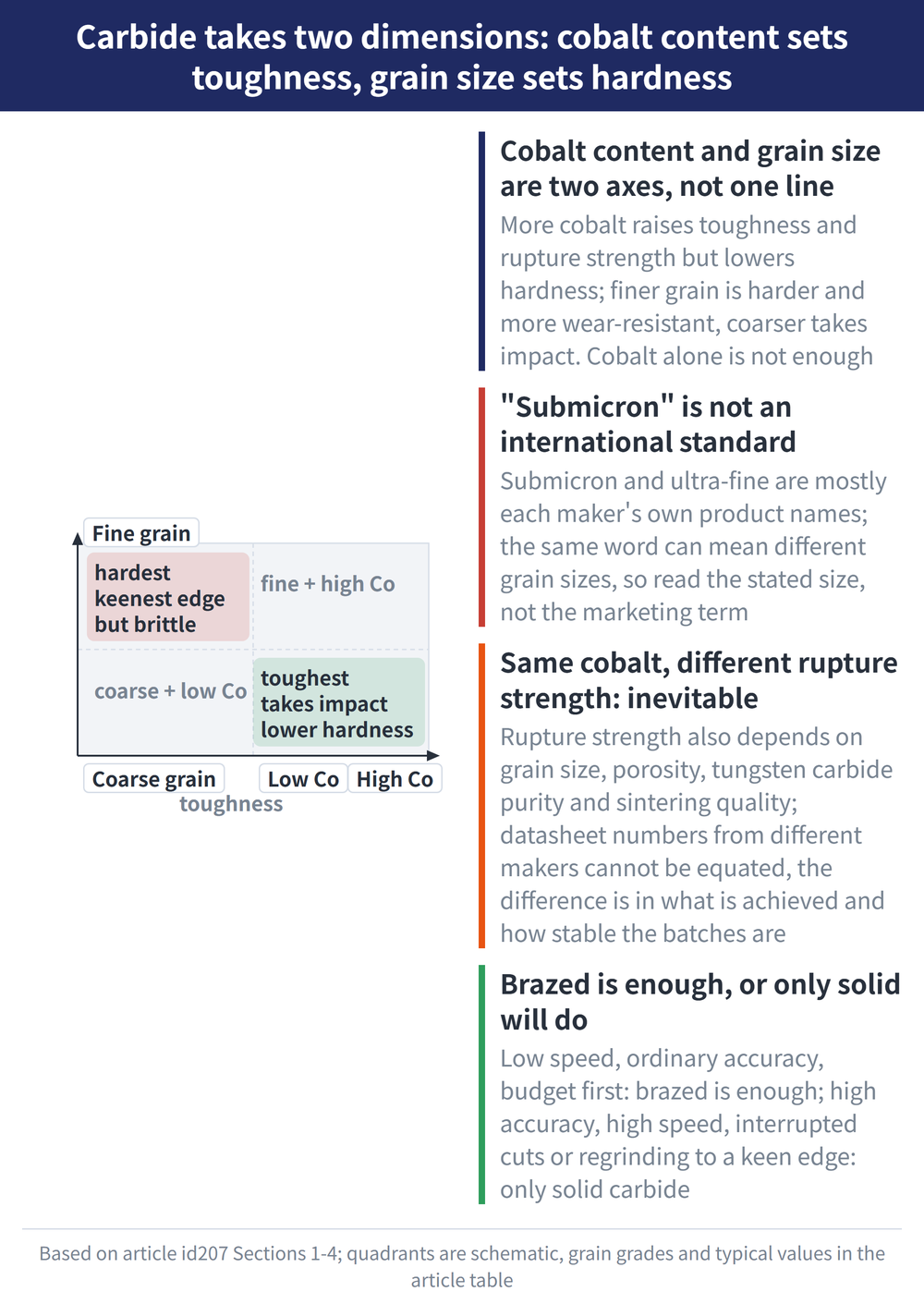
Carbide performance is not a single line but two dimensions: cobalt % sets toughness, grain size sets hardness. More cobalt % raises toughness and transverse rupture strength but lowers hardness; less cobalt % raises hardness and wear resistance but turns brittle.
Grain size runs from coarse down to nano, where finer is generally harder and more wear-resistant while coarser is more impact-resistant. The common grades and their typical values:
| Grain grade | Typical grain size | Performance tendency |
|---|---|---|
| Coarse | about ≳1.3µm | Good impact and rupture resistance, lower hardness |
| Fine | about 1.0–1.3µm | A hardness/toughness compromise, highly general-purpose |
| Submicron | about 0.5–0.8µm | Good hardness, wear resistance and edge sharpness |
| Ultra-fine | about 0.2–0.5µm | High hardness and very sharp edge, but weaker impact resistance |
| Nano | < 0.2µm | Highest hardness, most sensitive to sintering quality |
Key point: "submicron" is not an international standard
MG, SMG, submicron and ultra-fine are mostly each maker's own product names, not a unified international classification. Under the same word "submicron", one maker may mean 0.6µm and another 0.4µm. Choose by the actual µm figure stated, not by the marketing label.
The µm grades above are common industry typical/reference values; each maker's naming and boundaries differ, so follow the catalogue or standard.
2. "Same cobalt %, different TRS" is not a paradox — it is inevitable
People often ask why transverse rupture strength (TRS) varies so much at the same cobalt %. It is no paradox: TRS depends at once on grain size, porosity, WC purity and sintering quality, with cobalt % being only one variable.
For example, at the same 10% cobalt, refining the grain from about 1.2µm to about 0.4µm can raise hardness and lift TRS at the same time (the gain varies with formulation and process; makers publish no single figure); but very fine grain has weaker impact resistance and chips more easily.
Cobalt % alone is not enough
To judge whether a carbide fits, you must read cobalt % + grain size + quality together; miss any one and the rupture or hardness figures on the datasheet cannot be compared.
The µm and % figures above are typical examples that vary with formulation and process — follow the catalogue or standard. Do not guess cutting conditions; convert them with the end mill cutting conditions guide.
3. Why the same datasheet numbers from China, Japan or Europe are not directly comparable
On one datasheet, Chinese, Japanese and European carbides list similar Co% and hardness, yet you cannot treat them as equal. The difference is not in the paper numbers but in whether it can actually be achieved and how stable the batches are.
| Invisible difference | Why it matters |
|---|---|
| WC raw-material purity and size distribution | Impurities and uneven sizing directly lower hardness and rupture consistency |
| Grain-growth inhibitor | Only well-applied inhibitor keeps fine grain from growing during sintering |
| Sintering process (including HIP) | Whether hot isostatic pressing is used changes porosity and density greatly |
| Porosity grade (A/B/C-type pores) | Pores are crack starters, so the same Co% can still chip early |
| Batch consistency | One good piece does not mean a stable batch — this matters most in volume |
In practice: check the porosity grade and source, ask for measured hardness and rupture strength, and refer to real-world tool life reputation, not just the datasheet numbers. For the overall logic of choosing a material, see the cutting tool materials overview. For how to compare two brands' spec sheets field by field, see Comparing Cutting Tool Brands: Which Spec Fields Line Up, and Which Only Count Within One Catalog.
4. Brazed carbide vs solid carbide: when brazed is enough and when only solid will do
Both are carbide tools, but brazed and solid sit in very different places. Brazed means a carbide tip braze-welded onto a steel shank; solid means one-piece construction.
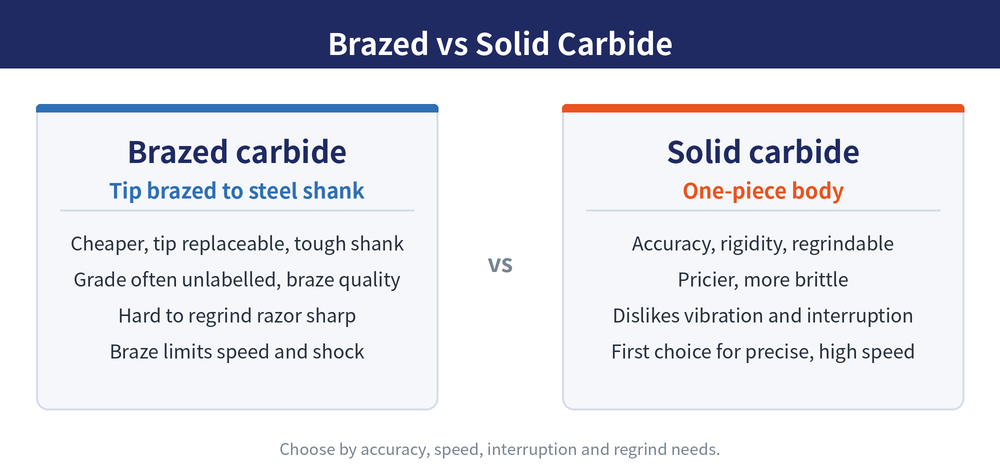
| Item | Brazed carbide | Solid carbide |
|---|---|---|
| Construction | Carbide tip braze-welded on a steel shank | One-piece |
| Cost | Cheaper, tougher steel shank | More expensive |
| Grey areas / weaknesses | Tip grade often unlabelled; braze-joint quality and heat-affected zone unclear; hard to regrind very sharp; braze layer limits speed and impact | More brittle, sensitive to vibration and interrupted cuts |
| Strengths | Replaceable edge, tough shank, low unit price | Good accuracy, rigidity and regrindability |
The rule: for low speed, ordinary accuracy and budget priority, brazed is enough; for high accuracy, high speed, interrupted cutting or the need to regrind to a very sharp edge, only solid will do.
5. Choosing carbide by tool type: which tool takes which material
Different tool types trade off hardness, toughness and edge sharpness differently, so the material choice differs too.
| Tool type | Mainstream carbide choice | Note |
|---|---|---|
| Milling cutters | Solid carbide (submicron to ultra-fine), usually with PVD | Mainstream, balancing hardness and edge sharpness |
| Drills | Mostly solid carbide, also brazed and exchangeable-head | Solid for high-speed, hard-to-cut and deep holes |
| Reamers | Solid or brazed carbide | For high accuracy and wear resistance |
| Taps | Mostly HSS | Toughness first; carbide taps are rare, special and brittle |
For the logic of choosing material by tool type, see how to choose tool material by tool type; for the carbide-versus-HSS trade-off on end mills, see carbide vs HSS end mills.
Last updated: 2026-10-28
6. Frequently Asked Questions (FAQ)
Q: Is "submicron" a standard specification?
No. Submicron, ultra-fine, MG and SMG are mostly each maker's own product names, not a unified international classification. The same "submicron" may mean 0.6µm at one maker and 0.4µm at another, so read the actual µm figure stated.
Q: Is higher or lower cobalt % better?
Neither is absolutely better. Higher cobalt % means more toughness and rupture strength but lower hardness, suited to impact and interrupted cuts; lower cobalt % means more hardness and wear resistance but brittleness. Choose it together with grain size and the cutting conditions.
Q: If Chinese and Japanese carbide datasheets show the same numbers, are they the same?
No. Even with similar Co% and hardness on paper, WC purity, grain-growth inhibitor, sintering and HIP, porosity grade and batch consistency create real differences. Check the porosity grade and source, ask for measured values, and refer to real-world tool life reputation.
Q: When should I use solid carbide and when is brazed enough?
Brazed is enough for low speed, ordinary accuracy and budget priority; only solid carbide will do for high accuracy, high speed, interrupted cutting or when you need to regrind to a very sharp edge.
This article is part of Tool Materials and Coatings: The Complete Guide - Separate Substrate From Coating, Then Work Back From the Workpiece; that guide shows how the whole topic fits together.









