Belt Grinding: How It Differs from Wheels, and Choosing the Contact Wheel
Belt grinding is elastic contact where wheel grinding is rigid—one difference that leads to lower temperature, less burn and a lower demand on machine rigidity. This covers when a belt can replace a wheel, how to choose the contact wheel (get it wrong and the best belt will not save you), and how to set speed, pressure, stock and grit by material.
1. The difference: elastic contact
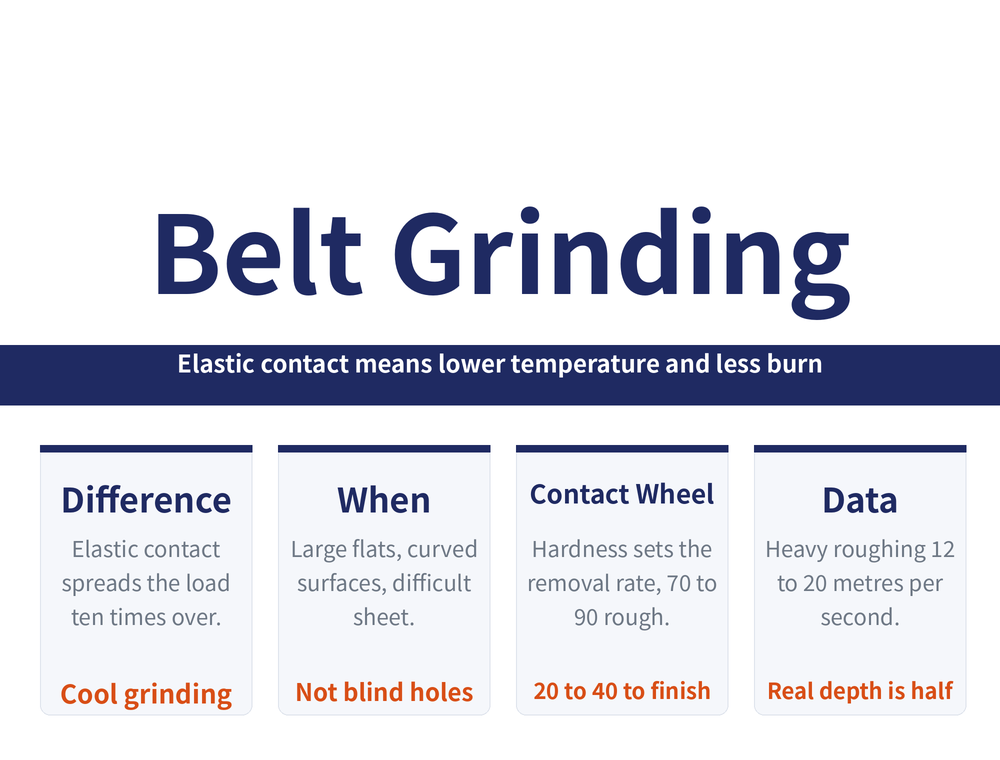
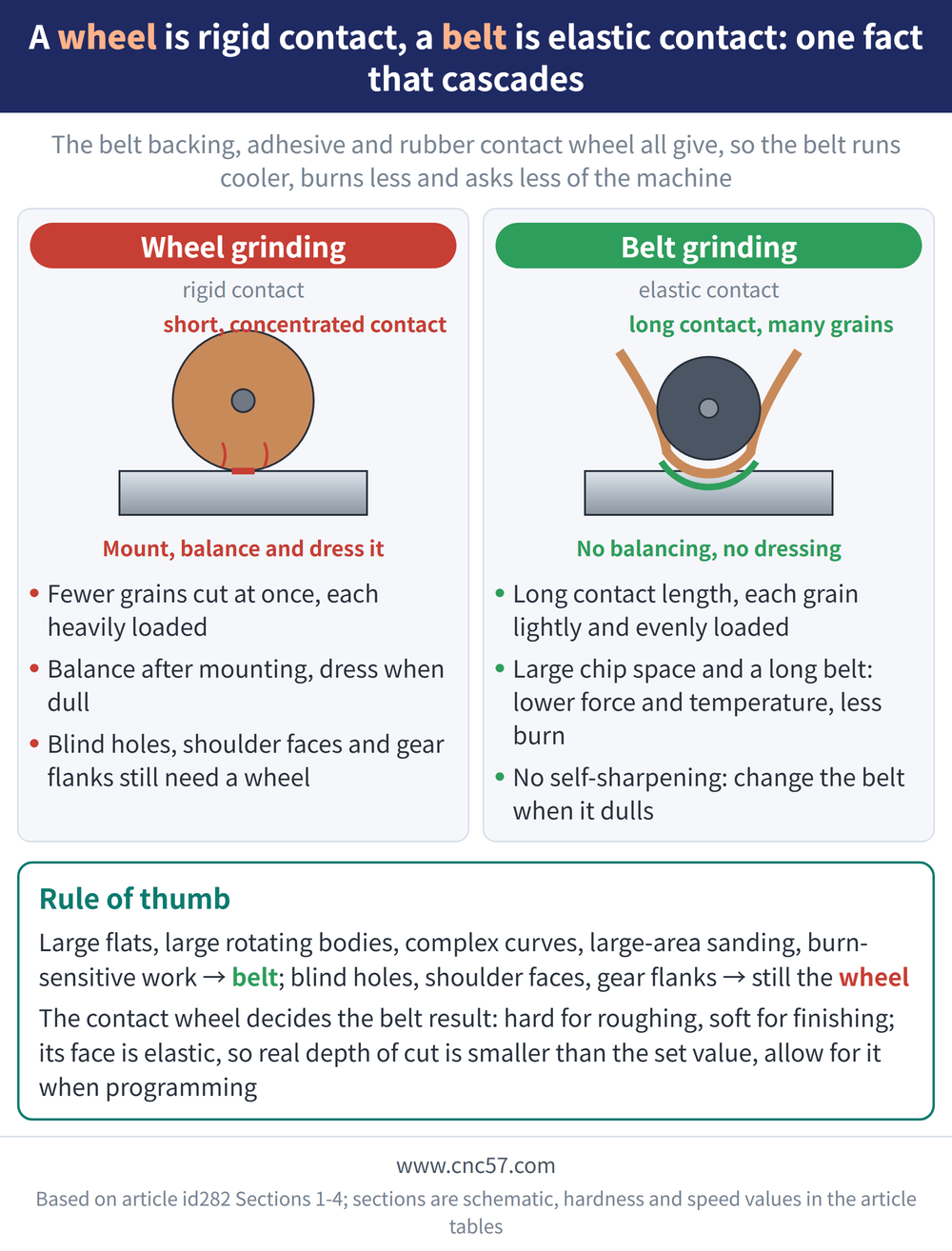
Wheel grinding is rigid contact; belt grinding is elastic—the backing, the adhesive and the rubber contact wheel all give. That single fact cascades:
| Property | Result |
|---|---|
| Long contact length | More grains cut at once, each lightly and evenly loaded |
| Large chip space | About ten times a wheel; swarf leaves as it forms |
| Long belt, good cooling | Lower grinding force and temperature, so less burn |
| Little vibration | Lower demand on machine rigidity, simple to automate |
| Electrostatic grain anchoring | Grains hold firmly, but there is no self-sharpening—change the belt |
One more practical difference: a belt change needs no balancing and the belt needs no dressing in service, so the whole wheel routine does not apply here—for wheels, see Mounting and Balancing a Grinding Wheel.
2. Where a belt fits
| Application | Notes |
|---|---|
| Large flat surfaces | Heat-resistant alloy, titanium, stainless, silicon steel sheet |
| Large rotating bodies | Large tube, vessel interiors, through and deep holes |
| Complex curves | Turbine blades, dish interiors, reflectors, cutlery, instruments |
| Large-area sanding | Body panels, hulls and bridge sections; welds, rust and paint |
| Precision work | Polyester-film belts with ultra-fine grain for super-finishing |
Where it stops: blind holes, shoulder faces on stepped shafts and gear tooth flanks are still hard to do with a belt. Belt widths run from 10mm up to 4.2m, but those three shapes sit outside its range.
3. The contact wheel decides the result
The contact wheel presses the belt onto the part, and its face hardness sets contact area, removal rate and surface quality—softer means more contact area and lower pressure per unit. Hardness is quoted in Shore A:
| Stage | Hardness Hs-A | Usual face |
|---|---|---|
| Roughing | 70–90 | Serrated rubber; knurled steel or wide-slot for more bite |
| Semi-finishing | 30–60 | Plain or X-serrated rubber |
| Finishing | 20–40 | Plain face; inflatable or foam types for final polish |
Faces are either plain or slotted, and slot helix angles run 30°–60°: a large angle cuts harder but leaves chatter marks, a small angle gives a more regular pattern—30° for finishing, 45°–60° for roughing. Complex curves want an X-serrated or inflatable wheel for flexibility; heavy work such as removing weld spatter or riser stubs wants knurled steel or a wide-slot rubber wheel. Fit high-precision bearings and dynamically balance the contact wheel—poor running accuracy simply becomes vibration.
4. Speed, pressure and stock
| Item | Typical range |
|---|---|
| Belt speed by load | Heavy roughing 12–20, medium 20–25, light finishing 25–30 m/s |
| Belt speed by material | Stainless 12–20, carbon steel 20–25, aluminium 22–28, brass 25–30 m/s |
| Contact wheel force | Generally 50–300N |
| Shaft stock on diameter | Clean hard parts 0.03–0.08mm; rough untreated parts 0.20–0.25mm |
These are handbook typical ranges; take actual figures from your machine and belt specification. ⚠ Because the contact wheel face is elastic, real depth of cut is only a half to a third of what you set—allow for that when programming.
5. Abrasive and grit by material
| Material | Abrasive | Rough to finish grit |
|---|---|---|
| Rolled steel | WA | P30–P60 to P150–P500 |
| Stainless steel | WA (C to finish) | P50–P80 to P150–P180 |
| Aluminium | WA, C | P30–P80 to P220–P320 |
| Copper alloy | A, C | P36–P80 to P180–P320 |
| Cast iron | C | P30–P60 to P120–P320 |
| Titanium, heat-resistant alloy | WA (C for titanium) | P36–P60 to P100–P240 |
Contact wheel hardness follows the stage values in section 3. On fluids: dry grinding uses solid grease or wax compounds to stop loading; non-ferrous wet work uses mineral oil blends; ferrous and stainless roughing uses sulphurised chlorinated oil; glass, stone, plastic and rubber run on plain water. For the full picture, see choosing a grinding fluid.
6. Frequently Asked Questions (FAQ)
Q: Why does belt grinding burn less?
Elastic contact lengthens the contact and puts more grains in the cut, so each one is lightly loaded. Chip space is about ten times a wheel's and the belt is long, so swarf leaves and heat escapes—force and temperature both stay low.
Q: Does a dull belt need dressing?
No. Electrostatic coating anchors the grains deep in the adhesive so they rarely shed, which also means there is no self-sharpening—when it dulls you simply change the belt, with no balancing and no dressing in service.
Q: How hard should the contact wheel be?
Shore A 70–90 for roughing, 30–60 for semi-finishing and 20–40 for finishing. Where removal rate matters most you can go straight to a hard face in steel, copper, aluminium alloy, bakelite or nylon instead of rubber.
Q: What is a belt not suited to?
Blind holes, shoulder faces on stepped shafts and gear tooth flanks—the belt cannot reach or seat on those. Large flats, curved surfaces and big rotating bodies are where it is strongest.
This article is part of Grinding Wheels and Machines: The Complete Guide - Reading the Wheel, Mounting It, Dressing It, and Tracing Defects; that guide shows how the whole topic fits together.
Published: 2026-08-16|Updated: 2026-08-16