Reading a CNC Lathe: Spindle, Turret, Tailstock, Bed
The fundamental difference between a lathe and a mill is that a lathe rotates the workpiece, not the cutter. Four places are enough to understand a CNC lathe — the spindle turns the part, the turret brings the tool to it, the tailstock supports long work, and the bed carries everything. This article explains what each does and how to read its specification.
1. The Four Main Parts at a Glance
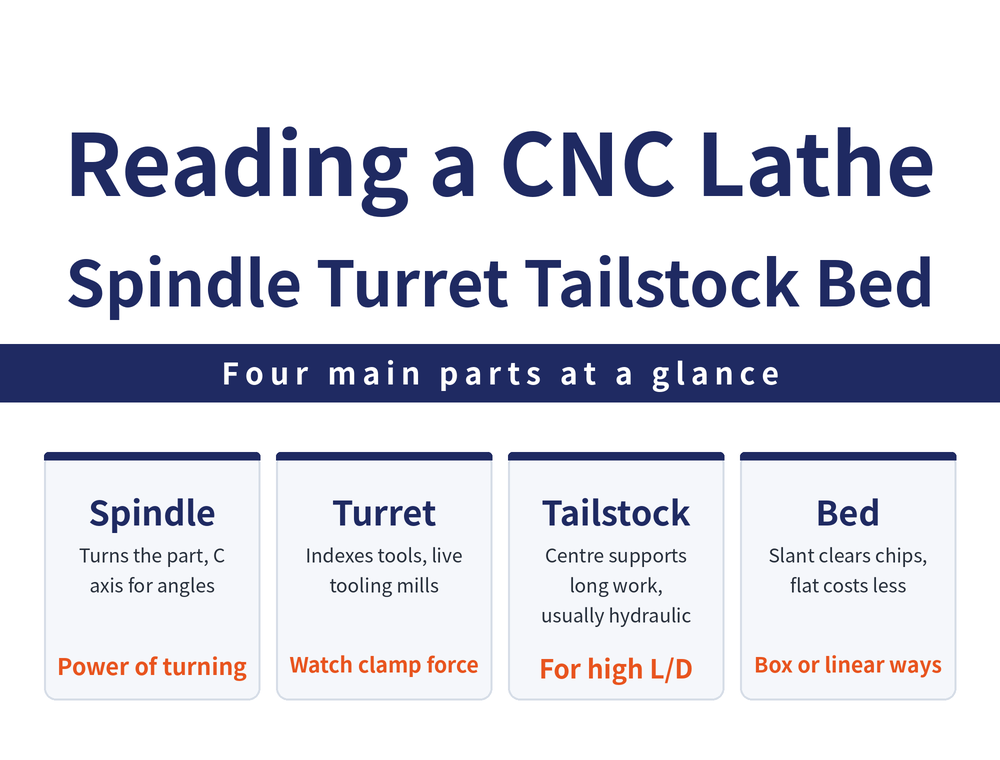
| Part | What it does |
|---|---|
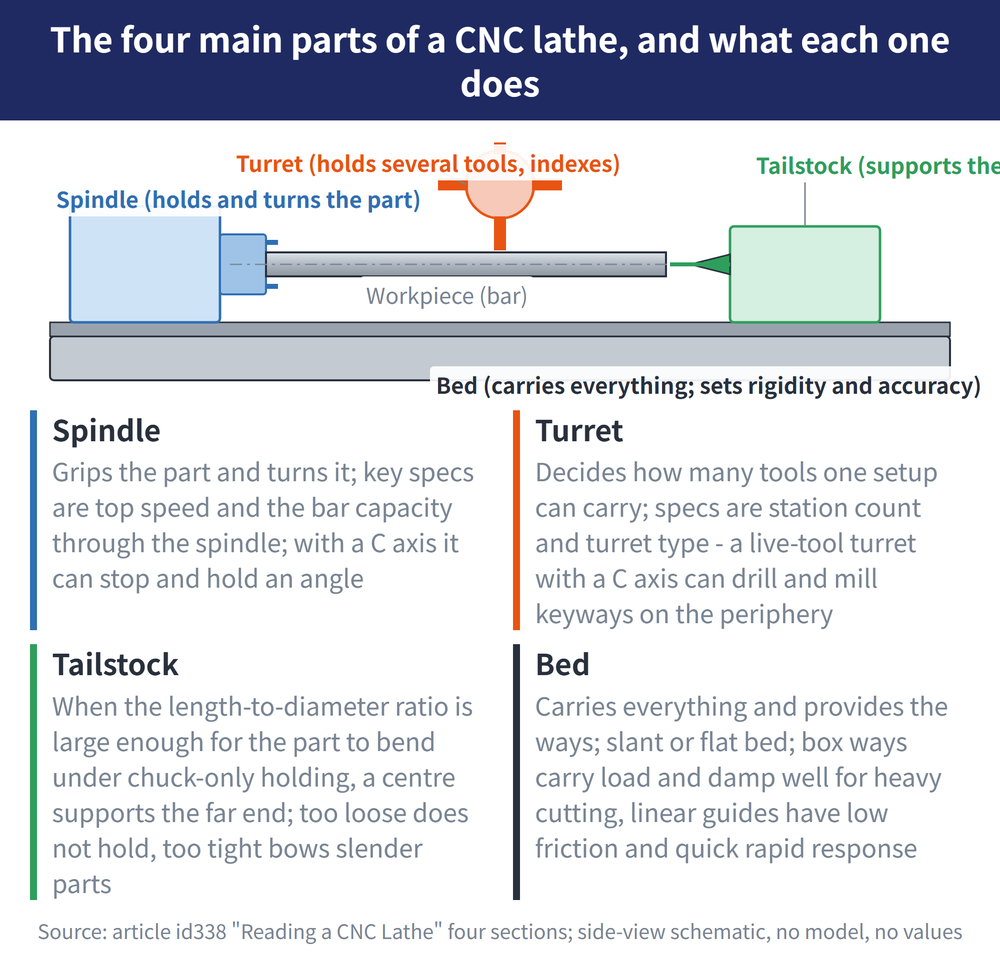
| Spindle | Grips and rotates the workpiece; the power source for turning |
| Turret | Holds several tools and indexes them into position by program |
| Tailstock | Supports the far end of long work with a centre, limiting deflection |
| Bed | Carries every other assembly and sets the rigidity of the machine |
Catalogues use both "bed" and "base" for this part; they refer to the same structure.
2. The Spindle: Speed and the C Axis
The core specifications of a lathe spindle are maximum speed and the workpiece size it can hold (usually quoted as bar capacity through the spindle). Bearing arrangement decides whether it favours high speed or heavy cutting, on the same principle as a milling spindle — see The Four Parts That Define a Machine Tool.
The other specification worth noting is the C axis: it lets the spindle do more than turn — it can stop and hold at a commanded angle. With a C axis and a live tooling turret, holes and keyways can be machined around the circumference without moving the part to a mill.
3. The Turret: Stations and Live Tooling
The turret determines how many tools can be set up at once. The usual specifications are station count (8 or 12, for example) and turret type:
| Type | What it can do |
|---|---|
| Standard turret | Takes fixed tools such as turning and boring tools |
| Live tooling turret | Stations are driven, so they can mill, drill and tap |
| Twin turret | Two turrets work simultaneously or split the job, raising output |
The turret's clamping force is a specification in its own right — the force holding it once indexed, which decides whether it shifts under a heavy cut.
4. The Tailstock: When You Need It
The criterion is simple: when the length-to-diameter ratio is large enough that holding the part at one end alone would let it bend. Gripped only in the chuck, long work deflects under cutting force and comes out tapered or with chatter marks.
The tailstock presses a centre against the far end to create two-point support. Most CNC lathes use a hydraulic centre, advanced and retracted by program or foot pedal with adjustable force — too light and it does not support, too heavy and a slender part is pushed out of line.
5. The Bed: Slant and Flat
| Type | Character |
|---|---|
| Slant bed | Chips fall away under gravity; good chip clearance, mainstream on CNC lathes |
| Flat bed | Simple structure and lower cost, but chips pile up on the bed surface |
Guideway type is also a selection item: box ways (sliding contact) carry more load and damp better, which suits heavy cutting; linear guideways have low friction and respond well in rapid moves. It is a trade-off, not a ranking.
6. Frequently Asked Questions (FAQ)
Q: What is the fundamental difference between a lathe and a mill?
A lathe rotates the workpiece while the tool stays still; a mill rotates the tool while the workpiece is fixed. That is why each suits different part shapes.
Q: What is the C axis?
A function that lets the spindle stop and hold at a commanded angle. With a live tooling turret it allows drilling or keyway milling around the circumference without moving to a mill.
Q: When is a tailstock needed?
When the length-to-diameter ratio is large enough that chuck-only holding would let the part deflect. A centre at the far end gives two-point support and prevents taper and chatter marks.
Q: Is a slant bed better than a flat bed?
A slant bed clears chips better and is mainstream on CNC lathes; a flat bed is simpler and cheaper. It is a trade-off, decided by the work and the budget.
This article is part of CNC Machining Fundamentals: The Complete Guide - Know the Machine and Shop, Then Read the Drawing; that guide shows how the whole topic fits together.