The Four Parts That Define a Machine Tool: Bed, Linear Guideway, Ballscrew, Spindle
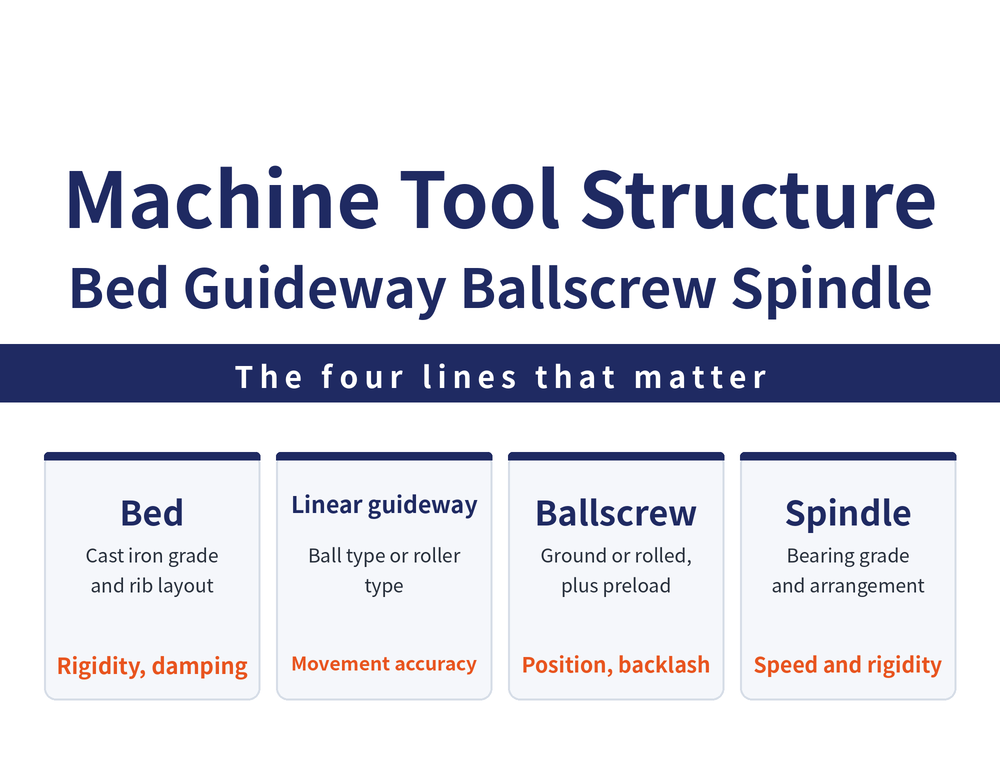
The hard part of reading a spec sheet is not decoding the model number — it is knowing which lines actually change what comes off the machine. Take a machine tool apart and four items decide accuracy and rigidity: the bed, the linear guideways, the ballscrews and the spindle. This article explains what each one does, how to read its specification, and what separates the grades.
1. One Machine, Four Decisive Parts
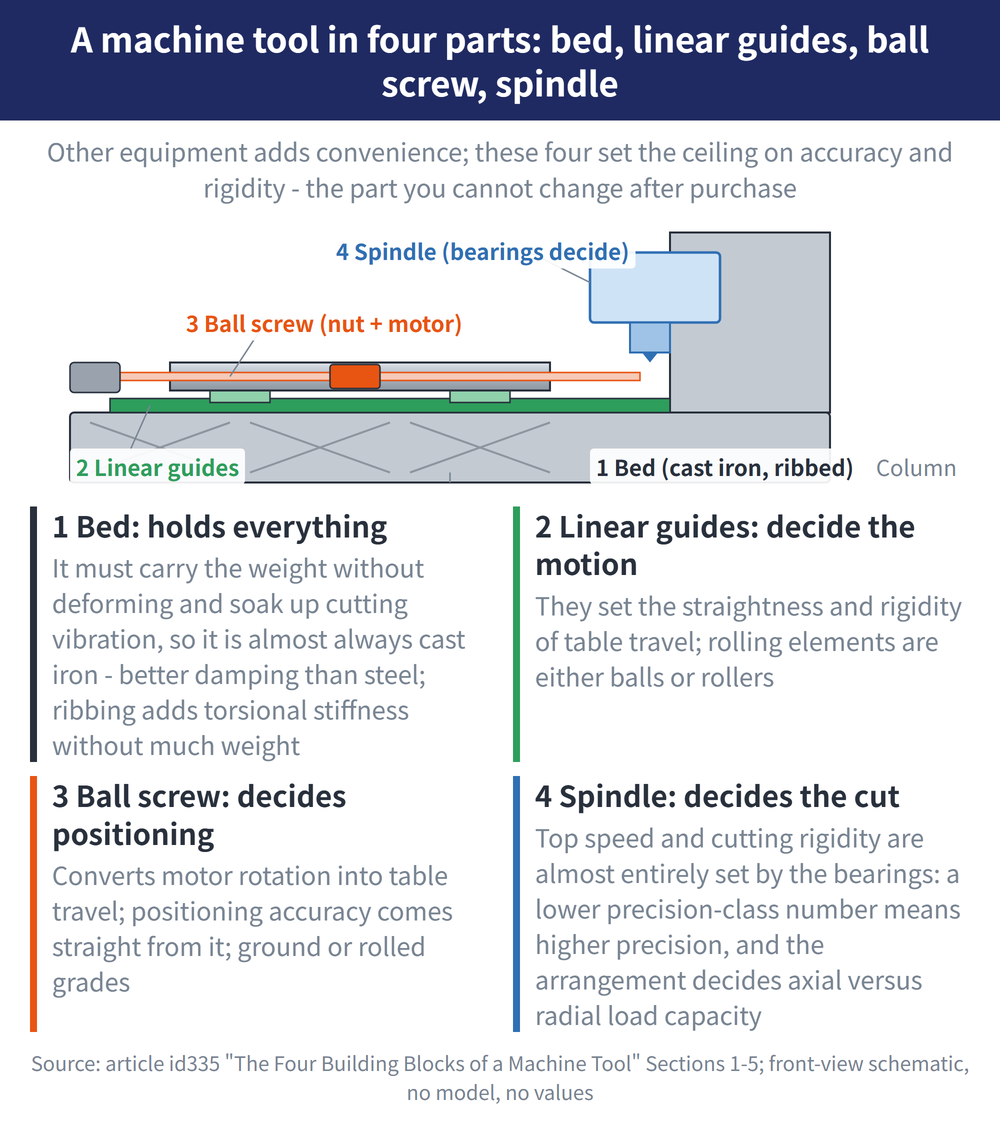
Whether it is a lathe, a milling machine or a machining centre, the structure breaks down into four decisive parts: the bed carries everything, the linear guideways govern movement, the ballscrews govern positioning, and the spindle governs cutting.
Other equipment affects convenience, but these four set the ceiling on accuracy and rigidity — the part you cannot change once the machine is on your floor.
2. The Bed: Cast Iron and Ribbing
The bed has to do two things at once: carry the weight without distorting, and absorb the vibration produced by cutting. That is why the material is almost always cast iron — its damping behaviour is better than steel, which is why it has proved so hard to replace in machine tools.
Two terms show up regularly on spec sheets. Meehanite cast iron is a material grade — a cast iron processed to control the form of the graphite. Cross ribbing refers to how the internal ribs are laid out, used to raise torsional rigidity without adding much weight.
Seeing either term means the builder has specified something deliberate about the bed, and it is worth asking for the details.
3. Linear Guideways: Ball Type and Roller Type
Linear guideways determine the straightness and rigidity of table movement. The rolling elements come in two forms:
| Type | Contact | Character |
|---|---|---|
| Ball type | Point contact | Low friction, good high-speed response, general purpose |
| Roller type | Line contact | Higher load capacity and rigidity, used for heavy cutting |
⚠ Terminology note: makers use several names for the same component — linear guideway, linear guide, linear motion guide and profiled rail guide all refer to the same thing. Match the model number rather than the wording.
4. Ballscrews: Ground and Rolled
The ballscrew converts motor rotation into linear table movement, and positioning accuracy comes directly from it. The key division in the specification is how it was made:
| Grade | How it is made | Where it is used |
|---|---|---|
| Ground | Thread form finished by grinding | Machine tool axes with high accuracy requirements |
| Rolled | Formed by thread rolling | Lower cost, where accuracy requirements are wider |
The other item to check is preload — removing the backlash between nut and screw. Maker manuals often write it as "C3 grade screw, 1/3 preload" (maker example; confirm against the catalogue). Only with enough preload does the table avoid lost motion when it reverses.
The recirculation type (internal or external) refers to how the balls are routed back, and affects smoothness and noise — worth asking about at selection time.
5. The Spindle: Bearing Grade and Arrangement
The spindle sets the maximum speed and the cutting rigidity, and both of those come almost entirely from the bearings.
Spec sheets list angular contact ball bearings together with an accuracy grade — for example a maker manual entry reading "P4 grade angular contact ball bearings" (maker example). The smaller the grade number, the higher the accuracy; the arrangement — how many bearings, face to face or back to back — determines whether the spindle is better at taking axial or radial load.
Spindle taper is part of the tool interface and relates to tool magazine and holder selection — see Spindle Taper Systems Overview.
6. Reading the Spec Sheet: Four-Part Quick Reference
| Part | What to look for | What it affects |
|---|---|---|
| Bed | Cast iron grade, rib layout | Rigidity and damping |
| Linear guideway | Ball or roller, size and load rating | Movement accuracy and load |
| Ballscrew | Ground or rolled, accuracy grade, preload | Positioning accuracy and backlash |
| Spindle | Bearing grade and arrangement, taper | Maximum speed and cutting rigidity |
7. Frequently Asked Questions (FAQ)
Q: Are a linear guideway and a linear motion guide the same thing?
Yes. Linear guideway, linear guide, linear motion guide and profiled rail guide are all names for the same component. Match the model number rather than the wording.
Q: What is the difference between a ground and a rolled ballscrew?
How the thread form is produced. A ground screw is finished by grinding and is more accurate; a rolled screw is formed by thread rolling, costs less, and is used where accuracy requirements are wider.
Q: Why are machine beds almost always cast iron?
Because cast iron damps better than steel, absorbing cutting vibration while still providing enough rigidity. That combination is why it has been so hard to replace in machine tools.
Q: What is ballscrew preload?
A setting that removes the backlash between nut and screw in advance. With too little preload the table shows lost motion when it reverses, which degrades positioning accuracy.
This article is part of CNC Machining Fundamentals: The Complete Guide - Know the Machine and Shop, Then Read the Drawing; that guide shows how the whole topic fits together.