Reading a Carbide Burr: HSS or Carbide, Cut Type and Coating
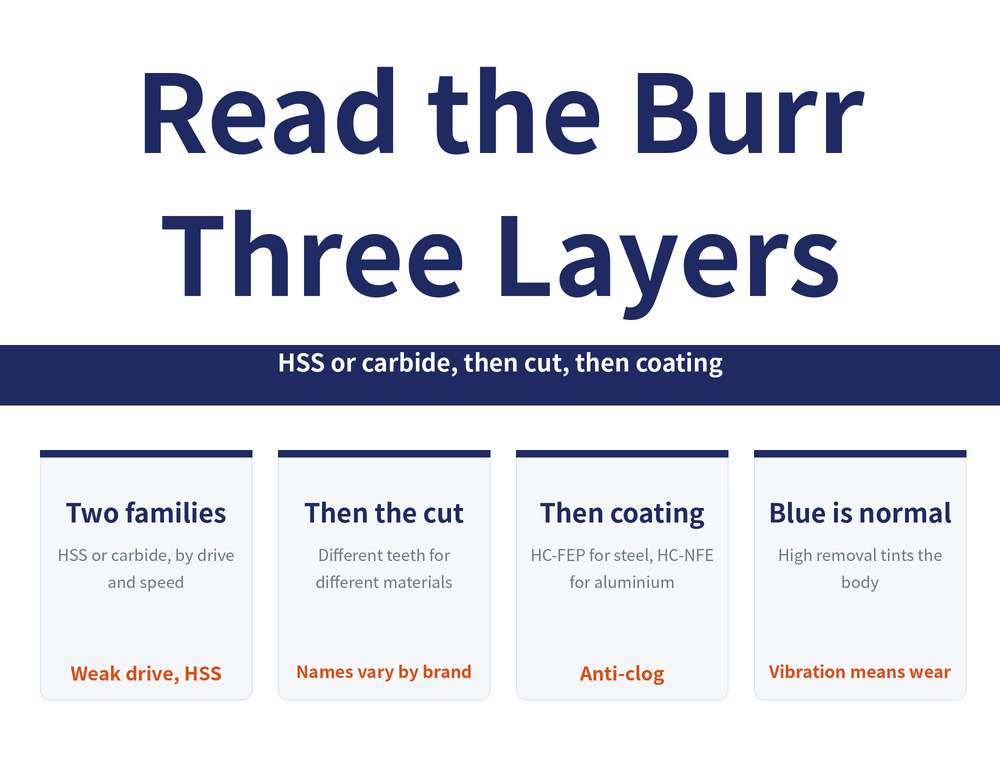
A carbide burr (often called a tungsten carbide burr or rotary file) is handy for chamfering, deburring and dressing welds, but the part numbers are a jungle. Choosing well comes down to three layers: HSS or carbide first, then the cut (different materials want different toothing), then the coating. This guide covers all three.
1. First: HSS or Carbide Burr
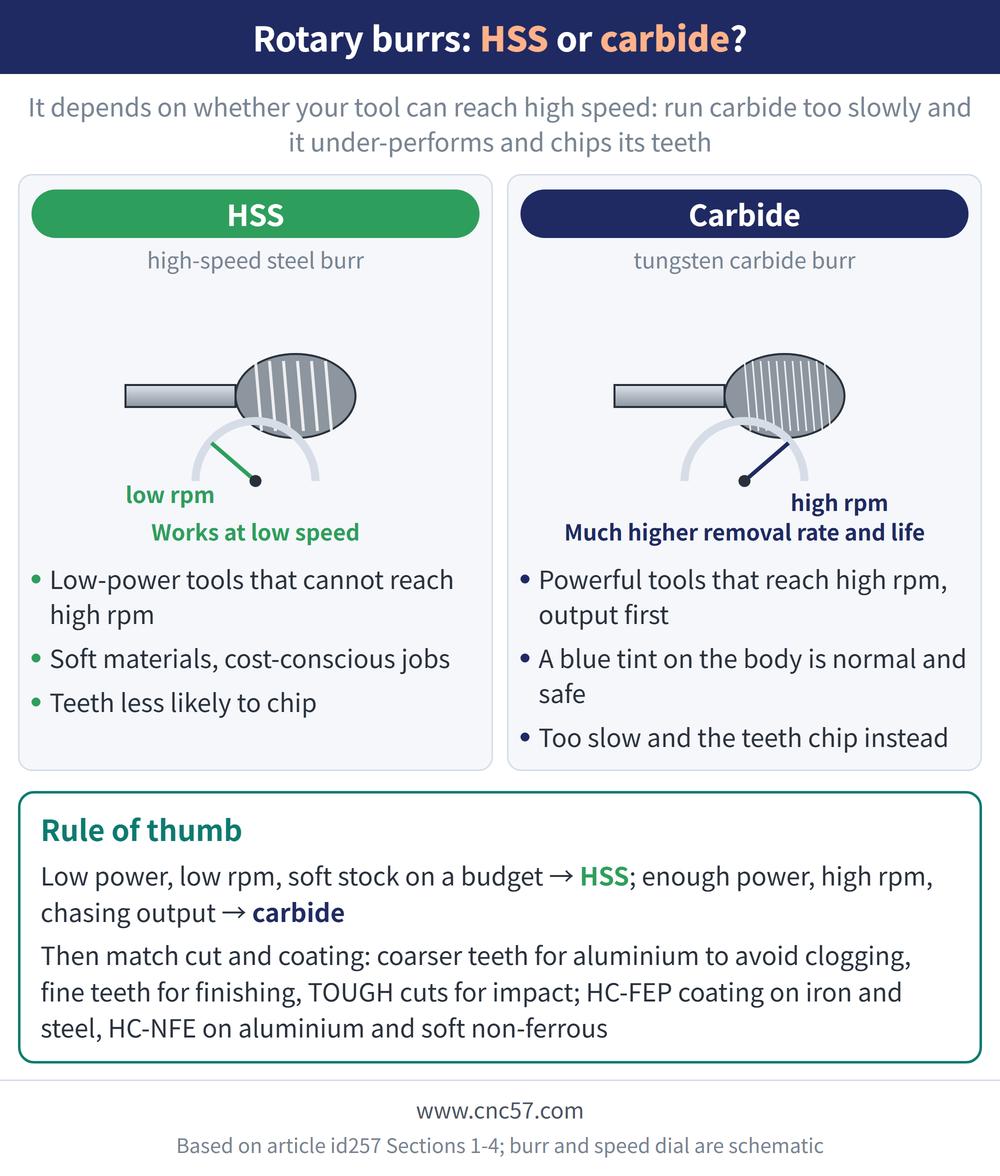
Burrs come in two families: high-speed-steel (HSS) rotary files and tungsten-carbide (TC) burrs. Choose by your machine and workpiece first:
| Your situation | Choose this | Why |
|---|---|---|
| Low-power drive, cannot spin fast | HSS burr | Works at low speed, and the teeth are less prone to chipping |
| Grinding soft material, watching cost | HSS | An economical choice on soft materials |
| Powerful drive, high speed, chasing efficiency | Carbide (TC) burr | Noticeably higher removal rate and tool life |
In short: force a carbide burr onto a drive that cannot spin fast enough and it will not perform, and the teeth chip easily.
2. Cut Types: Different Teeth for Different Materials
The cut is the toothing pattern. The principle is universal, different materials want different teeth, but the cut names (STEEL, INOX, ALU) are PFERD product names, not cross-brand terms; another brand uses different codes. Here is how PFERD positions its cuts (examples):
| PFERD cut (example) | Material / use |
|---|---|
| STEEL | Steel, cast steel |
| INOX | Stainless; lower heat avoids discolouration (per catalogue, also soft titanium of tensile strength < 500 N/mm²) |
| ALU | Aluminium and its alloys, non-ferrous, plastic |
| CAST | Cast iron |
| TITANIUM | Hard titanium |
| TOUGH / TOUGH-S | Harsh settings (shipyard, foundry, steelwork); on cast iron and steel (catalogue: < 54 HRC), impact- and chip-resistant |
| MICRO | Finishing, almost any material |
| EDGE | Defined 30°/45° chamfers or defined radii |
Just remember the rule: a coarser cut on soft material (aluminium) to avoid clogging, a fine cut for finishing, TOUGH for impact, EDGE for defined chamfers. For how stainless itself is machined, see the stainless steel guide; the exact grade comes from the catalogue.
3. Coating: One for Steel, Another for Aluminium
A coating puts a film between the teeth and the chip, cutting friction and heat and resisting build-up, so a higher speed is possible. PFERD HICOAT comes in two:
| Coating | For | Point |
|---|---|---|
| HC-FEP | Iron and steel materials | Built for heat and wear resistance |
| HC-NFE | Aluminium alloys, soft non-ferrous | Resists build-up so soft aluminium does not clog the burr |
Simple rule: HC-FEP for iron and steel, HC-NFE for aluminium and soft non-ferrous.
4. Is a Blued Burr Worn Out?
Because a high-performance carbide burr removes so much material, a blue tint on the body is normal and not a safety risk (the maker catalogue says so). No need to swap it out on sight.
The real sign to replace a burr is rough running, excessive vibration or heavy sparking when the parameters are already correct — that is wear. For how to run a burr, and how to set the contact angle and speed, see the operation guide in this series.
5. Frequently Asked Questions (FAQ)
Q: How do I choose between an HSS and a carbide burr?
Low-power, low-speed drive or soft material on a budget: HSS. Powerful drive, high speed, chasing efficiency: carbide. Forcing carbide without enough speed just chips the teeth.
Q: What do STEEL, INOX and ALU on a burr mean?
They are maker names for the cut (toothing), signalling which material that toothing is designed for. Codes differ by brand; the constant rule is different teeth for different materials.
Q: Aluminium keeps clogging my burr, what now?
Use a coarser cut (not too fine) and an aluminium coating such as HC-NFE, or apply grinding oil; both cut down build-up and clogging.
Q: Should I replace a burr that has turned blue?
No. At high removal a blue tint is normal and not a safety risk; only pair it with vibration or heavier sparking and it means wear.
This article is part of Deburring and Surface Finishing: The Complete Guide - Which Tool, Which Material, and What to Do in Volume; that guide shows how the whole topic fits together.
Published: 2026-08-11 | Last updated: 2026-08-11