Grinding Aluminium, Stainless and Steel: Deburring and Finishing by Material
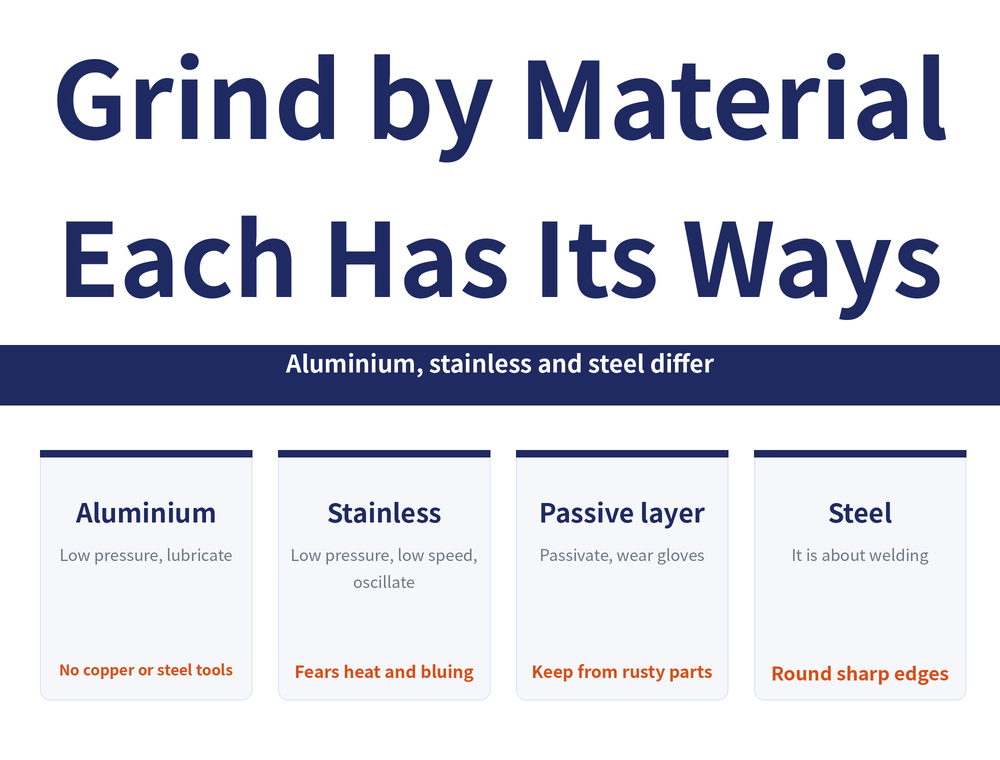
The same abrasive tool needs quite different handling on aluminium, stainless and steel, and the reason is not the abrasive grade but the material temperament: whether it smears, whether it conducts heat, whether it rusts. This guide takes the three common materials and tells you each one’s difficulty and how to handle it.
1. Three Materials at a Glance
| Aspect | Aluminium | Stainless | Steel |
|---|---|---|---|
| Main difficulty | Chips smear; soft metal embeds | Poor heat conduction; heat concentrates and blues | Grinds easily; the work is around welding and corrosion protection |
| Contact pressure | Keep it low | As low as possible plus oscillation | Normal |
| Cooling | Grinding oil to hold temperature down | Low speed, cool the part and tool | — |
| Worst enemy | Contact corrosion (tools carrying copper or steel) | Overheating, bluing, a damaged passive layer | Weld quality and coating adhesion |
2. Aluminium: Low Pressure, Lubricate, Do Not Mix Tools
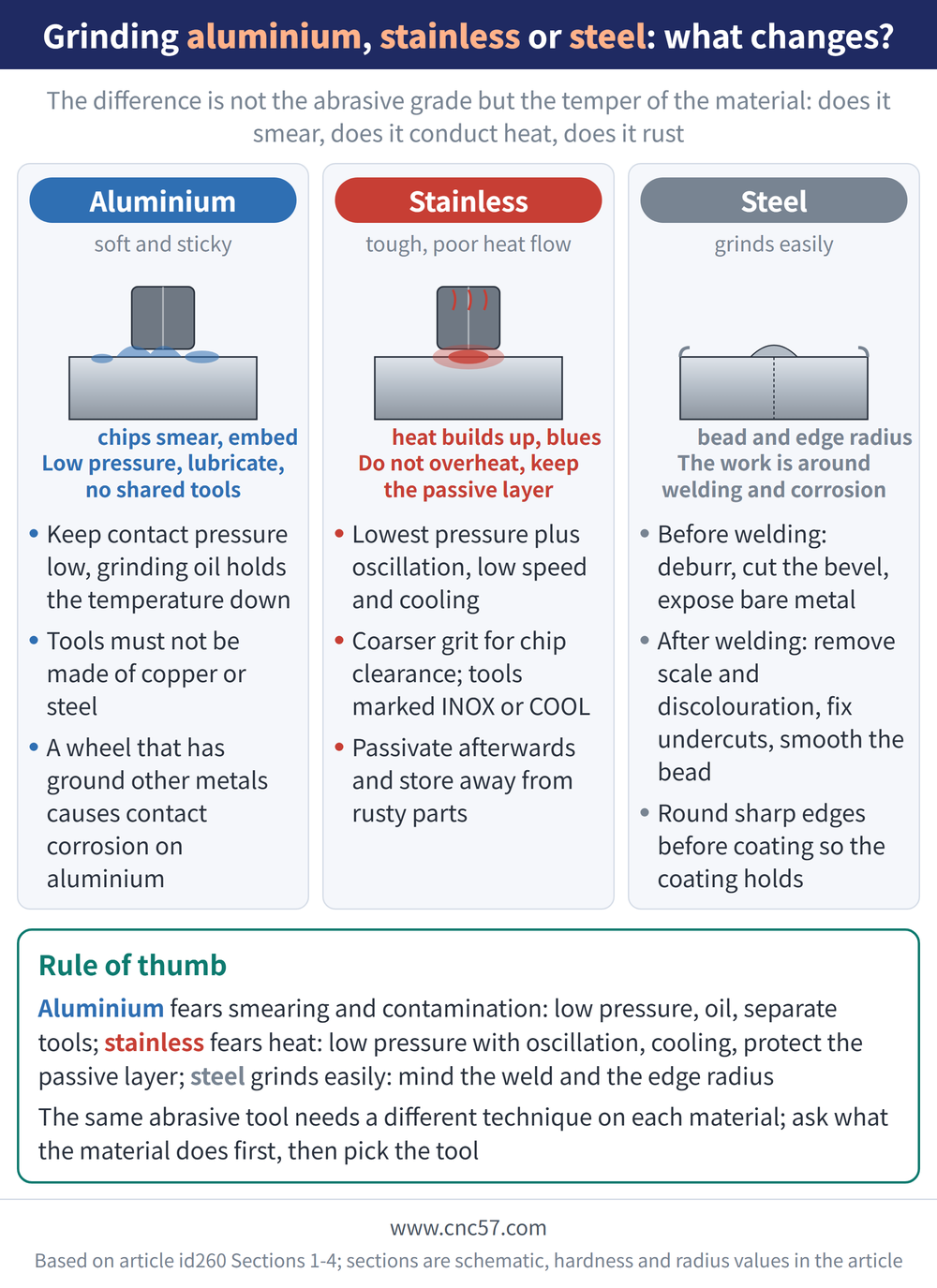
Aluminium is soft and sticky; chips smear and can embed in the surface. Keep the contact pressure low (too much causes local overheating that spoils the decorative anodised look); use grinding oil and lubricant to hold the temperature down, especially with finer grit.
The one rule that matters most: tools for aluminium (such as wire brushes) must not be made of copper or steel, and do not use a wheel or pad that has ground other metals, or you get contact corrosion on the aluminium. Keep the tools strictly separate. Soft aluminium below 40 HB needs extra care against smearing and embedded chips.
3. Stainless: Do Not Overheat, Do Not Ruin the Passive Layer
Stainless is tough and conducts heat very poorly, so heat concentrates at the cut and causes overheating and blue temper colours. Every measure revolves around that:
| Do this | Purpose |
|---|---|
| Low contact pressure plus oscillation | Spread the heat, do not let it concentrate |
| Low speed, cool the part (and the tool where practical) | Control heat build-up |
| Prefer a coarser grit for chip clearance | Leave room for chips, avoid clogging and secondary heat |
| Choose tools marked INOX / COOL / FREEZE | Low heat to prevent discolouration |
Protect the passive layer (the chromium-oxide film that keeps stainless from rusting): where practical use a passivating agent, which rebuilds the film in minutes; store finished parts away from rusty ones; wear cotton gloves where possible (salt from sweat hinders the passive layer); pad clamps with plastic or aluminium against marking and contamination. For how stainless itself is machined, see the stainless steel guide.
4. Steel: The Work Is Around Welding and Corrosion
Steel grinds easily, so the advice centres on welding and corrosion protection:
| Stage | What to do |
|---|---|
| Before welding | Deburr, cut the bevel (a V-joint per ISO 9692), grind the joint faces to bare metal |
| After welding | Remove scale and heat discolouration, fix undercuts and spatter, smooth the weld bead |
| Before corrosion protection | Remove contamination that hurts adhesion or causes corrosion; deburr and round sharp edges, ideally to a radius ≥ 2 mm |
| Final protection | Liquid or powder paint, or hot-dip galvanizing (or a duplex system of plating plus paint) |
The reason for the ≥ 2 mm radius is the same as on stainless: coating thins and peels on a sharp edge, and a rounded edge holds it.
5. Frequently Asked Questions (FAQ)
Q: What matters when grinding aluminium?
Keep contact pressure low and use grinding oil to lubricate and cool; above all, the tools must not contain copper or steel, and do not reuse a wheel that has ground other metals, or the aluminium gets contact corrosion.
Q: Why does stainless blue so easily?
Stainless conducts heat very poorly, so heat concentrates at the surface and tempers it. Use low pressure, low speed, oscillation, cooling and a coarser grit, and choose tools marked INOX or COOL.
Q: What rust protection does stainless need after grinding?
Where practical, use a passivating agent to rebuild the passive layer in minutes, store it away from rusty parts, and wear cotton gloves to avoid sweat contamination.
Q: What is the point of grinding steel before and after welding?
Before: deburr, cut the V-joint, expose bare metal. After: remove scale, repair and smooth the bead. Before protection: round sharp edges to ≥ 2 mm, then paint or galvanize.
This article is part of Deburring and Surface Finishing: The Complete Guide - Which Tool, Which Material, and What to Do in Volume; that guide shows how the whole topic fits together.
Published: 2026-08-11 | Last updated: 2026-08-11