
Dressing a Grinding Wheel: Choosing Turning, Crush or Grinding Method
After use, wheel grains dull, load up and lose form, showing slipping, vibration, burn and a worse finish—time to dress. Dressing splits into three methods: turning, crush and grinding. This lines up their principle, pros and cons and where each fits, then covers the two most-used tools: the diamond dresser and the diamond roller.
1. When to dress
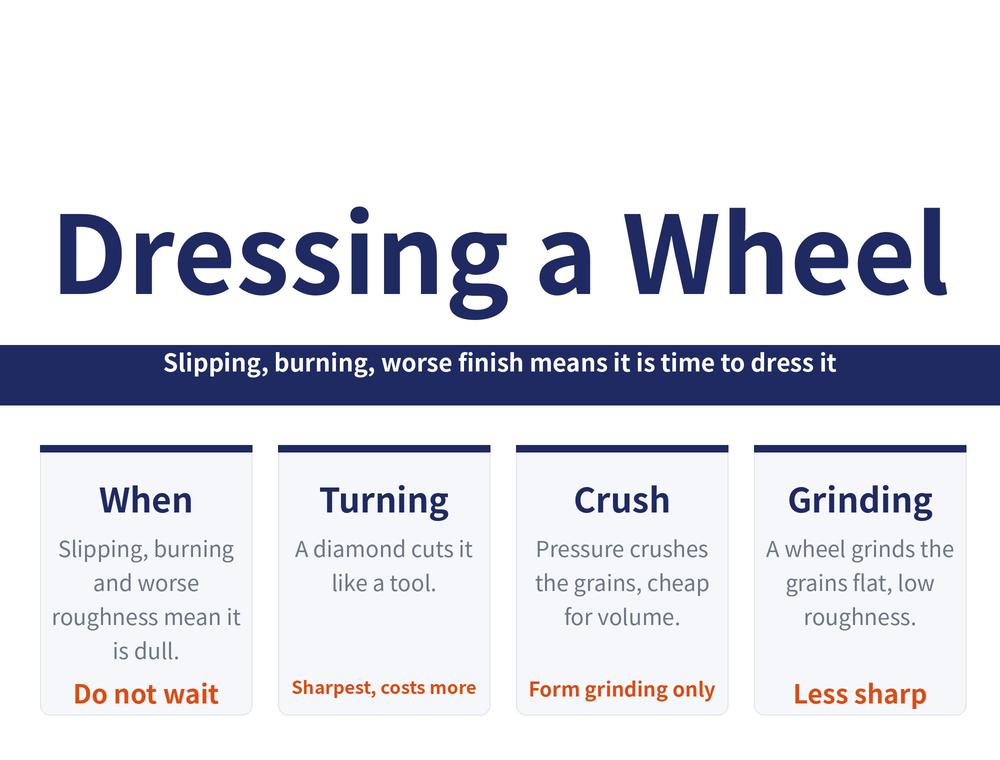
During grinding the grains wear, fracture and shed, so they dull, the face loads up and the form drifts. Leave it too long and a chain of symptoms appears:
The wheel slips on the work, efficiency drops, grinding force rises and distorts the part, vibration and noise appear, roughness worsens (a wavy pattern), and grinding heat rises to burn and micro-crack the work—when you see these, it is time to dress.
How fine you dress follows the operation: dress coarser for roughing to keep efficiency, finer for finishing to hold roughness, and finely for precision grinding.
2. The three methods compared
| Method | Principle | Pros, cons and fit |
|---|---|---|
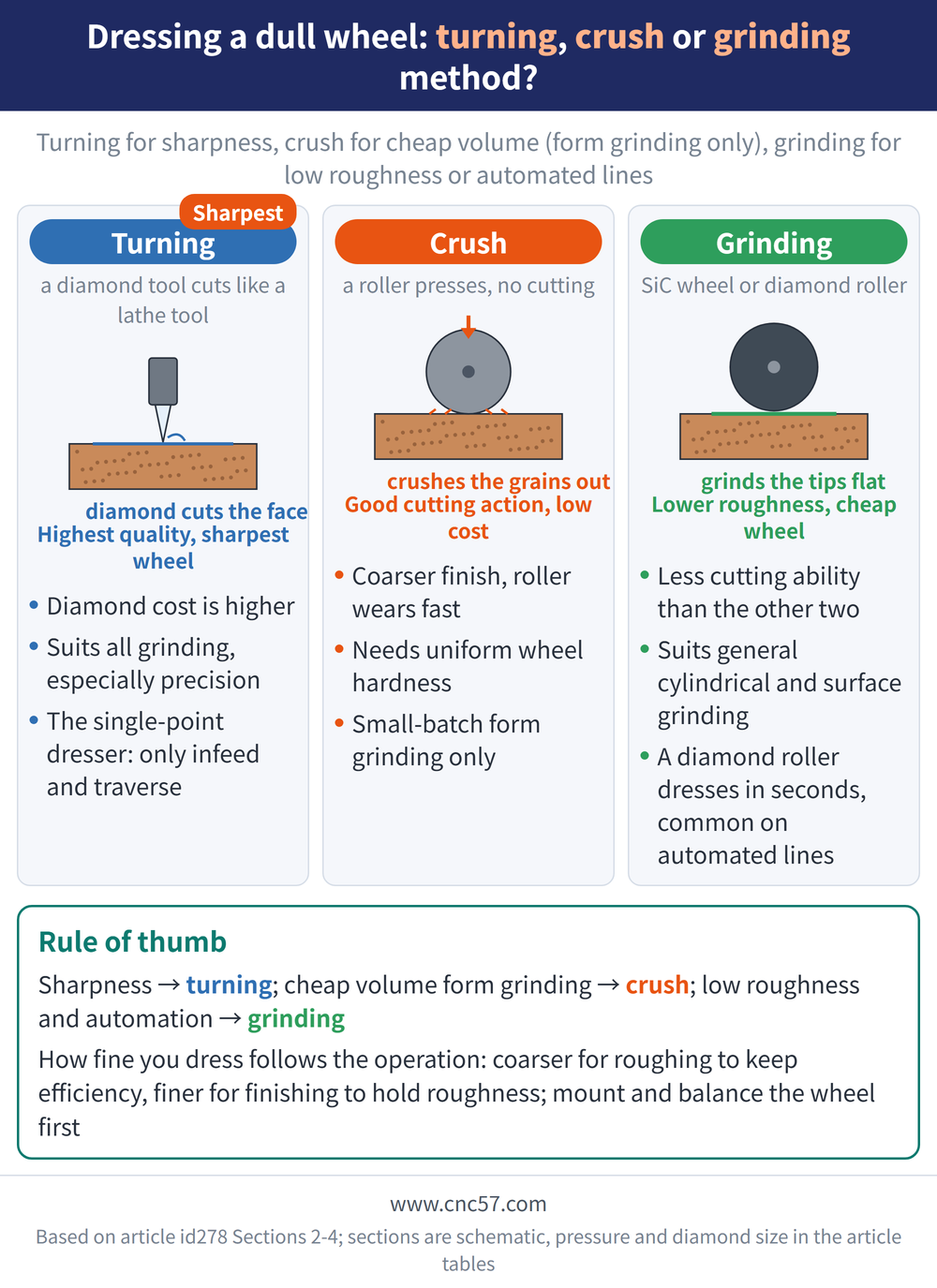
| Turning | A diamond tool cuts the wheel face like a lathe tool | Highest dressing quality, sharpest wheel; diamond cost is higher. Suits all grinding, especially precision |
| Crush | A crush roller presses at 3–5MPa to crush or push grains out (not cutting) | Good cutting action, low cost; but coarser finish, roller wears fast, needs uniform wheel hardness. Small-batch form grinding only |
| Grinding | A silicon-carbide wheel or diamond roller grinds the grain tips flat | Lower roughness, cheap wheel; but less cutting ability than the other two (less sharp). Suits general cylindrical/surface grinding and automated lines |
Quick rule: turning for sharpness, crush for cheap volume (form grinding only), grinding for low roughness or automated lines.
3. The most used: the single-point diamond dresser
Diamond is the main dressing tool (highest hardness and wear resistance). The single-point diamond dresser is a "stationary" dresser—only a normal infeed and a parallel feed, no motion along the wheel speed—matching the turning method.
Dressing quality depends on the diamond edge shape and wear resistance, the dressing feed and depth, wheel characteristics and coolant. For a low roughness, take both dressing depth and feed small, so fresh grain edges line up finely on the face; a single dressing depth is usually under 40μm. Flood with coolant while dressing to avoid a sharp temperature rise cracking the diamond.
Pick the diamond size by wheel diameter:
| Wheel diameter (mm) | Diamond size (ct) |
|---|---|
| ≤200 | 0.15–0.25 |
| 200–300 | 0.25–0.35 |
| 300–500 | 0.50–0.75 |
| 500–600 | 1.00–1.25 |
4. The diamond roller: plunge and traverse
The diamond roller is a "moving" dresser—dressing takes only seconds and it handles complex forms, so automated lines favour it. It comes in plunge and traverse types.
Plunge hinges on the dressing speed ratio qd (roller speed ÷ wheel speed): same direction is up-cut (unidirectional), opposite is down-cut. Radial infeed gives a crushing action (grains fracture, sharpen, cut strongly); the tangential relative motion gives a grinding action (grains flatten, lower roughness). So: rough with up-cut and a ratio above 0.5 for sharpness; finish with down-cut and small feed plus spark-out passes for low roughness.
Traverse mounts the roller on a swinging arm. By swing range it is mid, up or full dressing: up dressing gives fewer edges and higher roughness; full dressing gives more edges and lower roughness. Traverse does feed and spark-out in one swing for higher efficiency but a more complex arm; plunge is simpler and more common.
Mount and balance the wheel first so dressing stays stable—see Mounting and Balancing a Grinding Wheel.
5. FAQ
Q: How do I tell a wheel needs dressing?
Slipping, rising grinding force, vibration and noise, a worse finish (wavy pattern), even part burn and micro-cracks all mean the grains are dull or the face is loaded—time to dress.
Q: Which method leaves the sharpest wheel?
Turning gives the highest dressing quality and sharpest wheel, but diamond cost is higher. Crush is cheap for form-grinding volume; grinding gives low roughness and suits automation but is less sharp.
Q: Why must a diamond dresser be cooled?
Flood coolant while dressing to avoid a sharp temperature rise cracking the diamond. For a low roughness, take both dressing depth and feed small.
Q: What's the difference between up-cut and down-cut on a roller?
Same speed direction as the wheel is up-cut, opposite is down-cut. Rough with up-cut and ratio above 0.5 for sharpness; finish with down-cut plus small feed and spark-out for low roughness.
This article is part of Grinding Wheels and Machines: The Complete Guide - Reading the Wheel, Mounting It, Dressing It, and Tracing Defects; that guide shows how the whole topic fits together.
Published: 2026-08-16|Updated: 2026-08-16