
Three Things to Settle Before High Speed Grinding: How Fast Counts, What the Machine Needs, How the Wheel Is Reinforced
Is turning the wheel faster all there is to high speed grinding? Three things come first: how fast actually counts as high speed (sources give different thresholds), what the machine has to change, and how the wheel itself is reinforced so it does not burst. This article sets out the criteria and the quoted figures, and leaves the disagreements between sources side by side rather than reconciling them.
1. How fast counts as high speed? Three thresholds, and no averaging
This has to be settled first: the threshold that defines "high speed grinding" differs between sources, and each is a documented figure.
| Threshold | What the figure is for |
|---|---|
| Wheel speed above 35 m/s | One handbook's definition of high speed grinding |
| Peripheral speed above 45 m/s | Another book's definition of the same term |
| Speed above 50 m/s | The threshold above which dynamic balancing becomes mandatory |
| 60 / 80 m/s | A different kind of criterion: the burst safety factor boundary (2 below 60, 1.8 above 80), not a definition of high speed |
All four stand on their own, serve different purposes, and must not be substituted for one another or averaged. In practice, ask which document a claim of "high speed" refers to, and use that document's threshold; for balancing or safety factor questions, use the line written for that purpose. For reading wheel markings see the grinding wheel marking guide.
2. Four things that follow from more speed
Raising wheel speed does more than shorten the cycle. Four effects follow:
| Change | Result |
|---|---|
| More grains engaged per unit time | At the same feed, each grain takes a thinner chip and carries less force, so grain and wheel life both improve |
| Keep the chip thickness as before | Feed can rise substantially, so removing the same stock takes markedly less time |
| Shallower marks, lower radial force | Surface roughness falls and bending deflection drops, which favours slender shafts in particular |
| Centrifugal force rises with it | The wheel needs higher strength and a stronger bond, or it bursts |
The first three are gains and the fourth is the price — and it is a safety-level price. The next two sections deal with it.
3. Six things the machine has to change
Raising the speed is only the start; the machine has to follow:
| What changes | Approach and figures |
|---|---|
| Damping and rigidity | The wheel should be balanced twice, each time meeting the requirement at eight points around the circumference, with damping measures in place |
| Drive motor power | Increase by 75% to 100%, with the associated electrical components uprated to match |
| Spindle and bearing clearance | Friction and thermal growth can seize the spindle, so clearance is opened up; use a relieved drive so the bearing is loaded evenly (figures in the note below) |
| Spindle lubrication | A low viscosity spindle oil (grades 2 to 4), or 10% of a No. 22 turbine oil with 90% anhydrous kerosene; a circulating cooling and lubrication system is preferred |
| Coolant supply | Ordinary cooling cannot cope against the centrifugal field; deliver through a high pressure pump and dedicated nozzles, and add splash guarding |
| Wheel guard | At least 40% thicker than an ordinary guard, with a smaller opening angle and an energy-absorbing lining such as polyurethane foam |
⚠ The two sources disagree on spindle clearance: one gives 0.04 to 0.05mm, the other 0.03 to 0.05mm (stated twice in that book, so not a single misreading). The lower limits differ, and this site prints both rather than averaging or picking one. In practice, follow the machine manufacturer's specification.
4. The wheel is reinforced at the bore, not all over
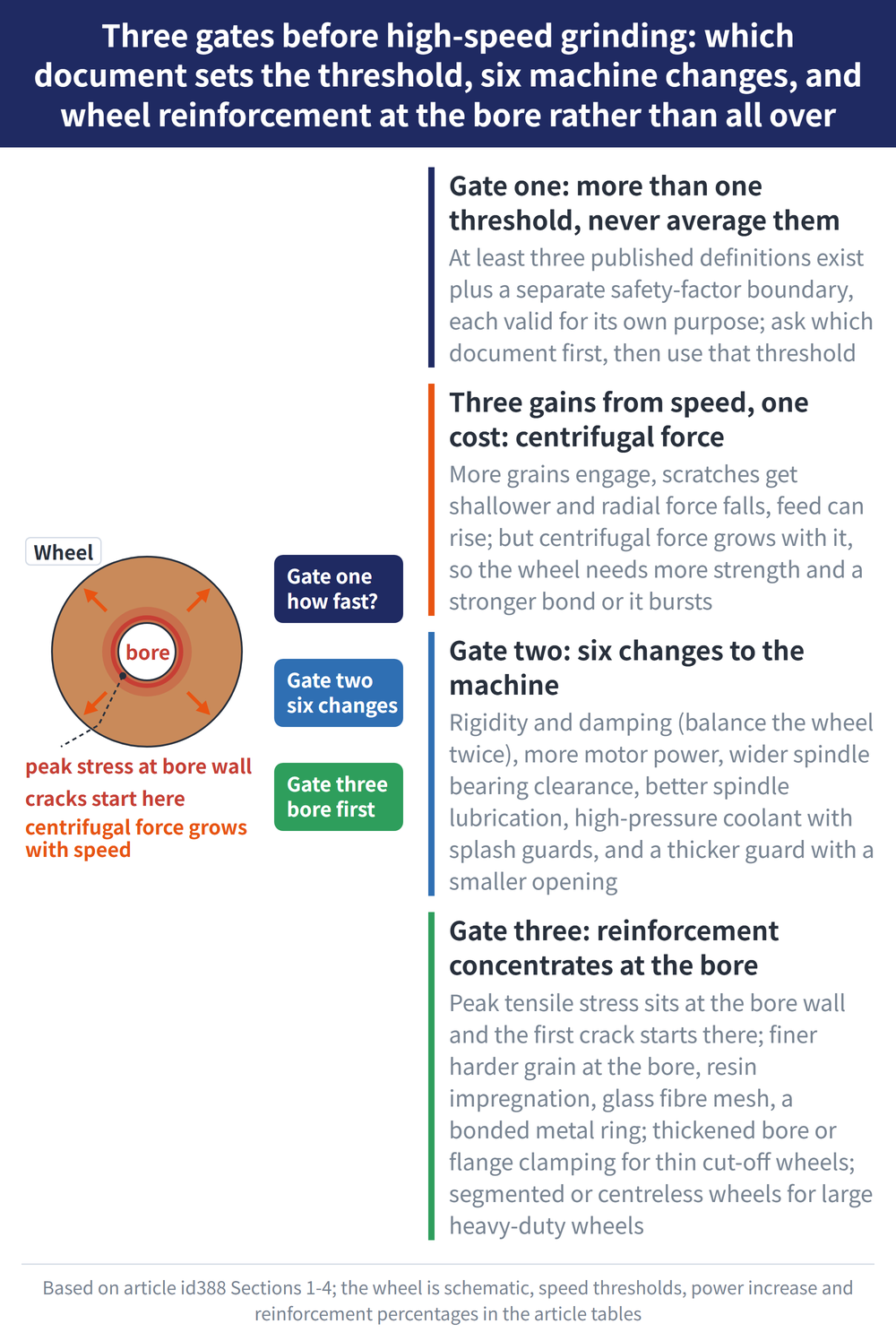
At speed, peak tensile stress sits on the bore wall, and a burst normally starts there. So besides improving the bond itself, most reinforcement is concentrated around the bore:
| Method | Effect and limits |
|---|---|
| 1 Finer grain and higher grade at the bore | Burst speed raised by 20% to 25%; general purpose |
| 2 Resin impregnation through the bore wall | Strength raised 5% to 15%; the more porous the wheel, the larger the gain |
| 3 Glass fibre mesh | Resin bonded wheels only; no quantitative figure |
| 4 Bonded metal ring at the bore | A steel or heat resistant alloy ring bonded with epoxy; no quantitative figure |
| 5 Thicker bore area or flange mounting | For thin cut-off wheels, where it works well; little benefit on thick wheels |
| 6 Segmented or bore-less wheels | Eight tapered segments on a steel flange with screws stops radial splitting; a bore-less design removes the stress raiser entirely. A design choice at manufacture, not a shop retrofit |
The selection logic is direct: higher speed without changing specification or bond points to 1, 2 and 4; a thin cut-off wheel points to 5; a large heavy-duty high speed wheel points to 6. For mounting and balancing see mounting and balancing a grinding wheel.
5. Frequently asked questions
Q: So what speed actually counts as high speed grinding?
There is no single answer, and that is not evasion. At least three defining thresholds are documented: 35 m/s, 45 m/s and 50 m/s, each from a different source. The 60 and 80 m/s figures also circulate but they mark burst safety factor boundaries, which is a different kind of criterion. The practical approach is to ask which document a claim refers to and use that threshold, rather than averaging the numbers into a consensus that nobody actually published.
Q: Can an ordinary grinder do high speed grinding if I just raise the speed?
No, and the risk is concentrated on the safety side. Higher speed means more centrifugal load on the wheel, so the wheel itself needs matching strength and bond. On the machine side six things follow: rigidity and damping, motor power up by 75 to 100 percent, spindle and bearing clearance, spindle lubrication, coolant delivery and splash guarding, and a guard at least 40 percent thicker. None of the six is optional once the speed goes up.
Q: Why is the reinforcement always around the bore?
Because peak tensile stress sits on the bore wall at speed, and a burst normally starts there. Since that is where failure begins, putting the material and structural work there is the most efficient answer and avoids upgrading the whole wheel to a more expensive specification. It also explains why two wheels with the same marking can carry different maximum speeds: the difference is often what was done at the bore.
Q: Do the six methods apply to thin cut-off wheels too?
Only the fifth is written for thin wheels: thickening the bore area or mounting on a flange, which works well there but does little on thick wheels. The others have limited effect on thin wheels. When buying, saying whether the wheel is thin or thick gets you a more useful answer than stating a speed requirement alone.
This article is part of Grinding Wheels and Machines: The Complete Guide - Reading the Wheel, Mounting It, Dressing It, and Tracing Defects; that guide shows how the whole topic fits together.
Published: 2026-08-30|Last updated: 2026-08-30