
Can a Worn Indexable Insert Be Reground? Criteria, Fixture and Stock Removal
Indexable inserts normally go in the bin once every corner is used, yet a scrapped insert has usually only lost its flank while the rake face is still sound. This guide covers when regrinding is worth it, which fixture and wheel to use, how much comes off each edge, how many times it can be done, and one measured result from a ductile iron job — roughing came back at half to four-fifths of a new insert, finishing at nine-tenths or better.
1. What actually fails on a scrapped insert
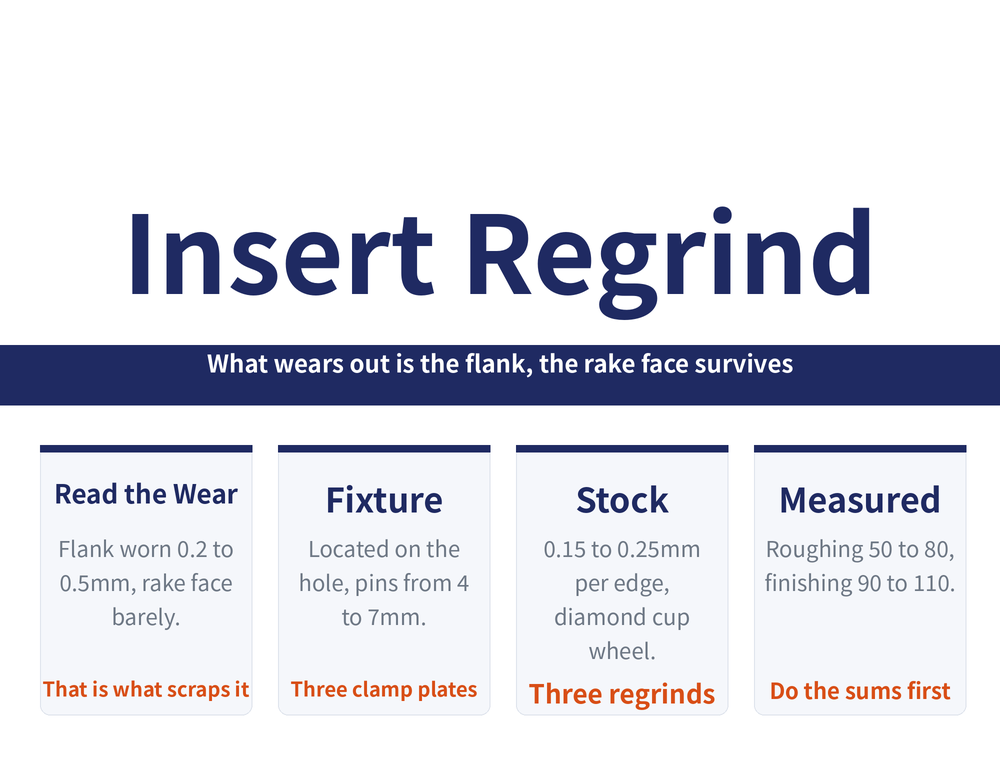
Look at scrapped inserts and one pattern shows: the rake face is barely worn while the flank is badly worn — the documented case measured about 0.2~0.5mm of flank wear. Two things follow: machined finish gets worse, and once the clearance is worn flat the insert makes face contact with the machined surface, so it is being dragged rather than cutting.
Put another way, the insert you throw away has failed on one face only. That is why the question is worth asking at all. For why edge geometry matters, see Turning Tool Edge Preparation.
2. Five reasons regrinding is worth it
| Reason | Detail |
|---|---|
| Cutting efficiency | No brazing heat, so the material keeps its original cutting properties; 30%~50% more productive than a brazed tool, about 80% less handling time |
| Insert cost | In normal use, more than half the cost of brazed tooling |
| Shank steel | An indexable shank lasts at least a year; one documented example puts annual consumption about 11 times apart |
| Tool management | Standardised shanks and inserts, fewer part numbers, simpler stock and issue |
| Coating | A reground insert takes a fresh coating well, which matters most on automated machines |
A common belief is worth puncturing: people feel that binning a whole insert is wasteful while a brazed tool can be used down to a stub — but a brazed tip gets small mostly on the grinding wheel, not in the cut.
3. The fixture: located on the insert's hole
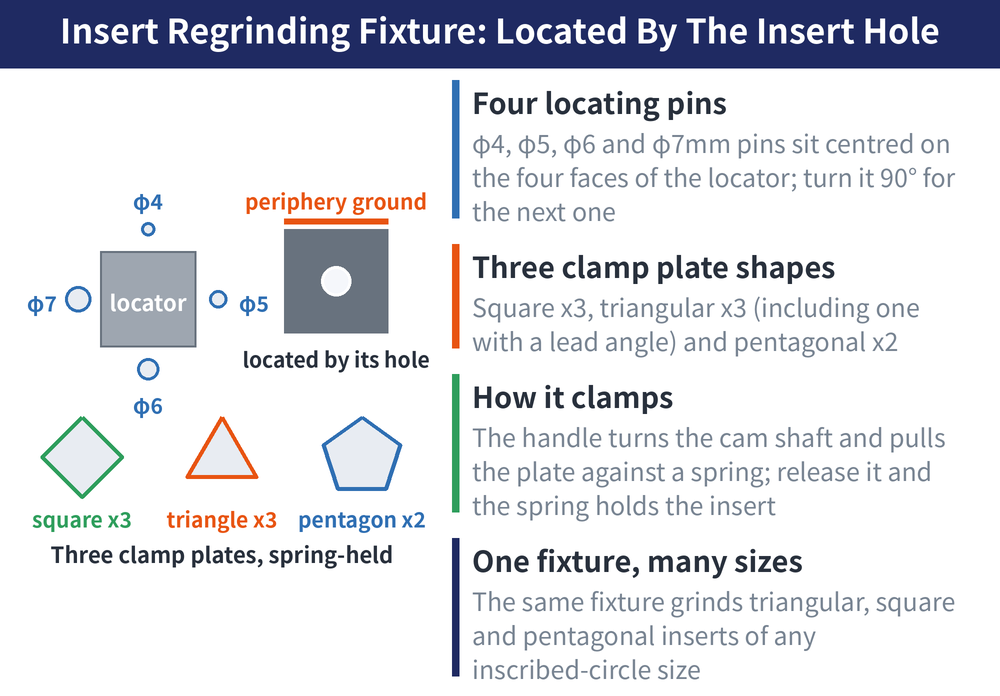
The insert goes on a tool grinder or a dedicated insert grinder, located on its own hole, and what gets ground is the periphery. One fixture body covers triangular, square and pentagonal turning inserts across a range of inscribed circle sizes.
| Part | Configuration |
|---|---|
| Locating pins | Four sizes, φ4, φ5, φ6 and φ7mm, one at the centre of each face of the locating block |
| Changing pins | Rotate the block 90° and the next pin comes up, matching another hole size |
| Clamp plates | Three kinds: 3 for square inserts, 3 for triangular (including with a minor angle), 2 for pentagonal |
| Operation | Pull the lever so the cam shaft turns and draws the clamp plate back against a spring, drop the insert on the pin, release, and spring force clamps it |
An improved version is also described: the two T-slot clamping screws are replaced by an eccentric shaft, more than ten times faster to load and unload; a tilting seat with 60° each way is added in the middle and a 45° swivelling tool mount on the right, which makes the fixture three-axis and lets it hold solid turning tools as well.
4. How much to take, and how often
| Item | Specification |
|---|---|
| Wheel | Cup-shaped synthetic diamond wheel |
| Shank allowance | Leave about 0.8mm on the shank's major and minor flanks beforehand |
| Stock per edge | 0.15~0.25mm |
| Number of regrinds | Three per insert (one source's figure, not a general rule) |
| Negative land | Ground in the same operation, same fixture and wheel |
The 0.8mm shank allowance is the line people skip: once the insert is smaller, a shank whose flanks were never relieved will foul it. For wheel selection, see Diamond or CBN Wheels.
5. Measured: how much comes back
The documented case is a differential housing for a drive axle, mostly ductile iron at 180~240HB, machined with indexable tooling on CNC. The method is to grind the rake face down 0.2~0.5mm, or to grind a 3mm long face at -5° rake along it with a diamond wheel — either way the worn part of the flank comes off with it, restoring the flank and leaving a sharper edge.
| Operation | Parts per reground insert (against a new one) |
|---|---|
| Roughing | 50%~80% |
| Finishing | 90%~110% |
Grinding the rake face destroys the coating there, but flank wear is what scraps the insert anyway, and that the changed rake and the slightly lower nose height make no difference in cast iron. ⚠ The table holds values from a single case (the two operations used different insert grades) with no sample size or method stated; there is no general "replace at" threshold, so prove it against your own grades and conditions.
6. Frequently Asked Questions (FAQ)
Q: How does a reground insert compare with a new one?
It depends on the operation. In the ductile iron case, roughing came back at 50%~80% of a new insert while finishing reached 90%~110%. In other words finishing inserts are the ones worth regrinding; roughing needs its own cost calculation.
Q: Is it not a waste to grind the coating off?
The premise is that the insert was scrapped for flank wear, so the coating on that face has already gone. A reground insert also takes a fresh coating well. What to watch is the changed rake and the slightly lower nose height — negligible in cast iron, worth proving in other materials.
Q: How many times can one insert be reground?
In one documented case, three times, taking 0.15~0.25mm per edge each time. That is a single case rather than a general rule; the real number is limited by insert thickness, grade and the shank allowance, so it has to be proven in your own shop.
Q: No dedicated insert grinder — will a tool grinder do?
Yes, either machine will do. The machine is not the constraint, the fixture is: it must locate on the insert's hole, offer pins for the hole sizes you run and clamp plates for the shapes, plus a cup-shaped synthetic diamond wheel.
This article is part of Tool Regrinding: The Complete Guide — Decide Whether to Grind, Then Look Up How, With What, and How to Check; that guide shows how the whole topic fits together.
Published: 2026-08-18|Last updated: 2026-08-18