Diamond or CBN Wheels: Abrasive, Bond, Grit, Concentration and Shape Codes
Diamond for carbide, CBN for high-speed steel—the first fork in superabrasive wheel selection, and the reason is chemistry rather than hardness. After the abrasive come three more choices: bond, grit and concentration, and shape code. This walks all four in order, then covers the water trap that quietly eats CBN wheel life.
1. Diamond or CBN: the reason is chemistry
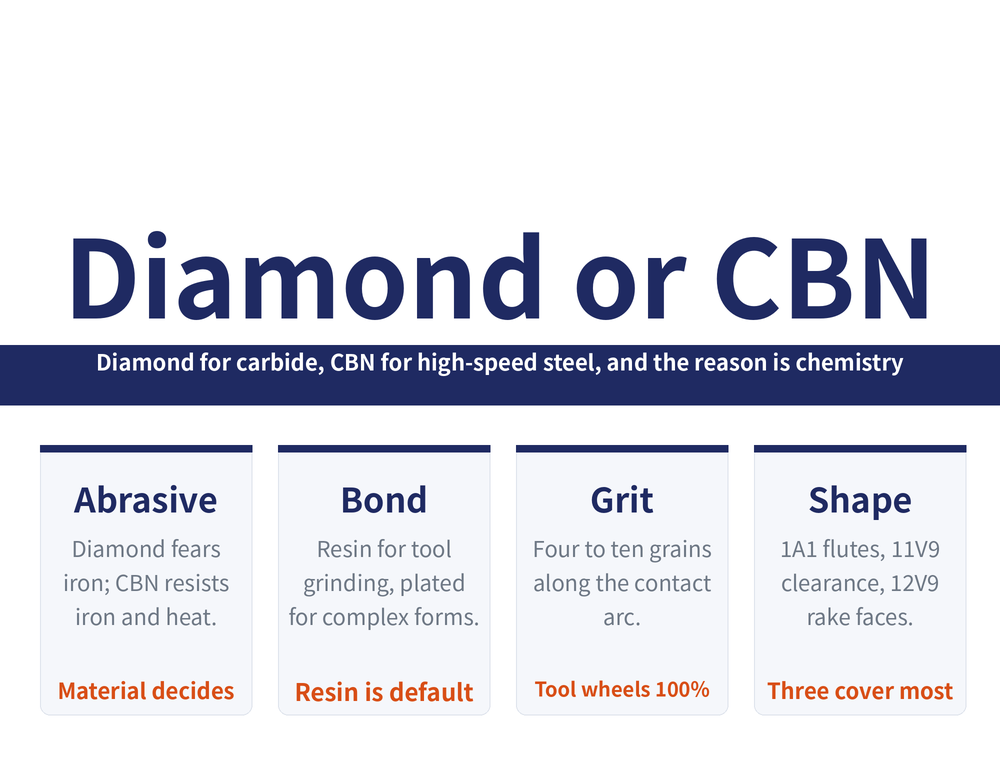
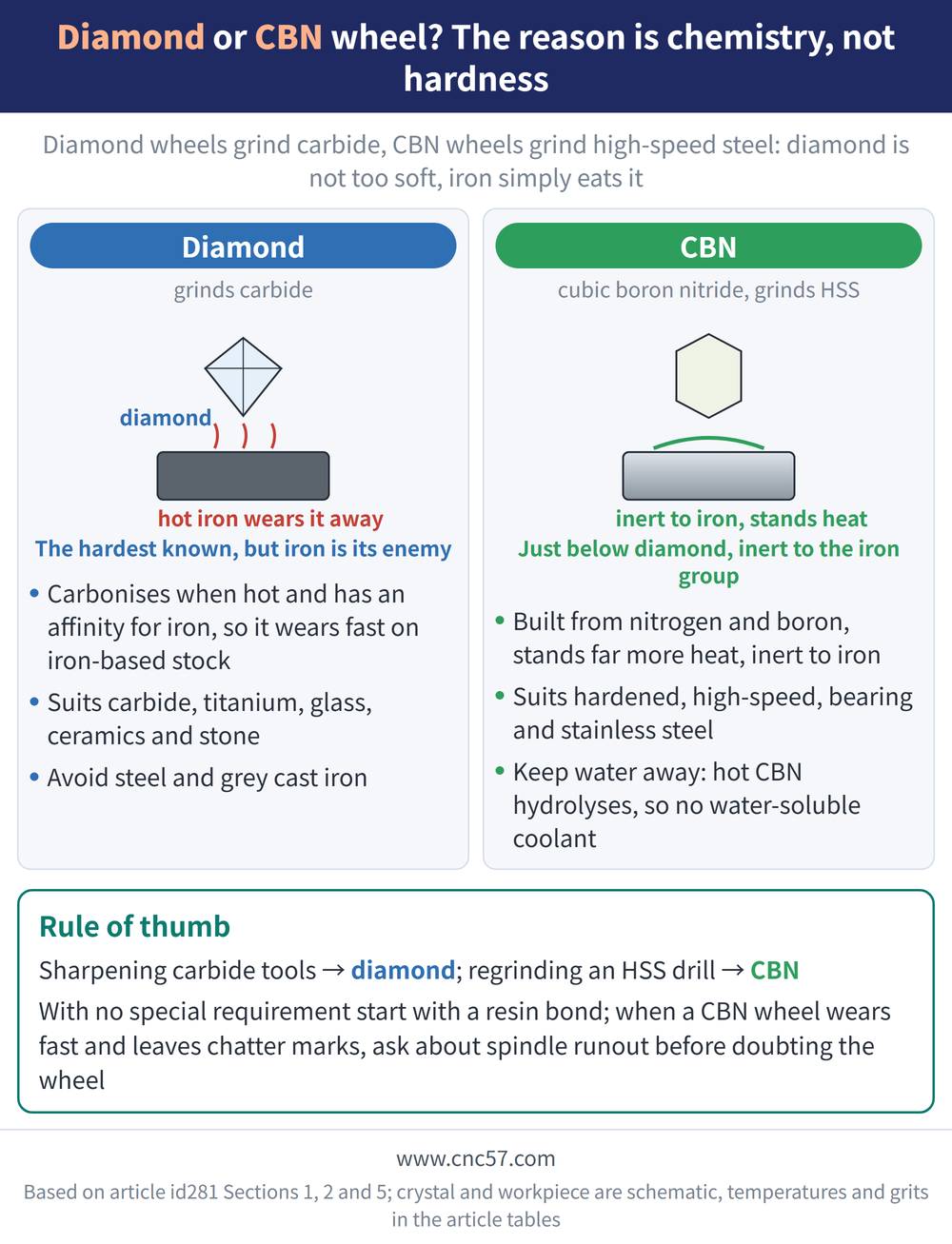
Tool grinders mostly grind high-speed steel and carbide, and ordinary abrasives will not touch either, so tool grinding always uses a superabrasive—diamond or CBN (cubic boron nitride). The one-line rule: diamond wheels grind carbide, CBN wheels grind high-speed steel.
| Compare | Diamond | CBN |
|---|---|---|
| Hardness | The hardest known | Just below diamond |
| Heat | Carbonises at 700–800°C | Stands 1300–1400°C |
| With iron | Affinity; wears fast when hot | Chemically inert |
| Grinds well | Carbide, titanium, glass, ceramics, stone | Hardened, high-speed, bearing and stainless steel |
| Avoid | Steel and grey cast iron | — |
Diamond is not too soft—iron simply eats it. Once the zone hits 700–800°C the carbon carbonises and its affinity for iron takes over, so wear runs away. CBN, built from nitrogen and boron, is inert to the iron group and stands far more heat, which fills exactly that gap.
2. Choosing the bond
| Bond | Character | Where it fits |
|---|---|---|
| Resin B | Self-sharpening, resists loading, runs cool | Tool sharpening, bores, cylindrical and surface work |
| Vitrified V | Wear and heat resistant, holds form, dresses easily, brittle | Roughing difficult materials, wide-contact form grinding |
| Metal M | Long life under heavy load, but loads up and is hard to dress | Roughing hard brittle materials and carbide, form grinding |
| Plated | Single layer, sharpest, needs no dressing, short life | Complex form grinding, high-speed grinding |
| Brazed | Large chip space, resists loading, runs cooler still | Ultra high-speed grinding |
Default: most diamond and CBN wheels for tool grinding use a resin bond. Unless there is a complex form, ultra high speed or heavy roughing involved, start with resin.
3. Setting grit and concentration
Four grit standards run in parallel: GB uses a pair of numbers (230/270), FEPA prefixes D for diamond and B for CBN, ASTM uses a single number, ISO states the micron band. The logics differ, so you cannot compare the numbers directly—look the equivalent up. The common band:
| GB | FEPA diamond / CBN | ASTM | ISO (μm) |
|---|---|---|---|
| 120/140 | D126 / B126 | 150 | 125-106 |
| 170/200 | D91 / B91 | 220 | 90-75 |
| 230/270 | D64 / B64 | 280 | 63-53 |
| 325/400 | D46 / B46 | 400 | 45-38 |
For tool grinding: fluting usually takes 230/270 or 170/200 in diamond, 170/200 or 120/140 in CBN; clearance faces go as fine as 325/400 in diamond, and sit between 230/270 and 120/140 in CBN. For the same job, diamond is normally chosen a little finer than CBN.
Concentration is not a code to memorise, it is grain density: pick it so that four to ten grains are working along the contact arc. Roughing and output want high concentration, finishing medium, polishing and fine grits low; diamond and CBN wheels for tool grinding usually run 100% concentration.
4. Shape codes: three cover most of it
Superabrasive wheels use the GB/T 6409.1 code set (1A1, 11V9 and so on), a separate system from conventional wheel shape codes—the two do not cross-reference. Tool grinding leans on three:
| Code | Shape | What it grinds |
|---|---|---|
| 1A1 | Straight | Profiles, flutes, ball ends, gashing, and drill points |
| 11V9 | Flaring cup | Clearance faces on end and peripheral teeth |
| 12V9 | Dish | Rake faces on end teeth and ball ends, gashed teeth |
The four families also cover chamfered, radiused and thin straight wheels plus cylinder, cup and dish variants, but matching these three codes settles most enquiries.
5. Two things to know before running one
First, the machine needs 50% more rigidity than ordinary grinding. A CBN wheel wants spindle axial float under 0.005mm, radial runout under 0.01mm and feed resolution under 0.005mm per step. Too little rigidity starts a chain: the wheel works while vibrating, wear rises and turns uneven, the grinding ratio drops, cost goes up, and loading and chatter marks follow. When a customer says a CBN wheel wears fast and leaves chatter, ask about spindle runout before doubting the wheel.
Second, CBN and water do not mix. Hot CBN hydrolyses with water into boric acid and ammonia, faster the hotter it runs, and the wheel wears accordingly. So do not run CBN with a water-soluble coolant—use light mineral oil, kerosene or light diesel; if water-based is unavoidable, add an extreme-pressure additive. Diamond is the opposite: kerosene, light diesel and water-soluble coolants all work well (soda water does not suit resin-bonded wheels).
Day-to-day rules: keep a dedicated flange on each wheel and never strip it off, mount to under 0.03mm radial runout, balance at despatch and in service, and do not store resin-bonded wheels too long as the bond ages. For mounting and balancing, see Mounting and Balancing a Grinding Wheel.
6. Frequently Asked Questions (FAQ)
Q: Regrinding an HSS drill—diamond or CBN?
CBN. High-speed steel is an iron-based material and diamond has an affinity for iron when hot, so it wears away fast. Carbide tools are the other way round: use diamond, which is harder and more efficient there.
Q: Which bond with no special requirement?
Resin. Most diamond and CBN wheels for tool grinding use it—self-sharpening, resistant to loading and cool running. Switch to plated for complex forms, metal for heavy roughing, brazed for ultra high speed.
Q: Can a CBN wheel run water-based coolant?
Not advisable. Hot CBN hydrolyses with water into boric acid and ammonia and wears faster; tests show water-soluble coolant giving even shorter life than grinding dry. Use light mineral oil, kerosene or light diesel.
Q: How do I remember 1A1, 11V9 and 12V9?
By the feature you are grinding: 1A1 (straight) for flutes, gashing and drill points; 11V9 (flaring cup) for clearance faces; 12V9 (dish) for rake faces and gashed teeth. Those three cover most tool grinding.
This article is part of Tool Regrinding: The Complete Guide — Decide Whether to Grind, Then Look Up How, With What, and How to Check; that guide shows how the whole topic fits together.
This article is part of Grinding Wheels and Machines: The Complete Guide - Reading the Wheel, Mounting It, Dressing It, and Tracing Defects; that guide shows how the whole topic fits together.
Published: 2026-08-16|Updated: 2026-08-16