Stationary Cutting: Choosing Among Five Methods
A stationary cutting machine cuts with a cut-off wheel, and on the same machine there are five cutting methods depending on the part shape, size and quantity. This guide maps you to the right one, and clears up the commonly confused index vs rotary methods.
1. Five Methods at a Glance
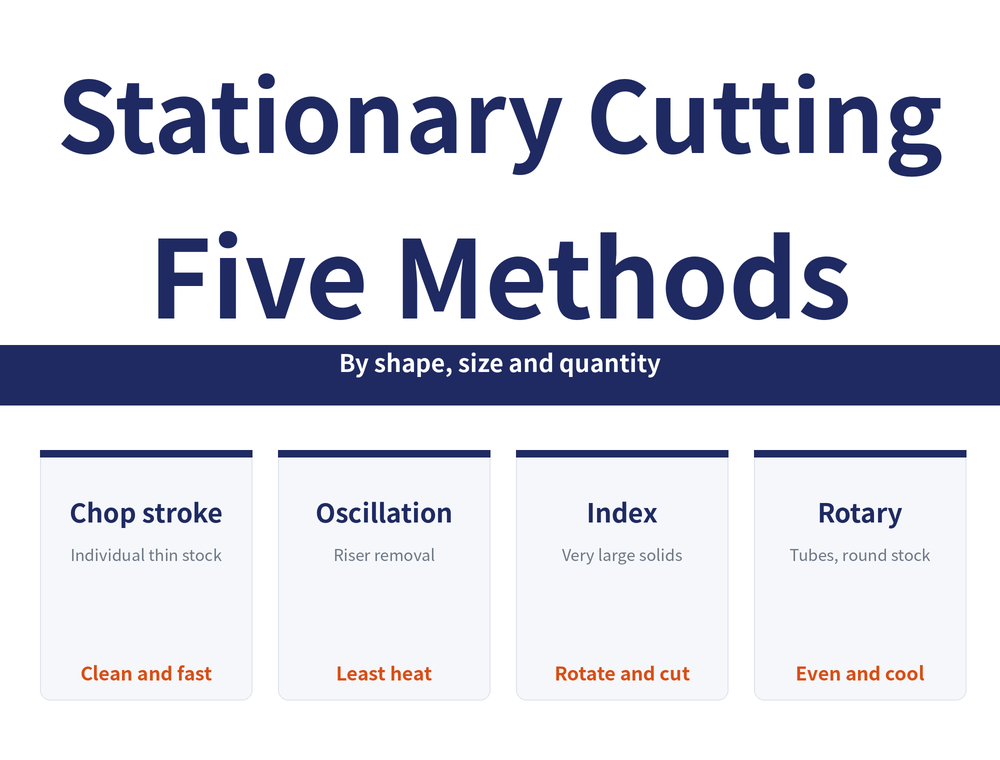
| Method | Best for | Core trait |
|---|---|---|
| Chop stroke | Individual parts, thin/small stock | Low vibration, clean cut, fast, little wheel wear |
| Oscillation | Foundry riser removal, heavy wet cutting | Low power, least heat input, best chip clearance |
| Horizontal | Several adjacent parts, large plate | One pass cuts the whole layer width |
| Index | Very large round solids and blocks | 2–4 partial cuts, rotating 180–90° each, small wheel on big section |
| Rotary | Large tubes and round solids | Part rotates continuously, even cut, low power, part stays cool |
2. How to Pick
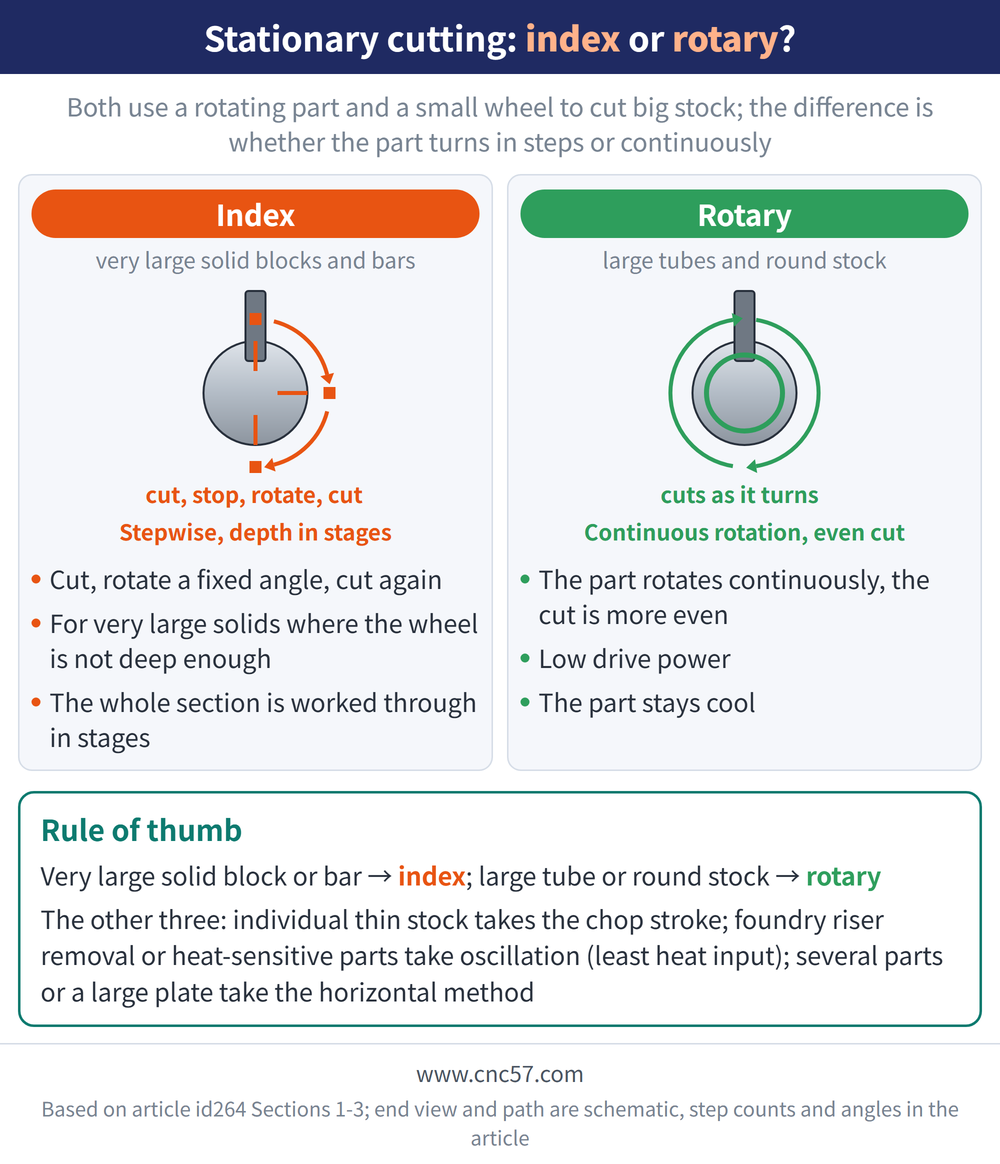
Quick match: individual thin stock → chop stroke; foundry riser removal or heat-sensitive → oscillation (least heat); several parts or a large plate → horizontal; very large solid block/bar where the wheel is not deep enough → index (cut, rotate an angle, cut again); large tube or round stock → rotary (cut while rotating, even and cool).
3. Index vs Rotary
Both use a rotating part and a small wheel to cut big stock; the difference is: index is cut–stop–rotate a fixed angle–cut, in steps, suiting solid blocks and bars by taking depth in stages; rotary spins the part continuously and cuts as it turns, suiting tubes and round stock with an even cut and a cooler part. For tool-based (lathe) parting and grooving, compare grooving tool selection.
4. Frequently Asked Questions (FAQ)
Q: How many stationary cutting methods are there?
Five: chop stroke, oscillation, horizontal, index and rotary, chosen by part shape, size and quantity.
Q: Which for foundry riser removal?
Oscillation: low drive power, least heat input to the part, and the best chip clearance.
Q: A very large solid will not part through, what now?
Use index: cut, rotate an angle, cut again, in 2–4 steps, so a small wheel works through the whole large section.
Q: What is the difference between index and rotary?
Index is stepwise (cut, stop, rotate, cut) for solid blocks and bars; rotary spins continuously and cuts as it turns, for tubes and round stock with an even cut.
This article is part of Deburring and Surface Finishing: The Complete Guide - Which Tool, Which Material, and What to Do in Volume; that guide shows how the whole topic fits together.
Published: 2026-08-11 | Last updated: 2026-08-11