Zero-Point Clamping Systems: Quick Changeover, the 4th Axis and 5-Side Machining
Every fixture change means picking up an edge finder again and resetting the work offset, and all of that time is machine downtime. A zero-point clamping system hands the centring step to the mechanism itself: the fixture plate drops onto the base plate, locates and clamps, and the coordinates stay where they were. This guide covers the limits of conventional mounting, how quick changeover works, the 4th-axis application, pull-stud 5-side machining, and how it differs from quick-change tool holding.
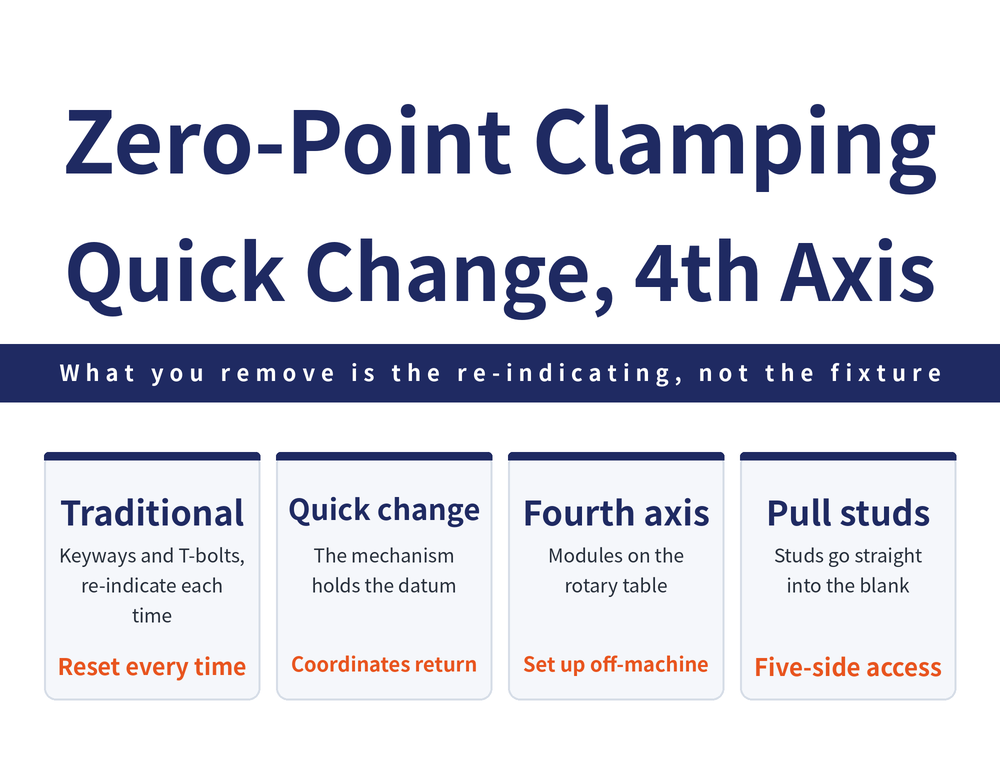
1. The Limit of Conventional Mounting: Re-Centring on Every Change
Before a fixture can cut, the machine has to know where it is. The simplest method is locating keys plus T-slot bolts to pull the fixture down onto the table, then a 3D-Taster or edge finder to centre it and set the fixture origin into the controller's work coordinate system.
G54–G59 are the work coordinate codes common on FANUC-type CNC controllers, an industry convention that lets several different part origins be stored and called from the program. For how the fixture itself is designed and where its locating points come from, see What Is a Jig and Fixture.
The problem is not whether it works. It is that the whole routine repeats on every fixture change: an experienced operator has to centre the fixture and set the offsets each time. In high-mix, low-volume work with frequent changeovers, that time lands squarely on machine downtime.
2. How Quick Changeover Works: Repeatability Moves to the Mechanism
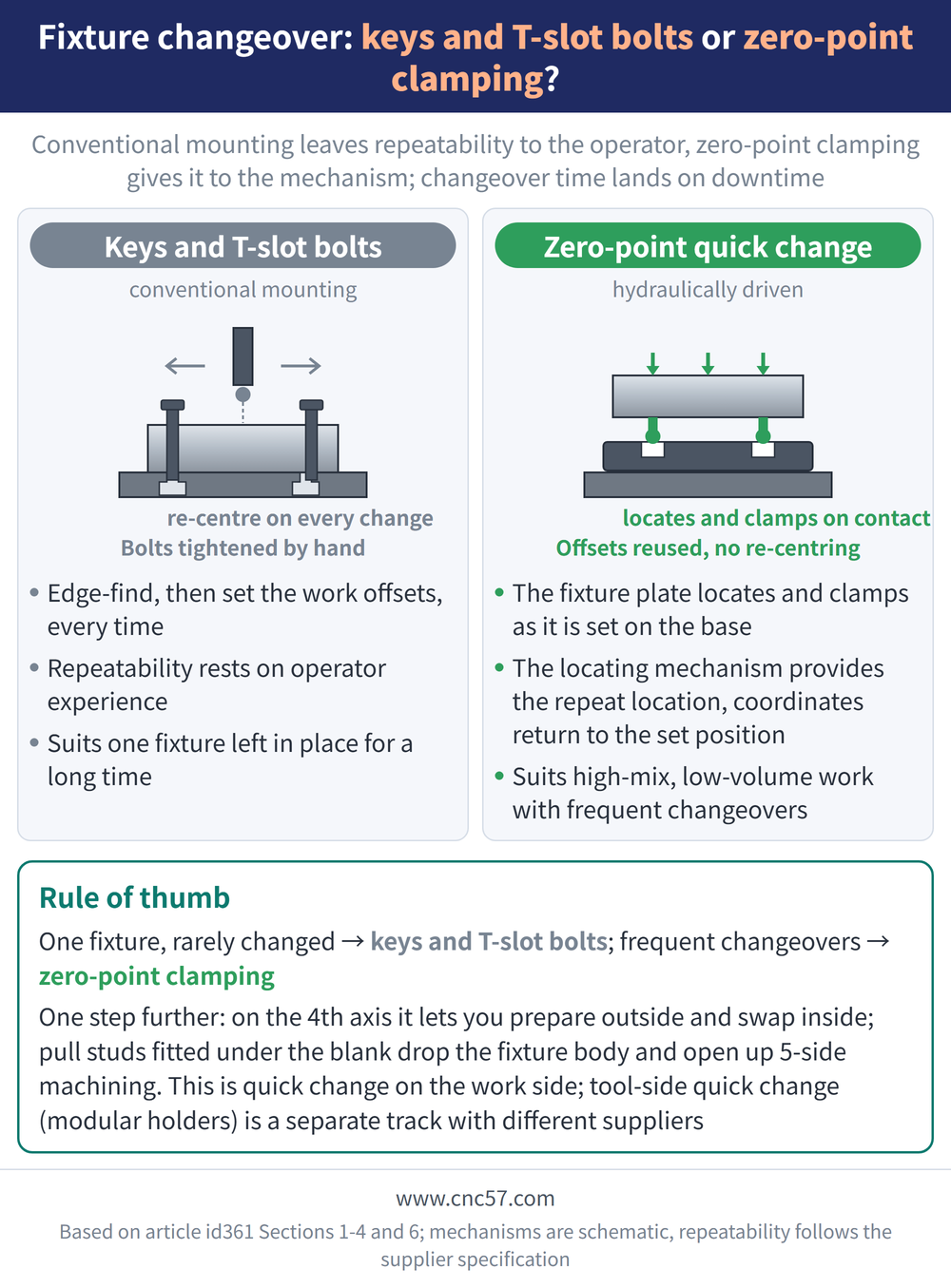
The faster route is a hydraulic fixture system built for quick location and clamping — what the shop floor calls zero-point clamping. Hydraulics drive the clamping mechanism, and the fixture plate locates and clamps as it is set onto the base plate.
The key point: changing the fixture does not require centring and setting the offsets again, because the locating mechanism itself provides the repeat location and the coordinates return to the position already set. Conventional mounting leaves repeatability to the operator; zero-point clamping gives it to the mechanism.
| Item | Keys + T-slot bolts | Zero-point quick-change system |
|---|---|---|
| Clamping | Bolts tightened by hand | Hydraulically driven |
| Offset setting | Edge-find, then set G54–G59 each time | Existing offsets stand; no re-centring |
| Repeatability rests on | Operator experience | The locating mechanism |
| Best suited to | One fixture left in place | High-mix, frequent changeover |
3. On the 4th Axis: Prepare Outside, Swap Inside
The quick-change element does not have to sit on the table. It can also be mounted on the 4th axis of a vertical machining centre — fit the quick-change element to the rotary table and the fixture plate can be swapped there.
The gain is division of labour: holding the part and changing the fixture plate are both finished outside the machine, and the machine itself performs one quick exchange. Setup time moves to a bench beside the machine while the spindle keeps cutting — prepare outside, change over quickly inside.
4. Pull-Stud Direct Clamping: Where 5-Side Machining Comes From
Taken one step further, the fixture body itself can be dropped. Pull studs are fitted directly under the workpiece blank, and the blank mounts straight onto the fixture base plate for machining, with no separate fixture body in between.
The sequence: the quick-change clamping system is installed on the machine base plate first, then the blank itself — not a fixture — couples to and releases from the base plate through the pull studs. All four sides and the top stay clear, which is what makes 5-side machining possible.
The studs are not consumed with the part: they can be removed from the finished component and reused on the next blank. In effect the object of "quick change" moves down from the fixture to the blank itself, which suits production runs of high-volume blanks of repeating size.
5. Repeatability: Take the Numbers From the Supplier
The first question anyone asks about zero-point clamping is how many microns of repeatability it delivers. Repeatability and the form of the locating mechanism differ from one system to another, so no figure is given here; ask the supplier for the measured repeatability of the specific model.
In practice, ask the system supplier for the catalogue and confirm repeatability, pull-stud retention force, base-plate load rating and the machine interface, taking the manufacturer's specification as authoritative. How much clamping force you actually need is the older question of working back from cutting force — see Why Vise Clamping Distorts the Workpiece.
6. Set Against Quick-Change Tool Holding: Work Side vs Tool Side
"Quick change" runs on two separate tracks in a machine shop and the two are easy to confuse. Zero-point clamping here is quick change on the work side: what changes is the fixture plate or the blank. Quick-change and modular tool holder systems are quick change on the tool side: what changes is the cutting head and the holder module.
| Comparison | Work side (zero-point clamping) | Tool side (modular holders) |
|---|---|---|
| What is exchanged | Fixture plate, workpiece blank | Cutting head, holder module |
| Datum to restore | Work coordinate origin | Tool length and radius offsets |
| Time saved | Centring and offset setting | Holder swaps and tool presetting |
| Supplier | Workholding makers | Tool holder makers |
The logic underneath is the same on both tracks: let the mechanism restore the datum after a change instead of the operator. Only the object differs — the part on one side, the tool on the other. Establish which side you are on before requesting quotations, or you will be talking to the wrong supplier.
Frequently Asked Questions (FAQ)
Q: With a zero-point system, do I still re-centre after a fixture change?
No. The locating mechanism itself provides the repeat location, so the coordinates return to the position already set and there is no need to edge-find and reset G54–G59. That is the core value over keys and T-slot bolts.
Q: What repeatability does a zero-point clamping system achieve?
It differs from system to system. Request the supplier's catalogue and treat the manufacturer's specification as authoritative, together with stud retention force and base-plate load rating.
Q: Does 5-side machining always need a separate fixture body?
Not necessarily. Pull-stud direct clamping fits studs under the blank so it mounts to the base plate with no fixture body, leaving all four sides and the top clear for 5-side machining. The studs can be removed from the finished part and reused.
Q: Is this the same thing as a quick-change tool holder system?
No. Zero-point clamping is work-side quick change — the fixture plate or blank is exchanged and the work coordinate origin is restored. A modular tool holder is tool-side quick change — the head and holder module are exchanged and the tool offsets are restored. The suppliers differ too.
This article is part of Workholding and Fixtures: The Complete Guide - Locate First, Then Clamp; How Much Force and Where It Comes From; that guide shows how the whole topic fits together.