Modular tool holder systems break "base holder + adapter + head" into standardized, interchangeable components, letting a small parts inventory cover a large number of tooling combinations while speeding up changeovers. This guide explains the design principle, the trade-offs against solid tooling, a real inventory-savings case, and exchangeable solid heads as a third path between indexable and solid tools.
1. What Problem Modular Tooling Solves
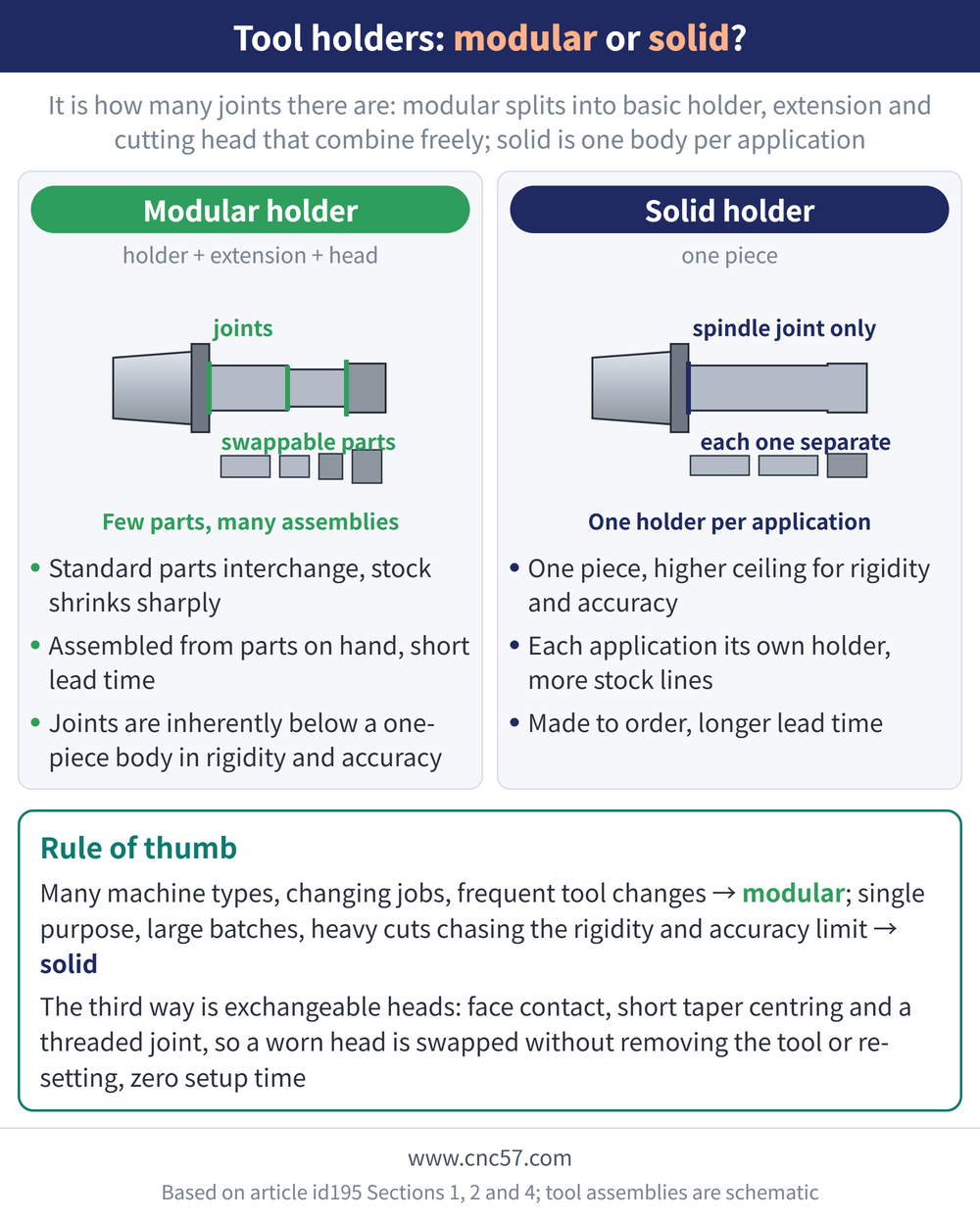
Conventional tooling is largely "one holder, one purpose" solid construction - as machine variety and job requirements multiply, tool inventory expands quickly. Modular holders instead split the system into standardized base holders, adapters (including extensions and reduction adapters), and heads, letting the same base holder combine with different heads and lengths to achieve "few parts, many configurations."
The full taper picture: see Spindle Taper Systems Overview.
2. Modular vs. Solid: The Trade-offs
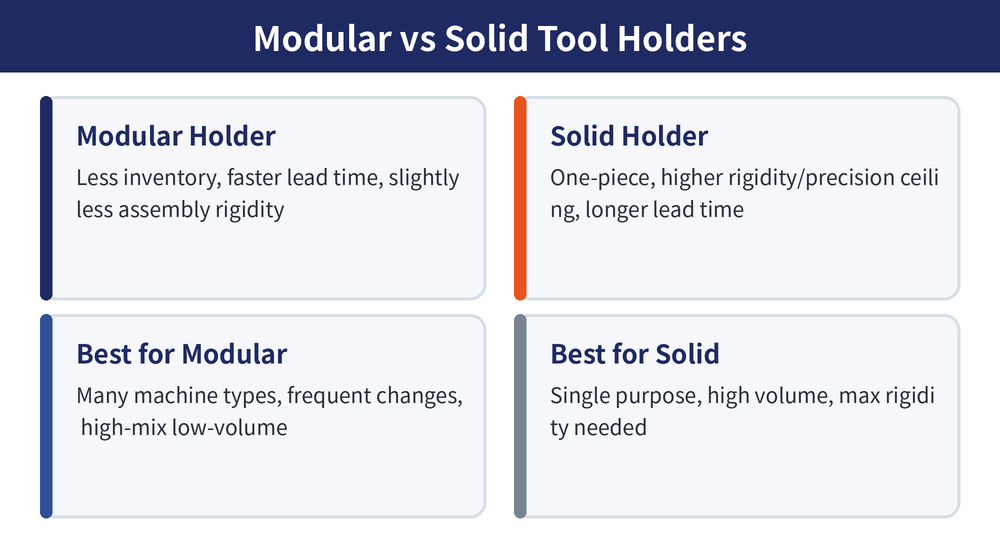
| Aspect | Modular Holder | Solid Holder |
|---|---|---|
| Inventory | Standardized parts interchange across configurations; inventory can be significantly reduced | Each application typically needs its own dedicated holder; more line items |
| Lead time / flexibility | Assembled from stock components; fast turnaround | Often made to order; longer lead times |
| Rigidity / precision | Assembly interfaces are inherently somewhat less rigid than one-piece construction; precision may be slightly reduced | One-piece construction gives a higher ceiling on rigidity and precision |
| Best fit | Many machine types, frequently changing jobs, frequent tool changes | Single dedicated use, high volume, applications demanding maximum rigidity/precision |
Modular is not "always better" - it trades a slight rigidity/precision cost for inventory savings and lead-time flexibility. That trade pays off especially well in low-volume, high-mix shops running many machine types, while solid holders retain the edge for single-purpose, heavy, precision-critical work.
Mill-turn modular interfaces: see HSK-T and PSC Interface Guide.
3. Inventory Savings from Modular Holders - a Real-World Case
The most direct value of modular tooling is covering a large number of configurations with a small parts count. Industry examples for machining-center tooling show that, with solid tooling, each combination of diameter, length, and angle typically requires its own dedicated part, so the part count and the number of configurations scale roughly one-to-one. A modular system instead needs only a small set of base holders, adapters, extensions, and reduction adapters, which combine to cover the same number of configurations - one documented case achieved the same configuration coverage as solid tooling using well under a tenth of the part count. Actual savings depend on your specific tool list and machine mix, so it's best to run the numbers against your own inventory.
4. Exchangeable Solid Heads: A Third Path Between Indexable and Solid
Beyond "modular holder plus fixed head," the industry also uses exchangeable solid head tooling, which combines three design elements: face contact between the carbide head and the holder (keeps overhang within tight tolerance and gives repeatable assembly dimensions), short taper centering (for high precision), and a threaded connection (for easy replacement).
| Holder Material | Characteristics | Best For |
|---|---|---|
| Steel | Most general-purpose | General applications |
| Carbide | High rigidity | Finishing/semi-finishing, long overhang, internal grooving |
| Heavy metal (high tungsten content) | Good vibration resistance, not recommended for heavy-duty cuts | Unstable cutting conditions |
Its core advantage is the "no-setup-time" principle: replacing a worn head does not require removing the tool from the machine or re-touching-off, which significantly cuts changeover downtime. The same holder can pair with multiple heads (and vice versa), turning the holder into a universal carrier that further reduces inventory needs.
Anti-vibration holders: see Anti-Vibration Tool Holder Guide.
5. Where Modular Quick-Change Is Headed
Modular quick-change is one of five current trends in tool holding systems (alongside shrink-fit holders, internal coolant supply, long-overhang/anti-vibration applications, and polygon taper connections), with its core value being simplifying the search for the optimal tool combination and reducing the need for special-purpose tools. Market share between indexable and solid (including exchangeable-head) tooling currently runs roughly one-to-one, reflecting two parallel development paths rather than convergence on one - the right choice still comes down to your machine mix, process stability requirements, and changeover frequency.
FAQ
Q1: Is modular tooling precision much worse than solid tooling?
The assembled interfaces in modular tooling (adapters, threaded joints) generally have a lower rigidity/precision ceiling than one-piece solid construction, but the actual gap depends on the interface design (e.g. short-taper centering, face contact). It's a trade-off of slight precision cost for inventory flexibility, not a reason to rule out modular tooling for finishing work - evaluate against your actual precision requirements.
Q2: How is exchangeable-head tooling different from indexable tooling?
Indexable tooling keeps a fixed holder and replaces the insert. Exchangeable-head tooling replaces the entire carbide head, and the swap doesn't require removing the tool from the machine or re-touching-off - you can resume machining right after the head change. That's the main difference from indexable tooling, where an insert change still typically requires re-setting the tool.
Q3: When should I choose modular versus solid tooling?
Modular tooling has the advantage when you run many machine types, jobs change frequently, tool changes are frequent, and you value inventory savings and lead-time flexibility. Solid tooling remains the safer choice for single-purpose, high-volume, heavy cutting that demands maximum rigidity and precision. Most shops use both, choosing per process.
Q4: Can I mix modular adapters from different brands?
Not recommended. The taper and thread specifications between adapters, holders, and heads in a modular system are usually proprietary to each brand - even if they look similar, compatibility isn't guaranteed, and mixing brands can lead to insufficient positioning accuracy or an outright failure to lock. Stay within one brand's system, or confirm compatibility with the manufacturer first.