
Boring Bar and Head Selection: Rigidity, Micro-Adjust and Coolant Delivery
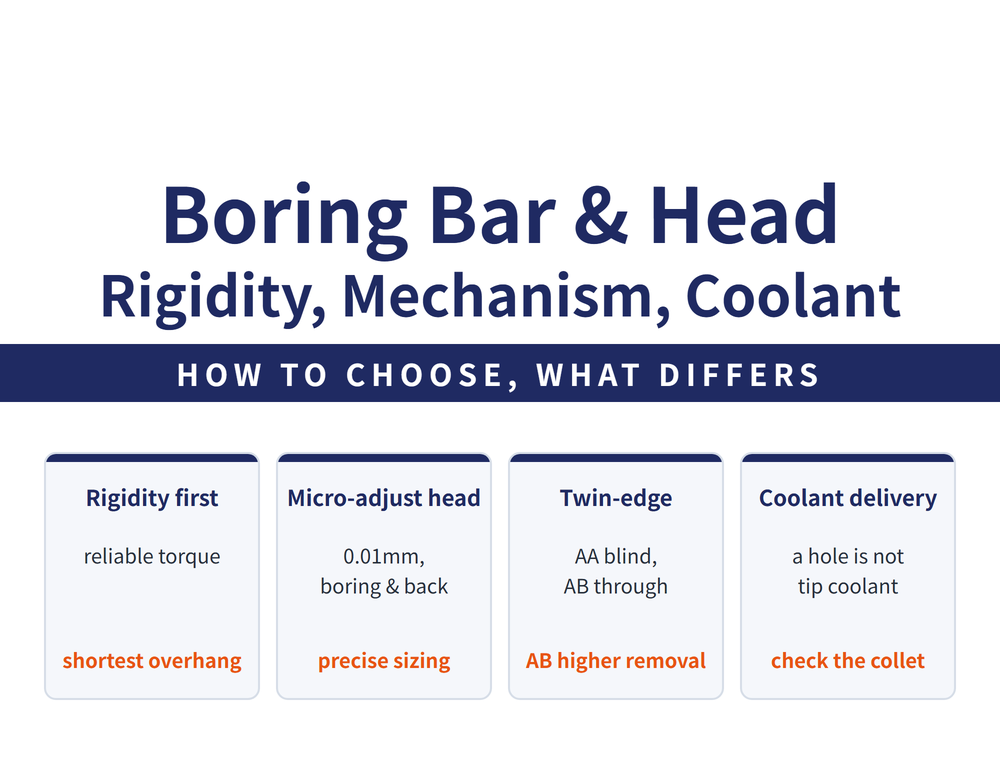
When choosing a boring bar and head, the manufacturer's first principle is that rigidity and reliable torque transmission matter most. This guide starts with the selection procedure, then covers the head mechanisms that decide usability: the 0.01mm graduation, boring versus back boring, the AA and AB twin-edge types, self-locking mechanisms, why coolant delivery depends on the collet, and the runout-compensation holder that fixes spindle ageing on the spot.
1. First principle: rigidity and torque transmission
On choosing a boring tool holder, the manufacturer is explicit: rigidity and reliable torque transmission are the most important factors. Two rules follow: use the strongest possible interface for the shortest overhang; and for best stability and hole quality, use dampened tools and tapered shanks. Evaluate across four areas: the part (diameter range, hole depth, tolerance, finish, sensitivity to vibration), the machine (spindle interface, speed, coolant pressure, power and torque, tool magazine), the tool (entering angle, insert geometry and grade), and cutting parameters (keeping torque and power in mind).
This article covers the selection procedure and head mechanisms; for the bar's ISO model codes and dimensions, see the boring bar model guide: ISO boring bar selection and specifications. For rough and fine boring tool choice, see rough boring tool selection and fine boring and tool overhang.
2. Micro-adjust fine boring head: 0.01mm graduation and boring / back boring
A fine boring head's core capability is whether it can precisely micro-adjust the hole diameter. Common heads move about 0.01mm per graduation (10 microns per division) with a pre-balanced design for stable accuracy, and one head often supports both boring and back boring — back boring machines a rear step or recess inside the hole that cannot be reached from the entry side.
When planning back boring: the pre-drilled hole must be large enough for the head to enter without interference. Catalogues often express the "minimum pre-drilled diameter for back boring" as a simple sum (a fixed structural offset constant plus half of the back-boring diameter), with the actual value depending on the head model. When back boring with a canned cycle (G87) on a machining centre, for how the tool shifts to pass the pre-drilled hole and why it can only return to the initial point, see Choosing a Boring Cycle: How G76 and G85-G89 Differ.
3. Twin-edge boring tools: the AA and AB division
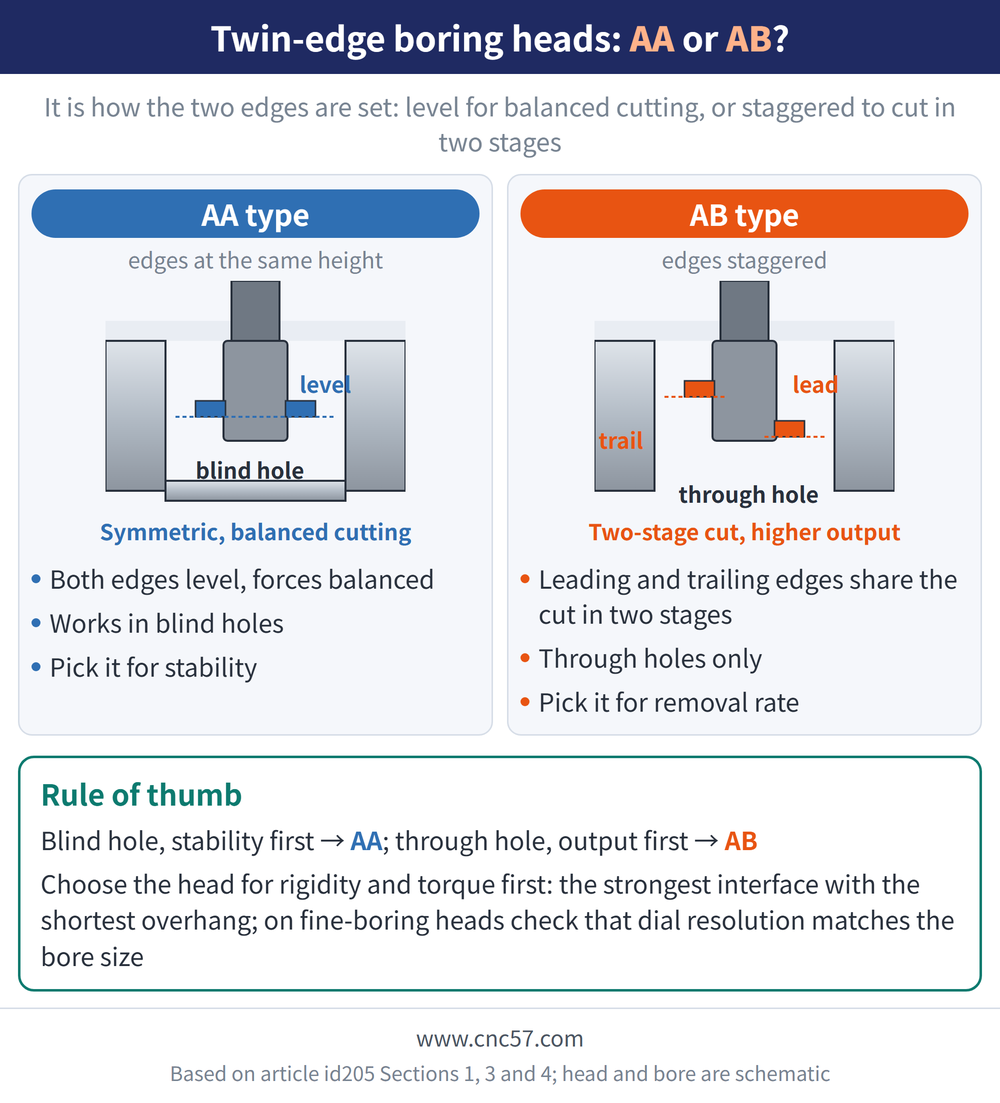
Twin-edge boring heads commonly come in AA and AB types, differing in the height arrangement of the two edges:
| Type | Edge arrangement | Use and character |
|---|---|---|
| AA type | Both edges at the same height | For blind holes, the two edges cut symmetrically in sync (balanced cutting) |
| AB type | Two edges front and rear, at different heights | For through holes, the front and rear edges divide the work into two stages; the manufacturer claims about twice the metal removal rate of AA |
The trade-off is clear: choose AA for balanced stability and blind holes; choose AB for efficiency on through holes. There is also a serrated adjustable rough boring head, whose rack structure combines high rigidity with easy adjustment, letting one wrench set a wide diameter range and covering very large diameters through modular assembly. These mechanism principles are general; specific model specifications are brand product data.
4. Self-locking mechanisms and graduation that varies with diameter
Some fine boring heads feature a self-locking function: no unlocking before adjustment and no extra locking after, merging "adjust" and "lock" into one action so that inconsistent locking torque no longer hurts diameter repeatability. Some can also be fitted inside blind holes and adjusted from the front.
Another detail easily missed at purchase: graduation density is not necessarily the same across head diameters. Some series use 0.05mm per division on small diameters but a finer 0.01mm on large ones. When comparing heads, check whether the graduation density matches the diameter.
5. Coolant through the holder: a coolant hole is not through-tool coolant
The most common misunderstanding is assuming that "the bar has a coolant hole" means "through-tool coolant". Where the coolant comes out of the same holder depends on the collet: with an ordinary collet it comes out through the collet, and only with a dedicated coolant collet does it reach the cutting edge. Jet-through delivery, which sprays from the holder face, is a different holder design. The collet and sealing nut each series needs vary, so confirm the matching collet model at purchase. For more on coolant-through holders, see Coolant-Through Tool Holders: Where the Coolant Comes Out Depends on the Collet; for why internal coolant matters so much to boring evacuation, see boring chip control and coolant: internal coolant, chip shape and speed limits.
6. Runout-compensation holder: fix spindle ageing on the floor
As a spindle's bearings age, runout increases. A runout-compensation holder provides a simple mechanism to adjust tool-tip runout right on the machine, correcting the eccentricity from spindle ageing on the spot without immediately replacing or servicing the spindle — for steadier diameter, lower surface roughness and longer tool life. Note this kind of holder is usually for reamers only. For countermeasures to shop problems like vibration and feed marks, see boring troubleshooting: vibration, chips, feed marks and power.
The head mechanisms, adjustment graduation (0.01mm per division), AA/AB removal-rate ratio, coolant-delivery types and runout-compensation holder here are drawn from a tool manufacturer (ANWY) catalogue as product examples; the mechanism principles are general, while specific specifications follow the manufacturer's datasheet, not measurements by this site.
Last updated: 2026-10-23
7. Frequently Asked Questions (FAQ)
Q: What should I prioritise when choosing a boring bar?
The manufacturer states clearly that rigidity and reliable torque transmission are the most important factors, because a boring bar is a cantilever and rigidity directly decides vibration and hole quality. Two practical rules: use the strongest interface for the shortest overhang, and use dampened tools and tapered shanks; then evaluate the part, machine, tool and cutting parameters.
Q: How do I choose between AA and AB twin-edge boring tools?
It depends on hole type. AA has both edges at the same height, cutting symmetrically in sync, suited to blind holes; AB has two edges front and rear dividing the work into two stages, suited to through holes, with the manufacturer claiming about twice the metal removal rate of AA. Choose AA for balanced stability, AB for efficiency on through holes.
Q: Does "the bar has a coolant hole" mean through-tool coolant?
No — this is the most common misunderstanding. Where coolant comes out depends on the collet: an ordinary collet gives through-collet delivery, and only a dedicated coolant collet carries it to the cutting edge; jet-through delivery from the holder face is a different holder design. Confirm the matching collet model at purchase.
Q: If spindle runout grows with age, must I replace the spindle?
Not necessarily right away. A runout-compensation holder adjusts tool-tip runout on the machine, correcting the eccentricity from spindle bearing ageing — a floor workaround before servicing or replacing the spindle, though usually for reamers only. If it comes with obvious vibration, also check overhang and clamping.
For the full reading guides on this topic, see Hole Accuracy: A Complete Reading Guide and Vibration and Chatter: A Complete Reading Guide.









