
How Heat Treatment Affects Machinability: Anneal to Nitride
The same block of steel cuts easily when annealed and is almost uncuttable once quenched — heat treatment changes the microstructure and hardness, and that decides machinability. Read the hardness and machinability of each state, and get the "machine first or heat-treat first" order right.
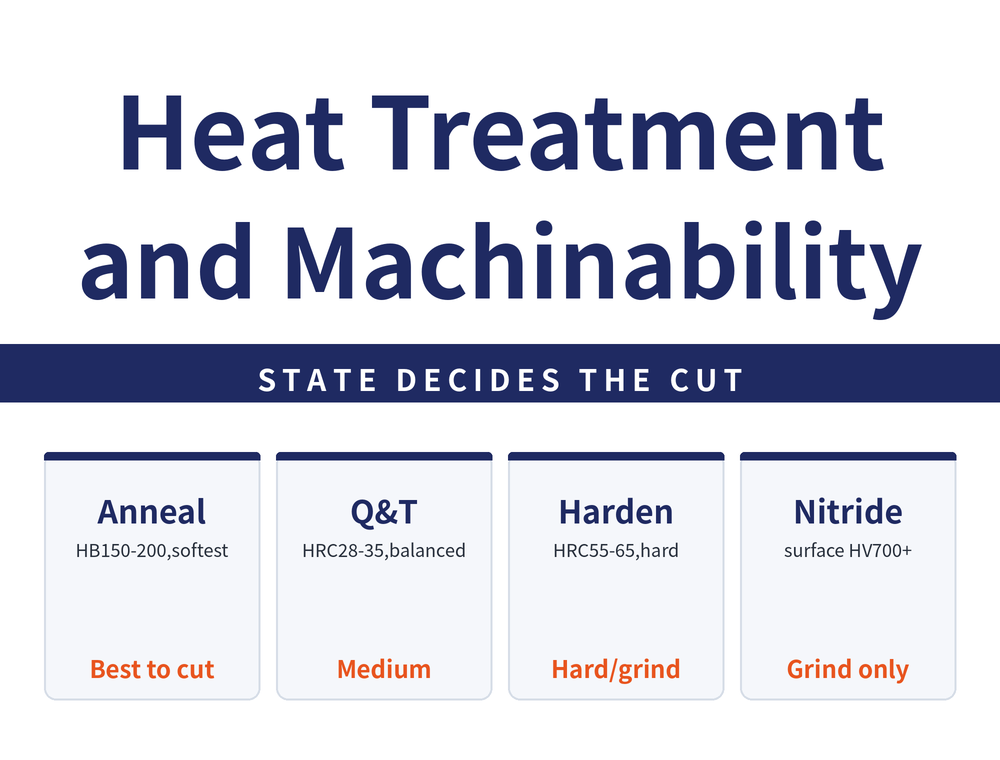
1. What heat treatment changes: microstructure, hardness and machinability move together
Heat treatment changes the steel's microstructure — the cooling rate after austenitizing decides whether ferrite, pearlite or martensite forms — and once the structure shifts, hardness shifts, and machinability follows.
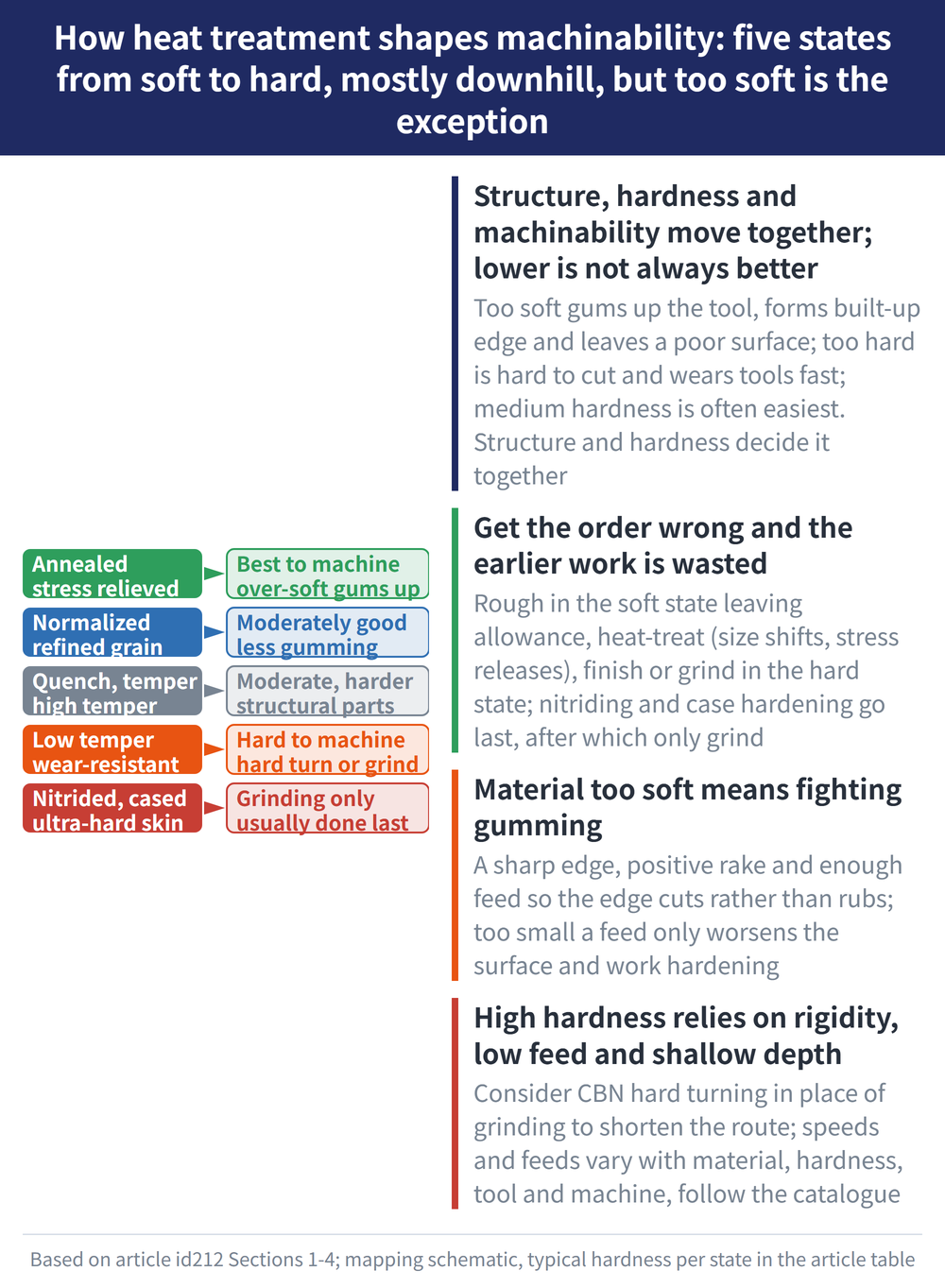
Lower hardness is not always better. Too low (annealed low-carbon) gums up the tool, forms a built-up edge and leaves a poor surface; too high is hard to cut and wears tools fast; medium hardness (about HB 200–250, typical) is often the easiest to machine. This "soft is not always easy to cut" rule is the key to reading each state.
Key point: machinability is set by microstructure and hardness together, not by the hardness number alone. The same grade can be the easiest or nearly impossible to cut depending on its heat-treatment state.
2. Machinability of five common states
Put the purpose, hardness and machinability of the common states side by side, and match your stock to a row on arrival.
| State | Purpose | Typical hardness | Machinability | Notes |
|---|---|---|---|---|
| Annealing | Soften, relieve stress | HB 150–200 | Best | Common supply state; low-carbon and over-soft can gum up the tool |
| Normalizing | Refine grain, even out structure | HB 170–230 | Moderately good | Improves cut surface, less gumming |
| Quench & temper (Q&T, high temper) | Balance strength and toughness | HRC 28–35 | Moderate, slightly harder | Common for structural parts |
| Quench + low temper | High hardness, wear resistance | HRC 55–65 | Hard to machine | Mostly hard turning / hard milling / grinding |
| Nitriding / case hardening | Ultra-hard, wear-resistant surface | Surface HV 700–1000 | Grinding only, in practice | Usually done last |
Hardness figures are typical/reference values, subject to each steelmaker's datasheet or the standard, and vary with grade, section and process. For scale conversion see material hardness and tool selection.
From soft to hard, machinability falls roughly monotonically, but annealed low-carbon "too soft" is the exception — gumming and built-up edge make the surface worse instead. For the overall hardness–machinability picture see the ISO workpiece material classification.
3. When to machine and when to heat-treat
Get the order wrong and the earlier work is wasted. The rule: rough in the soft state → leave allowance → heat-treat → finish or grind in the hard state; put nitriding / case hardening last, and after it only grind, never cut.
| Process stage | Material state | What to do |
|---|---|---|
| Roughing | Annealed / normalized (soft) | Bulk removal and shaping, leaving allowance for heat-treatment distortion |
| Heat treatment | Quench + temper (Q&T or hardening) | Reach target hardness; dimensions shift and stress is released here |
| Finishing | Hard state | Hard turn / hard mill or grind off the allowance to final size and surface |
| Surface hardening | Nitriding / case hardening | Applied last; afterwards only grind, no more cutting |
Distortion allowance and timing vary with grade, section and heat-treatment process; follow the heat-treater's and steelmaker's advice.
For how to finish high-hardness work and choose the tool material, see the hardened-steel machining guide and the tool steel machining guide.
For where heat treatment goes in the operation sequence, see Sequencing Machining Operations; when heat-treated parts come back wrong, see Heat-Treated Parts Come Back Wrong; for how much is left to cut on a carburised or nitrided part, see How Much Is Left to Cut on a Case-Hardened Part.
4. Practical reminders for machining
Material too soft means fighting gumming: use a sharp edge, positive rake and enough feed so the edge cuts rather than rubs, suppressing the built-up edge. Too small a feed only worsens the surface and work hardening; for the mechanism see work-hardening mechanisms and countermeasures.
High hardness relies on rigidity, low feed and shallow depth of cut to keep the cut stable, and consider cubic boron nitride (CBN) hard turning in place of grinding to shorten the route. To choose tools by hardness see material hardness and tool selection.
Cutting speed vc and feed per tooth fz vary with material, hardness, tool and machine; this article lists no specific values. Follow the tool catalogue, and for the calculation see the end mill cutting conditions guide.
Last updated: 2026-10-21
5. Frequently Asked Questions (FAQ)
Q: Why is steel that is too soft actually hard to machine?
Too soft (such as annealed low-carbon) gums up the tool and forms a built-up edge, worsening the surface and dimensional stability. The fix is a sharp edge, positive rake and enough feed so the edge cuts rather than rubs on the workpiece.
Q: Should I machine first or heat-treat first?
The general rule is to rough in the soft state leaving allowance, then heat-treat, then finish or grind in the hard state. Nitriding / case hardening goes last, after which you only grind, never cut.
Q: Can a nitrided part still be turned or milled?
Barely. The nitrided surface is about HV 700–1000 and is in practice grinding-only. That is why nitriding is usually the last step, and the finishing that sets size and surface must be done before it.
Q: What is the difference between quench-and-temper and quenching?
Quench-and-temper is quenching plus a high temper (typically HRC 28–35), balancing strength and toughness while staying machinable; quenching with a low temper aims for high hardness and wear resistance (typically HRC 55–65) and mostly needs hard turning, hard milling or grinding.
This article is part of Workpiece Materials: The Complete Guide - Name the Metal First, Then Match the Tool; that guide shows how the whole topic fits together.









