
Turning Copper and Brittle Materials: Washer Tools, Chip-Breaking and Chip-Curling Corrugated Edges
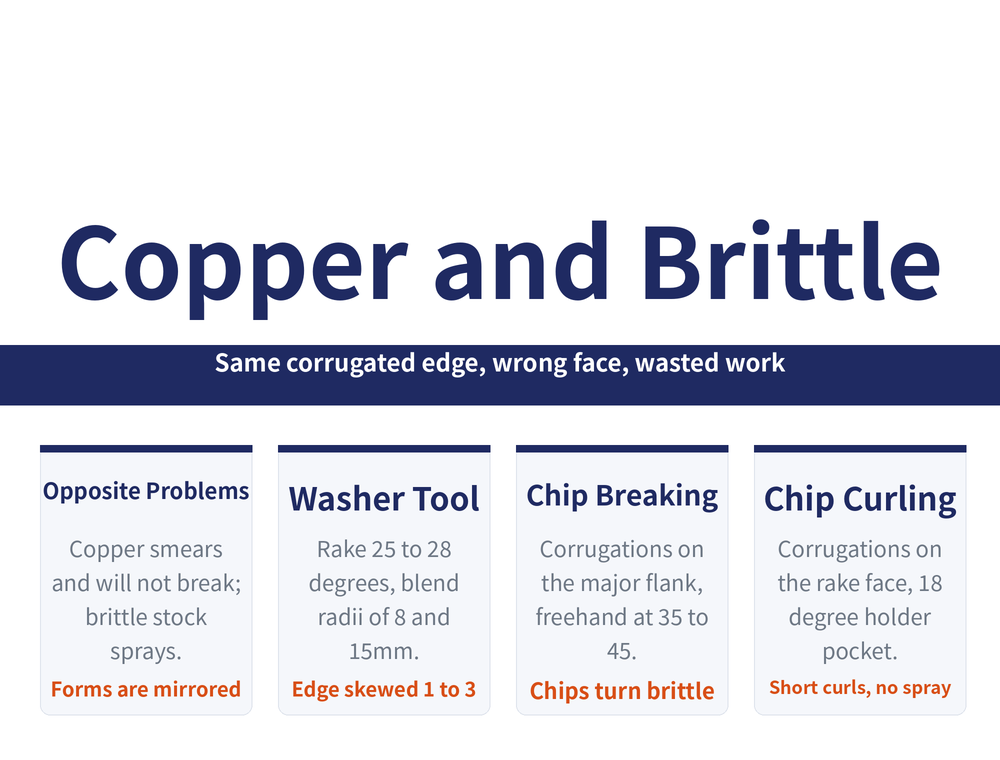
Pure copper will not break its chips; brittle materials spray fragments everywhere. The two problems are opposites, and so are the edge forms — they are ground on opposite faces. This guide covers the geometry of a copper washer tool, how the chip-breaking and chip-curling corrugated edges differ, and which side to touch up when a trial cut goes wrong.
1. Two materials, two opposite problems
Pure copper is soft and very ductile: chips smear rather than break, and the faces raise burrs. Brittle materials do the reverse — chips shatter and fly. One case asks you to break the chip, the other to make the fragments curl, which is why the two corrugated edge forms sit on opposite faces. Material-level guidance is in ISO N: Aluminium and Non-Ferrous Machining and ISO K: Cast Iron Machining; this guide covers only the edge forms.
2. Copper washer tool: the geometry
| Item | Value | Why |
|---|---|---|
| Rake angle | 25°–28° | Deliberately high, so the cut is light and chips flow |
| Clearance angle | 4°–6° | — |
| End clearance | 3°–4° | — |
| End cutting edge angle | 2°–3° | Defined in the dedicated guide |
| Inclination angle | 0.5°–1° | Ground on the 15mm radius |
| Edge width | By workpiece diameter | 2–3mm for 14–30mm washers; narrower is better until rigidity suffers |
The tool uses a YT15 insert (tungsten-titanium-cobalt, ISO P) on a medium carbon steel body. Both cutting edges and the nose are ground keen and the nose is left unchamfered. Angle definitions are in Turning Tool Lead Angle Guide.
3. What really matters: two radii and 1°–3°
On the upper rake face, 0.5–1mm back from the main edge, grind two blend radii of 8mm and 15mm — that is what makes the chip curl away. The second trick is against burrs: skew the main edge 1°–3° to the spindle axis so the centre of the washer is cut first and the ring the width of the tool drops off last, leaving a clean face.
4. Which side to touch up after a trial cut
| Symptom | Cause | Fix |
|---|---|---|
| One face bright, one rough | The two end edges are not equally keen | Stone the rougher side upward from the nose, one to three passes |
| Both faces rough | Both end edges are too keen | Stone both edges lightly upward from the nose, one to two passes |
| Chip veers before it parts | Main edge is off level, or inclination is too near the edge | Stone the other edge along the radius, square to the main edge |
The stone used is a 20mm square, grade K, F240 fine stone. All three symptoms are edge condition, not cutting data — do not start changing speeds first.
5. Chip-breaking tool: corrugations on the major flank
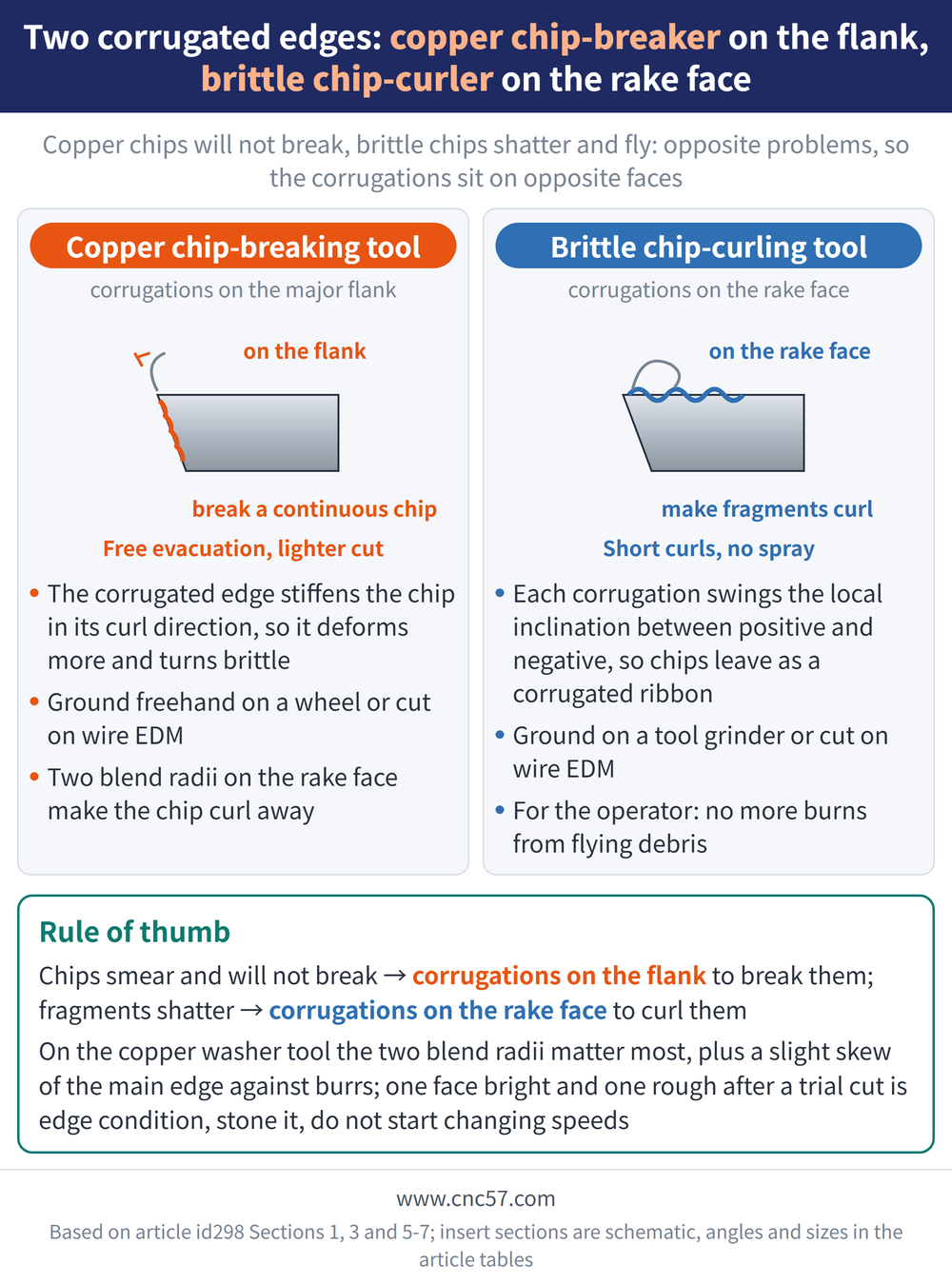
The tool uses a YG6 insert (tungsten-cobalt, ISO K), and the main angles can be ground freehand on an ordinary silicon carbide wheel. The working feature is a corrugated arc edge 1.5mm × 0.8mm on the major flank.
Both readings, stated plainly: within the same section, “three rows” is described in one place and “four to five arcs” in another. The counts disagree, so both are reproduced rather than silently reconciled. In practice, cover the flank width evenly.
| Method | How |
|---|---|
| Freehand, step 1 | Dress the wheel periphery and one side square with a diamond dresser |
| Freehand, step 2 | Hold the rake face at 35°–45° to the wheel, flank rolled 10°–15° |
| Freehand, step 3 | Start at the nose and take one arc at a time in small increments |
| Wire EDM | Clamp the tool in a fixture giving 15° flank, then program the corrugations |
In pure and oxygen-free copper the corrugated edge stiffens the chip in its curling direction, so deformation rises, the chip turns brittle and both cutting and evacuation get easier. General chip control is covered in Turning Chip Control.
6. Chip-curling tool: corrugations on the rake face
Same corrugations, mirrored: this form is ground on the rake face. The insert is ground on a tool grinder with a cup-type diamond wheel, or the grooves are cut on a wire EDM to program. It is then clamped from above into a holder pocket with 18° rake, 5° inclination and 4° flank clearance.
The mechanism: as each corrugation cuts, the local inclination angle swings between positive and negative, so fragments no longer shatter and fly. They leave the rake face as a corrugated ribbon, stronger in the curl direction, and come off as short curls. For the operator, the difference is not being burned by flying debris.
7. The two corrugated forms side by side
| Item | Copper, chip breaking | Brittle, chip curling |
|---|---|---|
| Ground on | Major flank | Rake face |
| Purpose | Break a continuous chip | Make fragments curl |
| Result | Free evacuation, lighter cut | Short curls, no spray |
| Made by | Freehand wheel or wire EDM | Tool grinder or wire EDM |
All three forms are extras ground on top of the basic angles; other common variants are in What Else You Can Grind Into a Turning Tool. Work out speeds and feeds for your own material and machine with Turning Cutting Conditions — the single-case figures are deliberately not reproduced here.
8. Frequently Asked Questions (FAQ)
Q: Why does turning copper need 25° or more rake?
Copper is ductile and weak. With little rake the tool pushes the material instead of cutting it, so smearing gets worse. High rake keeps the cut light and the chip flowing.
Q: What stops the washer face from raising burrs?
Skew the main cutting edge 1°–3° to the spindle axis. The centre is severed first and the tool-width ring drops off last, so the face is left clean.
Q: Can both corrugated forms go on one tool?
They do opposite jobs, so there is no reason to. Decide first whether you are fighting a chip that will not break or fragments that shatter, then pick the face.
Q: No wire EDM — can a bench grinder do it?
For the copper chip-breaking edge, yes: it can be ground freehand on an ordinary silicon carbide wheel. The rake-face curling form is better done on a tool grinder.
For the full reading guide on this topic, see Turning: The Complete Guide.
Published: 2026-08-17|Last updated: 2026-10-20









