
K-Group Cast Iron Machining Guide: Grey & Ductile Iron
Cast iron is ISO 513's group K (insert colour: red), classed by graphite form into grey iron, ductile iron and others. Its chips are usually short and it is relatively easy to cut — but don't be fooled by "easy": cast iron's real trouble is that graphite and hard points wear tools fast, dry cutting raises a lot of dust, and brittleness chips the edges/exit, plus the cast skin often contains sand and hard points. This guide covers the cast-iron types, their grades and tool-selection direction; for the overview see "ISO Workpiece Material Classification."
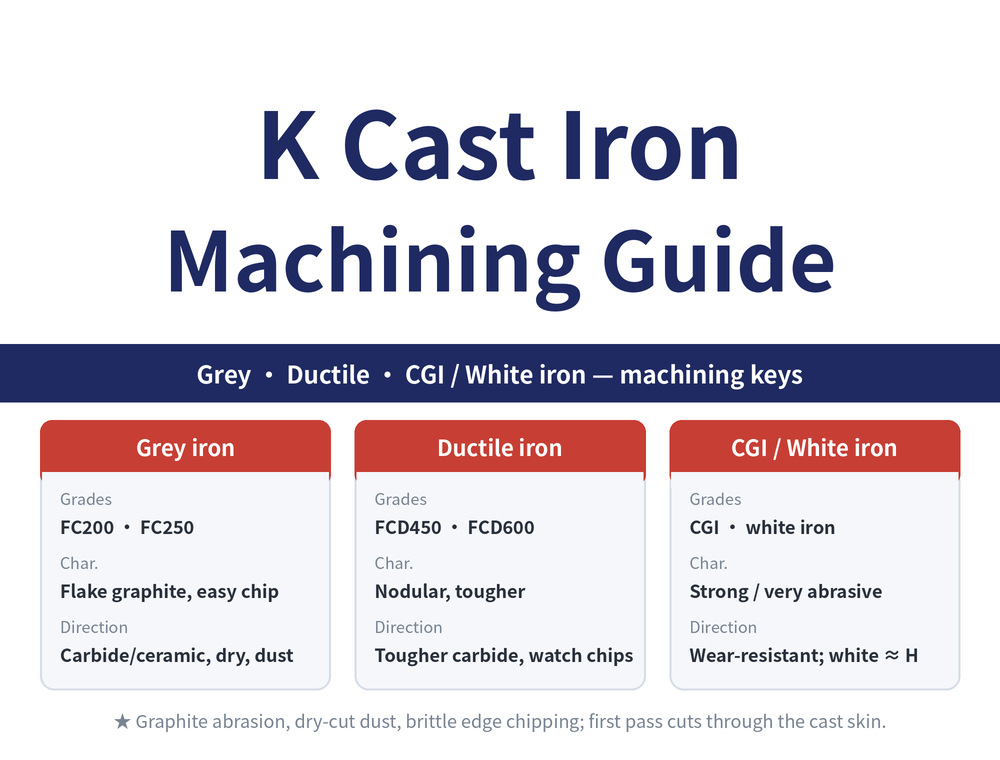
Cast-iron types and machinability
| Type | Representative grades | Graphite form / characteristics | Main challenge | Tool / direction |
|---|---|---|---|---|
| Grey iron | FC200, FC250 | Flake graphite, easy chipping, damping, good conductivity | Graphite abrasion, dust, brittle edge chipping | Carbide/ceramic, often dry, wear coating, dust extraction |
| Ductile iron | FCD450, FCD600 | Nodular graphite, tougher, higher strength | Longer chips, still abrasive | Tougher carbide, watch chip control, AlCrN |
| Compacted graphite (CGI) | engine blocks, etc. | Between grey/ductile, high strength | Highly abrasive, harder to cut | Wear-resistant tool, lower vc, stable cooling |
| White iron | white, high-carbide | High hardness, very abrasive | Very hard to cut | CBN/ceramic, light cuts, near group H |
In practice grey iron is the most common and easiest (good chipping, dry-cuttable); ductile iron is tougher and stronger with longer chips, needing chip control and more force; CGI is abrasive and harder; white iron is essentially a hard material, machined like group H.
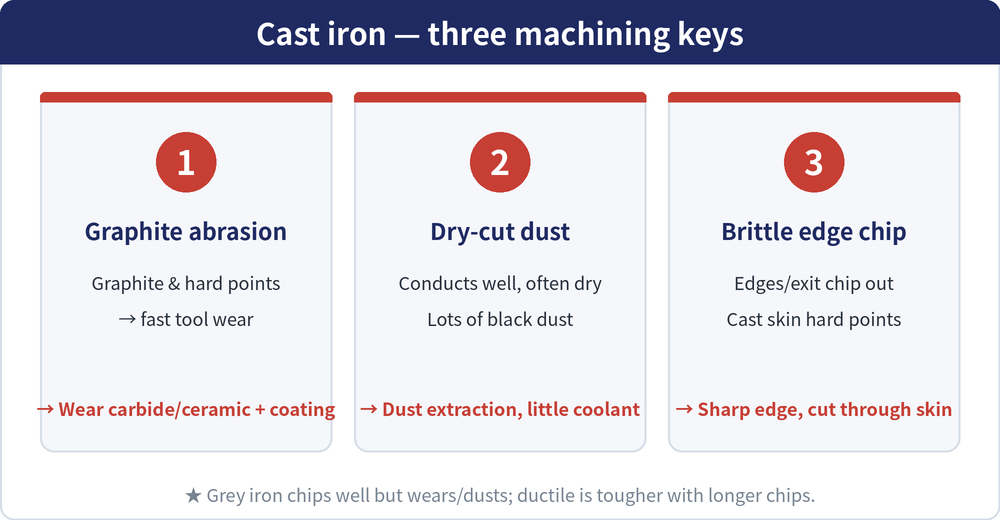
Three machining keys for cast iron
| Item | Description |
|---|---|
| Graphite abrasion | graphite, silicon and casting hard points/sand make cast iron abrasive and shorten tool life — use wear-resistant carbide or ceramic with a wear coating. |
| Dry-cut dust | grey iron conducts heat well and chips finely, so it is often cut dry (adding coolant turns iron powder into slurry that hinders evacuation), but it raises a lot of black dust — use dust extraction and protection. |
| Brittle edge chipping | cast iron is brittle, so edges and exits chip easily; use a sharp edge, climb milling and controlled exit to reduce it. |
| Cast skin hard points | the cast skin often holds sand, scale and hard points — make the first pass deep enough to cut through the skin, never rubbing lightly on it. |
Tool grade and coating direction
For grey iron, turning often uses ceramic or CBN (fast, wear-resistant) and milling mostly uses carbide + wear coating (TiAlN/AlCrN); ductile iron is tougher, so pick a tougher carbide and watch chip control; white iron and hard CGI are handled with CBN/ceramic and light, fast cuts. For full grade and coating selection, see "Cutting Tool Material Classification."
Key cutting strategy
| Item | Description |
|---|---|
| First pass | cut deep enough to pass through the cast skin's hard points; never rub lightly on the skin. |
| Coolant | grey iron is mostly cut dry with dust extraction; ductile iron or finishing may use coolant as needed. |
| Strategy | prefer climb milling and control the exit to reduce chipping; for interrupted cuts choose a tougher coating to avoid edge chipping. |
| For specific vc/fz values, see "End Mill Cutting-Conditions Calculation Guide." | |
Turning: why the first cut on cast iron must go under the skin
Grey iron itself turns easily. The trouble is the hard casting skin, the dust and the local heat at the edge: the chips are fragments, but force and heat concentrate on the cutting edge.
| Item | What to do |
|---|---|
| What goes wrong | With too shallow a cut the nose keeps scraping skin and sand inclusions and breaks; fragments and dust get into the machine slideways |
| Choosing the tool | K-grade carbide; for high-speed finishing consider ceramic inserts, using black ceramic for interrupted cuts or harder iron |
| Starting conditions | Start from row K in section 6 of the cutting conditions guide; on rough castings take as deep a cut as machine power allows, getting under the skin in one pass |
| Coolant and chips | Grey iron is mostly turned dry with dust extraction; clear the fragments so they do not wear the machine |
| Common problems | Nose chipping: first check for a shallow cut scraping the skin. Build-up on the flank with ductile iron: increase the clearance angle |
For chip-curling tools on brittle materials see Turning Copper and Brittle Materials: Washer Tools, Chip-Breaking and Chip-Curling Corrugated Edges; for cutting conditions see Turning Cutting Conditions Guide: Speed, Feed & Tool Life; for wear patterns see Tool Wear Guide: Chipping, BUE & Thermal Crack Solutions.
Milling: why cast iron edges break out and inserts crack
Cast-iron chips come off in fragments, so evacuation is rarely the problem. The trouble is brittleness and thermal shock: an edge without support breaks away, and an insert that heats and cools on every cut cracks.
| Item | What to do |
|---|---|
| What goes wrong | Workpiece edges break out at the exit; thermal cracks on the insert; graphite and casting skin wear the flank fast |
| Choosing the cutter | Strong negative inserts that can be used on both sides; fine pitch suits short chips; consider CBN for high-speed production |
| Starting conditions | Use the cast-iron row of the calculation guide; slotting depth can be twice the steel value because the fragments do not pack |
| Coolant and chips | Mostly dry: coolant in interrupted cutting heats and cools the insert in turn, and coated inserts crack |
| Common problems | Exit breakout: offset the cutter centre into the work, slow the feed or add support at the exit. Fast flank wear: move to a more wear-resistant grade |
For where to place the cutter centre see Milling Entry, Exit and Engagement: The Hidden Cause of Chipping; for exit burrs see Face Milling Troubleshooting: Symptoms, Causes and Fixes; for when CBN dry milling pays see Dry Milling by Material: Cast Iron, Steel, Aluminium and Stainless Strategies. Speed and feed conversions are in End Mill Cutting Conditions Guide.
Drilling: why cast iron wears drills and breaks out at the exit
Cast-iron chips come off as powder, which should be easy to clear. The trouble is that the powder gets between the margins and the hole wall and grinds the drill like an abrasive; add hard spots in the casting skin and breakout at the exit, and the keys above all show up inside the hole.
| Item | What to do |
|---|---|
| What goes wrong | Powder chips wear the margins and outer corners; hard spots and sand holes chip the edge or push the hole off line; breakout at the exit |
| Choosing the drill | Double point angle to protect the outer corners; keep the edge sharp and the chisel edge short; with a drill jig, a point without a chisel edge can be used |
| Starting conditions | Low speed and high feed so the drill gets through quickly; for HSS drills in cast iron up to 200 HB, feed is about twice that for mild steel of the same diameter (typical range), approaching steel values as hardness rises |
| Coolant and chips | Gray iron is usually drilled without cutting fluid, for the same reason it is cut dry; in deep holes the powder will not clear, so retract to clear it |
| Common problems | Outer corners wear fast: use a double point angle. Exit breakout: reduce feed before breakthrough. Hole off line: check for hard skin, spot the entry first |
Feed varies with diameter and hardness; follow the drill catalog. For conversions see Drilling Parameters Guide; for when to reduce feed at the exit see The Moment a Drill Breaks Through; for point grinds see Drill Point Types by Material and Hole.
Tapping: why cast iron can only take a cutting tap
Cast iron has little ductility: under a form tap it does not flow into a thread, it crumbles, so form taps are out. With a cutting tap the trouble is powdery chips and tap wear.
| Item | What to do |
|---|---|
| What goes wrong | Powdery chips jam the flutes; the tap wears fast, and a worn tap leaves the thread undersize |
| Choosing the tap | Grey iron: mainly straight-flute taps, the strongest type and suited to short chips; ductile iron can also take spiral-flute or spiral-point taps |
| Starting conditions | Grey iron about 12-17 m/min with straight-flute taps and 15-25 m/min with carbide taps (typical range) |
| Oil and chips | Carbide taps can run dry in grey iron, or with light oil or water-soluble fluid; in blind holes make sure the powder clears |
| Common problems | Thread undersize, gauge will not go: check tap wear, switch to a nitrided tap or an oversize-class tap |
For the difference between the two tap types see Cutting Tap vs Forming Tap; for nitriding and coatings see Tap Surface Treatment Guide; for hole sizes see Metric Tap Drill Size Chart; for RPM conversion see Tap Cutting Speed Guide.
FAQ
Can cast iron be cut dry?
Grey iron is often cut dry — it conducts heat well and chips finely, and adding coolant turns iron powder into a slurry that hinders chip evacuation. But dry cutting raises a lot of dust, so dust extraction and protection are essential. Ductile iron or finishing may use coolant as needed.
Why does cast iron wear tools so much?
Cast iron contains graphite, silicon and casting hard points/sand, making it abrasive and shortening tool life. Use wear-resistant carbide or ceramic/CBN with a wear coating, and cut the first pass through the cast skin's hard points to reduce wear. For the causes and remedies of chilled, high-chromium and high-silicon irons, see Machining Difficult Cast Irons.
How does machining grey iron differ from ductile iron?
Grey iron chips well and is dry-cuttable but brittle and edge-chip-prone, with clear graphite abrasion and dust; ductile iron is tougher and stronger with longer chips, needing chip control and handling higher cutting force — use a tougher tool.
Why do casting edges/exits chip out?
Cast iron is brittle, so material at the exit lacks support and chips easily. Use a sharp edge, prefer climb milling, lower the feed at the exit and watch the cast skin's hard points to reduce chipping.
For the full reading guides on this topic, see Tool Life and Wear: A Complete Reading Guide and Chip Control: A Complete Reading Guide.
This article is part of Workpiece Materials: The Complete Guide - Name the Metal First, Then Match the Tool; that guide shows how the whole topic fits together.
Further reading
Published: 2026-06-24 | Last updated: 2026-10-21









