
Tool Steel Machining Guide: Cold-Work, Hot-Work and High-Speed
Tool steel splits into three families — cold-work, hot-work and high-speed — and the difficulty is that it cuts fine when annealed but demands a different method once quenched to high hardness. Read the three families and the heat-treatment state, and you know when plain carbide is enough and when only CBN (cubic boron nitride) or grinding will do.
1. First, sort the three families of tool steel
Tool steel splits by use into cold-work, hot-work and high-speed; starting from "what it is for" is faster than memorising grades.
| Family | Representative grades (JIS≈AISI) | Character | Typical uses |
|---|---|---|---|
| Cold-work tool steel | SKD11≈D2, SKS3 | High carbon, high chromium, wear-resistant, dimensionally stable | Stamping dies, shear blades, forming dies |
| Hot-work tool steel | SKD61≈H13, SKD6≈H11 | Medium carbon, medium alloy, tough, thermal-fatigue resistant | Die-casting dies, forging dies, extrusion dies |
| High-speed steel | SKH51≈M2, SKH9 | High alloy, high carbide content, wear- and heat-resistant | Mostly the cutting tools themselves (end mills, drills, taps) |
Grades and the JIS≈AISI pairings are typical values; "≈" is a classification match, not identical chemistry — defer to the standard or catalogue. For the workpiece grouping see the ISO workpiece material classification.
2. Why tool steel is hard to machine: carbide wear plus high hardness
Tool steel is hard to machine for two reasons: alloy carbides abrade the edge, and heat treatment raises the hardness.
Annealed (typically about HB 200–250) it still cuts, but the hard carbides formed by high chromium, tungsten and molybdenum keep wearing the cutting edge. After quenching it is harder still — as workpiece hardness after quench and temper, cold-work reaches HRC 58–62 and high-speed steel HRC 63–66 typically — where plain carbide no longer bites and both material and method must change.
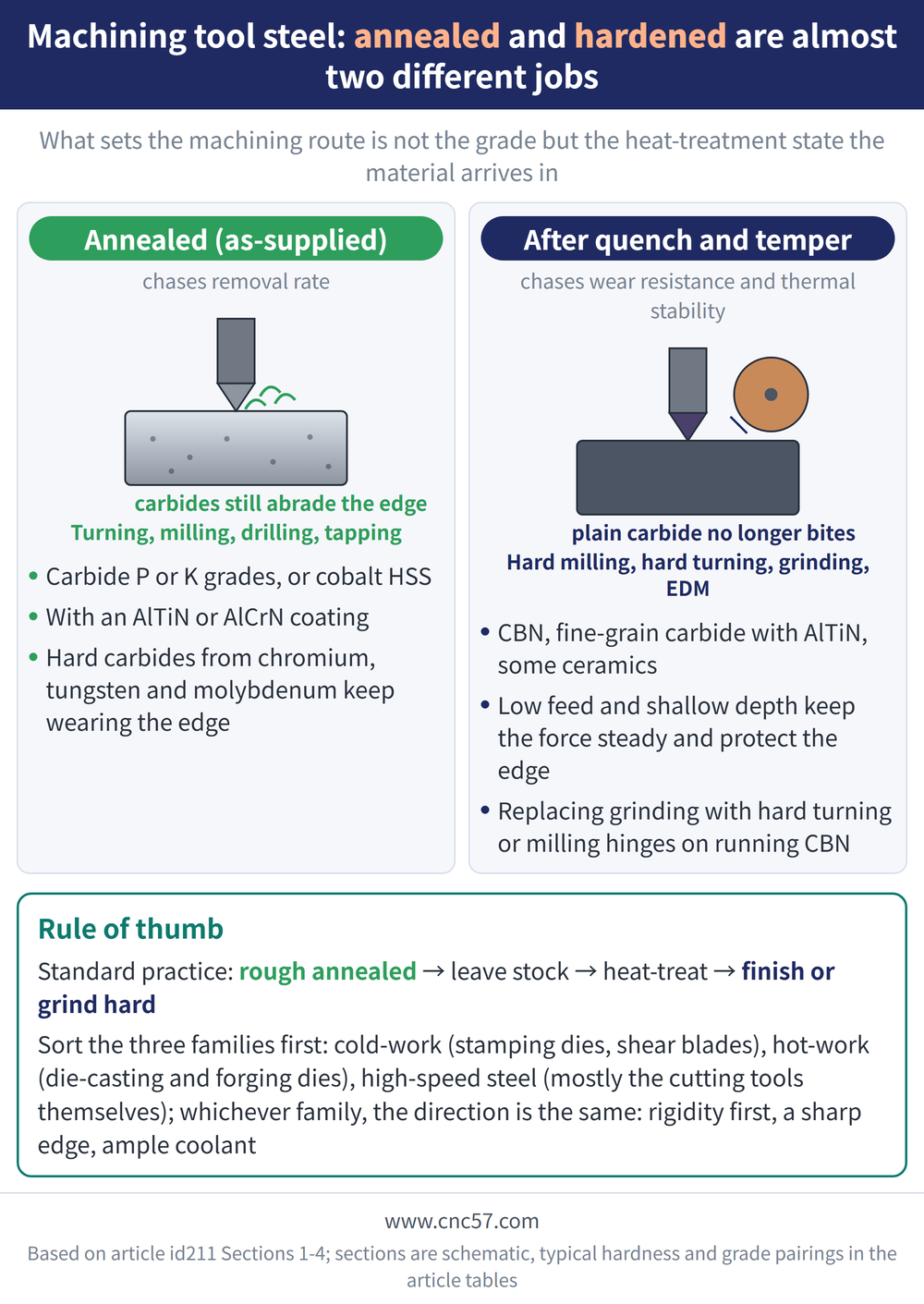
On the same tool steel, annealed and quenched are almost two different jobs: one chases removal rate, the other chases tool wear resistance and thermal stability.
Hardness figures are typical values; defer to the standard or catalogue, as they vary with grade, batch and heat-treatment condition. For matching hardness to tools see hardness and tool selection.
3. The key is heat-treatment state: the annealed versus hardened route
What sets the machining route is not the grade but the heat-treatment state the material arrives in.
| State | Typical hardness | Machining method | Tool material and coating direction |
|---|---|---|---|
| Annealed (as-supplied) | HB 200–250 | Turning, milling, drilling and tapping all workable | Carbide P/K grades or cobalt HSS + AlTiN/AlCrN coating |
| After quench and temper | HRC 55–65 | Hard milling / hard turning, or grinding and EDM | CBN, fine-grain carbide + AlTiN, some ceramics |
Hardness figures are typical values; defer to the standard or catalogue.
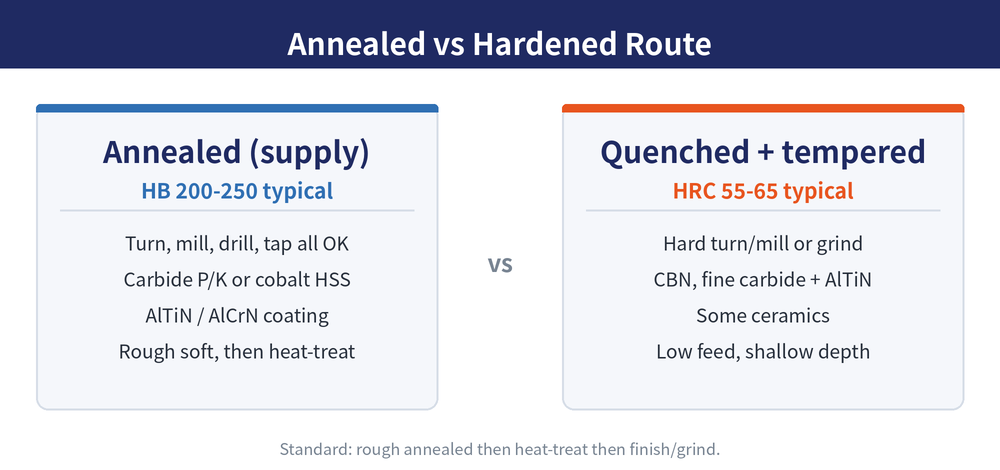
The standard practice: rough in the annealed state → leave stock → heat treat → finish or grind. After quenching this is hardened-steel machining; for method see the hardened-steel machining guide, and for annealed steel in general the P-group steel machining guide. Tool steel overlaps heavily with mold parts; for families and hardness grades see the die and mold steel machining guide.
4. Cutting strategy: the broad direction
Whichever family, the direction is the same: rigidity first, a sharp edge, ample coolant. Carbide wear is high, so a dulled edge chips; weak holding or machine rigidity lets the tool deflect.
As hardness rises the strategy shifts to low feed and shallow depth of cut to keep cutting force steady and protect the edge; replacing grinding with hard turning or hard milling hinges on running CBN. Specific cutting speed (vc) and feed per tooth (fz) should not be borrowed as blanket values — compute them from the tool, grade and state, per the end mill cutting conditions guide. For matching tool material and coating to the workpiece see material and coating selection by workpiece.
vc/fz are not given as specific values; defer to the tool catalogue and actual trials.
Last updated: 2026-10-25
5. Frequently Asked Questions (FAQ)
Q: What is the difference between SKD11 and SKH, and what is each for?
SKD11 (≈D2) is a cold-work tool steel — high carbon, high chromium, wear-resistant — used mostly for stamping dies and shear blades; SKH (high-speed steel, e.g. SKH51≈M2) is high-alloy and heat-resistant, used mostly for the cutting tools themselves such as end mills, drills and taps. Grade pairings are typical values; defer to the standard or catalogue.
Q: Does tool steel have to be heat treated before machining?
No. The standard practice is to rough in the annealed state leaving stock, then heat treat, and finish or grind last, which lowers the amount of hard machining and the distortion risk after quenching.
Q: At HRC60 after quenching, can it still be milled with carbide?
For small-stock finishing, fine-grain carbide with an AlTiN coating works, paired with low-feed, shallow-depth hard milling; for larger removal or tighter demands, switch to CBN, some ceramics, or move to grinding and EDM.
Q: Are tool steel and mold steel the same thing?
They overlap but are not identical. Tool steel is a use-based umbrella term (cold-work, hot-work, high-speed); mold steel is the subset meant for molds. Many grades are shared (such as SKD11 and SKD61) and the machining logic is common.
This article is part of Workpiece Materials: The Complete Guide - Name the Metal First, Then Match the Tool; that guide shows how the whole topic fits together.









