
P Steel Machining Guide: Carbon, Alloy & Mold Steel
Group P (steel) is the broadest and most commonly machined workpiece group in ISO 513, covering carbon steel, alloy steel (quenched-and-tempered / carburized / nitrided), and mould and alloy tool steels in the annealed or pre-hardened state. Its hardness range is huge, from soft-and-sticky low-carbon steel to high-strength Q&T steel: annealed/pre-hardened cuts easily, but once hardened (HRC45+) it moves to group H — the same steel is often "dual-listed" by hardness state. This guide covers common grades and tool-selection direction; for the overview see "ISO Workpiece Material Classification."
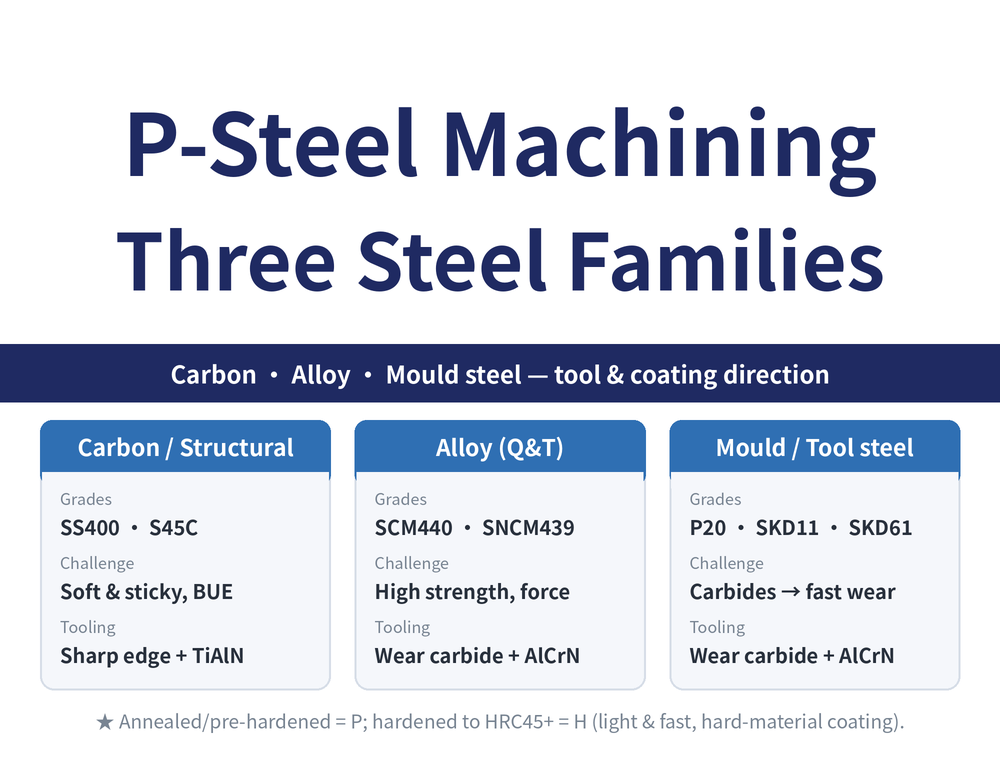
What group P covers
| Item | Description |
|---|---|
| Carbon / structural steel | low-carbon SS400 and sections, medium-carbon S45C. |
| Alloy steel (Q&T / carburizing / nitriding) | Cr-Mo Q&T steel SCM440 (≈4140), Ni-Cr-Mo high-strength steel SNCM439 (≈4340), carburizing SCM415/420, nitriding steel SACM645. |
| Mould / alloy tool steel (annealed or pre-hardened) | pre-hardened P20, cold-work SKD11/DC53, hot-work SKD61/DHA-WORLD, stainless mould steel Stavax, plus the alloy tool ("oil") steels. After hardening (HRC45+) they move to group H. |
Machining challenges
| Item | Description |
|---|---|
| Soft steel sticks | low-carbon steel and the soft pre-treatment state of carburizing/nitriding steels are ductile and prone to built-up edge (BUE) and burrs. |
| High cutting force on Q&T alloy steel | SCM440 and SNCM439 are high-strength, so tool load and heat are significant. |
| Tool/mould-steel wear | chromium- and vanadium-carbide content (SKD11, DC53) wears tools quickly. |
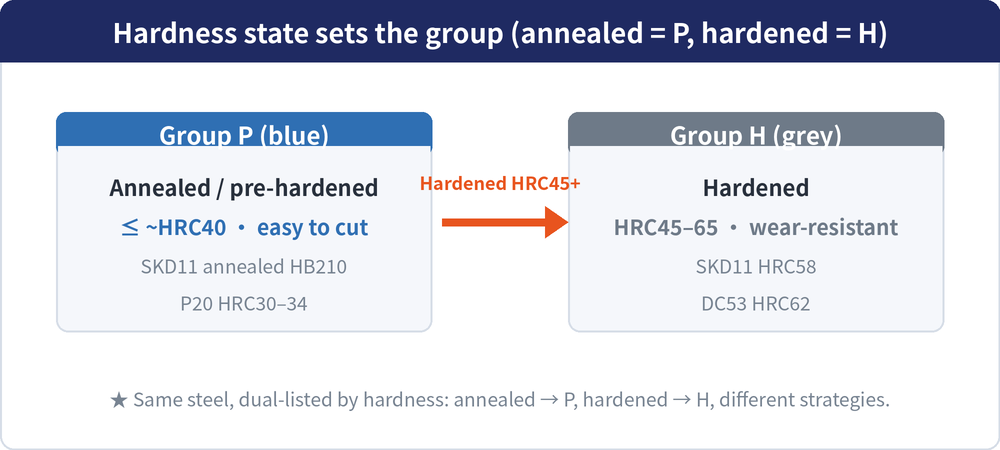
Annealed = P, hardened = H: dual-listing by hardness state
In the annealed / pre-hardened state a steel is low in hardness and easy to cut — group P; once hardened to HRC45+ its hardness jumps and it moves to group H, needing wear-resistant tools, light-and-fast cutting and dedicated hard-material coatings. When choosing tools, consider both "material family" and "current hardness state."
Representative grade reference (machined in annealed/as-supplied state)
| Grade | Type | Typical hardness (as machined) | Main challenge | Tool / coating direction |
|---|---|---|---|---|
| SS400 / sections | Low-carbon structural | ~HB120–160 | Soft & sticky, BUE, burrs | Sharp edge, TiAlN, ample coolant |
| S45C | Medium-carbon | ~HB170–200 | General, slightly sticky | General carbide/HSS, TiN/TiAlN |
| SCM440 (≈4140) | Cr-Mo Q&T alloy | ~HB280–320 | High strength, high force | Wear-resistant carbide, AlCrN |
| SNCM439 (≈4340) | Ni-Cr-Mo high-strength | ~HB290–340 | Even higher strength, more heat | Wear carbide, AlCrN, lower vc |
| SCM415 / 420 | Carburizing Cr-Mo | Pre-carburizing ~HB150–200 | Soft before carburizing; hard surface after | General tool before; see group H after carburizing |
| SACM645 | Nitriding steel | Pre-nitriding ~HB250–300 | Q&T hardness before; hard case after nitriding | Wear tool before; case sees group H after |
| P20 / 718 | Pre-hardened plastic-mould | ~HRC30–34 (pre-hardened) | Machinable as-is; free-cutting (S-bearing) grades cut well | Carbide, AlCrN |
| SKD11 / DC53 ★ | Cold-work mould (annealed) | ~HB210–250 | High Cr/V carbides → fast wear | Wear-resistant carbide + AlCrN |
| SKD61 / DHA-WORLD ★ | Hot-work mould (annealed) | ~HB200 | Tough, sticky | Carbide, TiAlN |
| Stavax ★ | Stainless mould (annealed) | ~HB190 | Corrosion-resistant, slightly sticky (stainless) | Sharp carbide, AlCrN |
| Alloy tool / oil steel ★ | Alloy tool steel (annealed) | Annealed ~HB200 | Carbide content → wear | Wear-resistant carbide, AlCrN |
★ Once hardened to HRC45+ these become group H, with a different strategy (light-and-fast, hard-material coatings) — see the "H Hardened Steel" article; the same steel is dual-listed by hardness state.
More on alloy steels (common in practice)
Alloy steels are group P's most common high-strength family: SCM440 (≈4140) and SNCM439 (≈4340) are usually supplied Q&T, high-strength and high-force, needing wear-resistant tools, AlCrN coating and a moderately lower cutting speed. Carburizing steels (SCM415/420) and nitriding steel (SACM645) are soft "before surface hardening" and machined as group P; finishing the hard surface layer afterwards belongs to group H. Alloy tool/oil steels and cold/hot-work mould steels follow the same logic: annealed = P, hardened = H.
Challenges and countermeasures
Adjust tools and parameters by steel type and hardness state: soft steel — focus on BUE control; Q&T alloy steel — control cutting force; tool/mould steel — focus on wear resistance.
Tool grade and coating direction
General carbon steel can use carbide or HSS with TiN/TiAlN; for Q&T alloy steel and tool/mould steel, use a wear-resistant carbide with AlCrN/nano coating. For full grade and coating selection, see "Cutting Tool Material Classification."
Key cutting strategy
| Item | Description |
|---|---|
| Cutting speed | the harder the material, the lower the speed; soft steel can run faster to suppress BUE. |
| Coolant | ample coolant on soft steel reduces adhesion; on alloy/mould steel balance heat removal and tool life. |
| Strategy | prefer climb milling; for higher hardness reduce depth of cut and raise rigidity. For specific vc/fz values, see "End Mill Cutting-Conditions Calculation Guide." |
Turning: break the chip first, and slow down as hardness rises
Steel turns into long continuous chips. Get the chip to break first, then set cutting speed by hardness. Quenched-and-tempered high-strength steel cuts with high force and loads the tool nose heavily.
| Item | What to do |
|---|---|
| What goes wrong | Long chips wrap around the part and holder; high-strength steel breaks chips even less readily, and crater wear on the rake face leads to chipping |
| Choosing the tool | P-grade carbide for carbon and alloy steel; a tougher grade for grooving and other interrupted cuts |
| Starting conditions | Start from row P in section 6 of the cutting conditions guide; slow down clearly for quenched-and-tempered high-strength steel compared with ordinary carbon steel |
| Coolant and chips | Emulsion coolant is the usual choice; chip breaking comes from matching the chipbreaker to the feed |
| Common problems | Chips too long: raise feed or depth of cut, or change the chipbreaker. Crater wear: change the grade and lower speed first |
For matching the chipbreaker see Turning Chip Control Guide: Chip Breaker & Cutting Conditions; for speed, feed and tool life see Turning Cutting Conditions Guide: Speed, Feed & Tool Life. Once the steel is hardened above HRC 45, read Hard Turning Guide: Replacing Grinding at HRC45–65 instead.
Milling: from carbon steel to mold steel, choose by hardness first
Within group P, mild steel, quenched-and-tempered alloy steel and annealed mold steel give different milling problems. Find the row for the current hardness in the calculation guide first, then decide flute count and helix.
| Item | What to do |
|---|---|
| What goes wrong | Mild steel builds up edge and burrs; the harder the steel, the heavier the edge load, with chipping and crater wear |
| Choosing the cutter | Mostly four flutes, standard or low helix for steel; low helix and high rigidity as hardness rises |
| Starting conditions | The calculation guide splits steel into general structural, carbon, alloy, mold and high-hardness steel; pick the row by hardness |
| Coolant and chips | Face milling of steel is usually wet; ample coolant on mild steel reduces sticking |
| Common problems | Crater wear: lower speed, raise feed, use a sharper chip breaker. Fast flank wear: move to a more wear-resistant grade |
For flute count and helix see End Mill Flute Count and Helix Angle: How to Choose. For mold steel start with Three Steps for Mold Milling Tool Selection: Application, Geometry, Grade, In That Order, then check Die and Mold Steel Machining Guide: Six Families, Hardness Grades and Tool Choice. For why SKD11 wants climb milling see Climb Milling vs Conventional Milling. Speed and feed conversions are in End Mill Cutting Conditions Guide.
FAQ
What does group P include?
Carbon steel (S45C/SS400), alloy steel (SCM440, SNCM439, carburizing and nitriding steels), and annealed/pre-hardened mould and alloy tool steels (P20, SKD11/DC53, SKD61, Stavax, alloy tool/oil steels). Once hardened to high hardness they move to group H.
Which alloy steels are common in practice?
Most common are Cr-Mo Q&T steel SCM440 (≈4140) and Ni-Cr-Mo steel SNCM439 (≈4340); also carburizing SCM415/420 and nitriding steel SACM645. Q&T steels are high-strength and need wear-resistant tools, AlCrN and a moderately lower speed.
Are mould steels (SKD11, DC53, P20…) group P or H?
It depends on the current hardness state. Annealed/pre-hardened (e.g. P20, annealed SKD11) is group P; hardened (HRC45+, e.g. SKD11 HRC58, DC53 HRC62) is group H. The same steel is dual-listed by state.
Why does soft steel (SS400) stick and form burrs?
Low-carbon steel is highly ductile and prone to built-up edge. A sharp cutting edge, TiAlN coating, ample coolant and a moderately higher cutting speed improve it.
This article is part of Workpiece Materials: The Complete Guide - Name the Metal First, Then Match the Tool; that guide shows how the whole topic fits together.
Further reading
Published: 2026-06-24 | Last updated: 2026-10-20









