
H-Group Hardened Steel Machining Guide: Hard Milling
Hardened steel is ISO 513's group H (insert colour: grey), driven by hardness state — typically HRC45–65 quenched/heat-treated steel, such as hardened SKD11, DC53 and SKD61, plus bearing steel SUJ2 and powder high-speed steels. It is hard, high-strength, high in cutting force, prone to tool wear and chipping, and runs hot at the tip, though chips are short and brittle. Today it is largely hard-milled directly on quenched parts, partly replacing EDM and grinding. This guide covers tool-selection direction for the hardened-steel types; for the overview see "ISO Workpiece Material Classification."
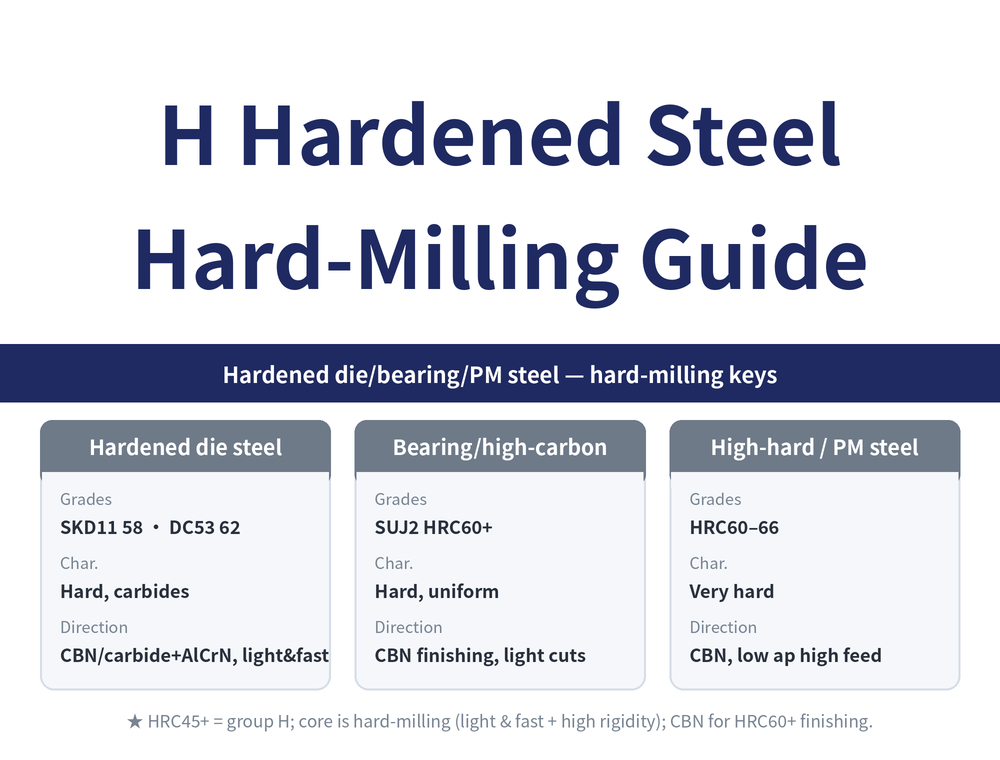
Hardened-steel types and machinability
| Type | Representative grades / hardness | Characteristics | Main challenge | Tool / direction |
|---|---|---|---|---|
| Hardened cold-work die steel | SKD11 HRC58–62, DC53 HRC62 | Hard, Cr/V carbides | Fast wear, chipping, high force | CBN / fine-grain carbide + AlCrN, light & fast |
| Hardened hot-work die steel | SKD61 HRC48–52 | Tough, hard, heat-resistant | High force, heat | Fine-grain carbide + AlCrN/nano, high rigidity |
| Bearing / high-carbon steel | SUJ2 HRC60+ | Hard, uniform structure | Wear, chipping | CBN finishing, light cuts |
| Powder HSS / high-hard die steel | HRC60–66 | Very hard, wear-resistant | Extreme wear, very hard to cut | CBN, low ap high feed, high rigidity |
The common logic: the harder the steel, the smaller the load per tooth. HRC45–55 is mostly hard-milled with fine-grain carbide + AlCrN/nano coating; for HRC58 and above, especially finishing, CBN (cubic boron nitride) is the first choice. Note: the same steel is group P and easy to cut when annealed, and only moves to group H after hardening (see the dual-listing in the "P-Steel Machining Guide").
A sprayed or fused alloy overlay on the surface is just as hard to cut once it passes HRC50, but it cannot be cut like hardened steel: choose carbide with high thermal conductivity, the opposite of the hardened-steel choice. See Machining Thermal Spray Coatings.
Three hard-milling keys for hardened steel
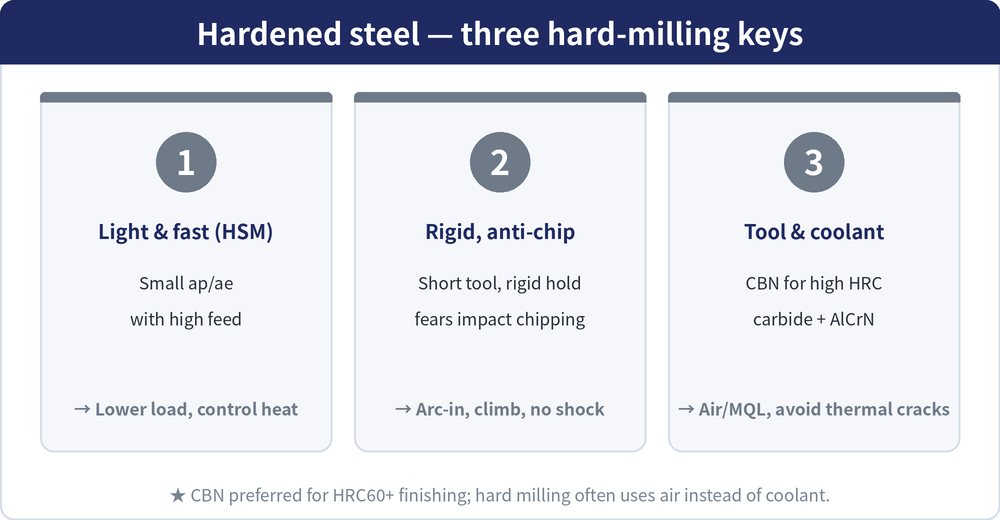
| Item | Description |
|---|---|
| Light & fast (HSM) | use a high-speed strategy of small depths (ap/ae) + high feed to lower the load per tooth and heat build-up, protecting the edge and extending life. |
| Rigidity & anti-chipping | hardened steel fears impact chipping — use a short tool, shrink-fit holder and rigid machine, and reduce shock with arc-in entry, climb milling and no sudden heavy cuts. |
| Tool & coolant | for high HRC (especially HRC60+ finishing) use CBN; for medium hardness use fine-grain carbide with AlCrN/nano heat-resistant coating. Hard milling often replaces coolant with air/MQL to avoid thermal shock cracking the CBN/coating. |
Tool grade and coating direction
Medium hardness (HRC45–55) mainly uses fine-grain carbide + AlCrN/nano coating; high hardness (HRC58+, especially finishing) prefers CBN for heat and wear resistance and edge retention. Rough out leaving an even stock for finishing; finish with light, fast paths and constant edge engagement. For full grade and coating selection, see "Cutting Tool Material Classification."
Key cutting strategy
| Item | Description |
|---|---|
| Light & fast | small ap/ae, high feed and high rpm to lower load per tooth and heat. |
| High rigidity, low shock | short overhang, rigid fixturing, arc-in entry and climb milling to avoid chipping. |
| Coolant | hard milling mostly uses air/MQL to avoid thermal-shock cracking; adjust per tooling system. |
| For specific vc/fz values, see "End Mill Cutting-Conditions Calculation Guide." | |
Turning: can you still turn after hardening? What hard turning needs
Hardened steel cuts with more force than before hardening, but it has little ductility and hardly sticks. With the right tool and conditions it can be turned to a finish close to grinding.
| Item | What to do |
|---|---|
| What goes wrong | A positive-rake carbide tool chips almost as soon as it cuts; the radial force is high, so a machine short on rigidity chatters |
| Choosing the tool | CBN or ceramic inserts for finishing; negative rake and negative inclination, with a nose radius that is not too large |
| Starting conditions | Small depth of cut and small feed; hardness decides the cutting speed, so the harder the part, the slower |
| Coolant and chips | CBN is mostly run dry; if coolant is used it must flow steadily, or thermal shock cracks the edge |
| Common problems | Edge chipping: check that the rake is negative and the nose is strengthened. A white layer on the surface: see the hard turning guide |
For the full method see Hard Turning Guide: Replacing Grinding at HRC45–65; for how much it actually saves see How Much Does Hard Turning Actually Save: Twelve Quantified Cases; for regrinding CBN turning tools see Regrinding CBN Turning Tools: Never Along the Rake Face, Flank Meets the Wheel First.
Drilling: why the drill chips so fast once the steel is hardened
When drilling, the whole drill is buried in the hole and its edges are loaded the entire time, and hardened steel is both hard and strong, so the cutting edges and chisel edge chip first. Most of the hard-milling tactics above do not carry over into the hole.
| Item | Approach |
|---|---|
| What goes wrong | Cutting force far above the unhardened state, high edge heat; fast wear, chipped edges |
| Choosing the drill | Solid carbide or indexable, not replaceable-head; large point angle, small helix, thick web |
| Starting conditions | Very low cutting speed and small feed; see the table below |
| Coolant and chips | Neat (non-water-soluble) cutting oil, never interrupted; the opposite of hard milling |
| Common problems | Edge chipping: lower the entry feed, use a shorter drill, check spindle runout; vibration: smaller helix |
| Carbide drill, about 50 HRC | Cutting speed | Feed |
|---|---|---|
| Drill dia. 5–10 mm | 8–10 m/min | 0.01–0.04 mm/rev |
| Drill dia. 11–30 mm | 8–12 m/min | 0.02–0.06 mm/rev |
These are typical ranges for rigid parts. As hardness rises further, bring the feed down with it, to roughly 0.025 mm/rev at 55 HRC and 0.02 mm/rev at 64 HRC. Follow the drill catalog in practice; for conversions see Drilling Parameters Guide; for the three carbide drill types see How to Choose a Carbide Drill Bit, and for a precision-drilling example in hard material see 3-Flute Drill Guide. When a hardened part needs a precision hole, the process route is in Machining Route Selection.
Tapping: can you still tap after hardening?
Yes, but with a different tap. Hardened steel is both hard and strong, so wear and thread chipping are far worse than before hardening; above about 45HRC the chips break into powder, and once they pack the flutes the tap breaks.
| Item | What to do |
|---|---|
| What goes wrong | Fast tap wear and chipped threads; at 45-55HRC chips turn to powder and jam if evacuation is poor |
| Choosing the tap | From about 40HRC general-purpose taps struggle, so use a tap made for heat-treated steel; spiral-flute taps reach only about 45HRC |
| Hole and starting conditions | With a carbide tap the thread engagement can drop to about 50%, opening the hole slightly to cut the load; take the speed from the tap catalog |
| Oil and chips | A fluid with good lubricity and enough flow; a carbide tap short of lubrication tends to weld and chip |
| Common problems | Carbide tap chipping: check machine vibration and spindle runout, use a rigid holder. Tap will not cut: switch to thread milling |
For using carbide taps see the Carbide Tap Guide; for choosing the holder see Tool Holders for Tapping; for thread milling see the Thread Milling Guide.
FAQ
How hard is "group H"?
Generally HRC45 and above after quenching/heat treatment (commonly HRC45–65). The same steel is group P and easy to cut when annealed, and only becomes group H after hardening — with a completely different strategy.
Carbide or CBN for hardened steel?
HRC45–55 is mostly hard-milled with fine-grain carbide + AlCrN/nano coating; for HRC58 and above, especially finishing, CBN (cubic boron nitride) is the first choice for heat/wear resistance and edge retention.
Should I use coolant for hard milling?
Hard milling often uses air or MQL instead of coolant. On quenched parts, the thermal shock from coolant (rapid heating/cooling) can micro-crack and chip CBN or coatings, so dry/air is common — adjust per the tooling system's recommendation.
Can hard milling replace EDM or grinding?
In many mould applications it partly can — hard-milling quenched parts directly saves EDM and some grinding steps and shortens lead time. But it demands high machine and clamping rigidity and the right tooling/paths (light & fast), so the whole setup must be matched for stability. Which shapes can switch to hard milling, and the three conditions to meet first, are covered in Hard Milling or EDM.
This article is part of Workpiece Materials: The Complete Guide - Name the Metal First, Then Match the Tool; that guide shows how the whole topic fits together.
Further reading
Published: 2026-06-24 | Last updated: 2026-10-21









