
ISO Turning Insert Guide: CNMG Designation & Selection
The ISO turning-insert standard uses a coded designation (e.g. CNMG, DNMG) that combines shape, clearance, tolerance, hole type and chipbreaker into one code, letting users quickly judge performance and application. This guide covers shape codes, clearance, tolerance, nose radius, size and chipbreaker to help precise selection and raise efficiency and quality.
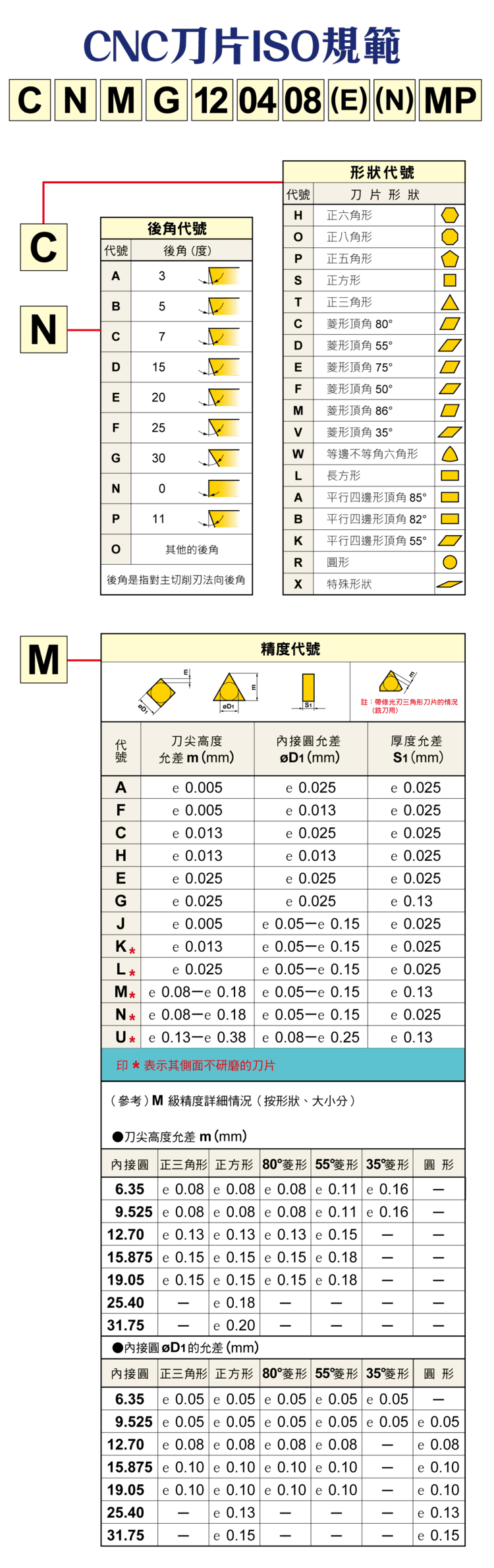
1. Insert Designation Structure
A standard code (e.g. CNMG) reads: 1st letter shape, 2nd clearance angle, 3rd tolerance class, 4th hole type and chipbreaker. It quickly identifies insert traits and standardises global use.
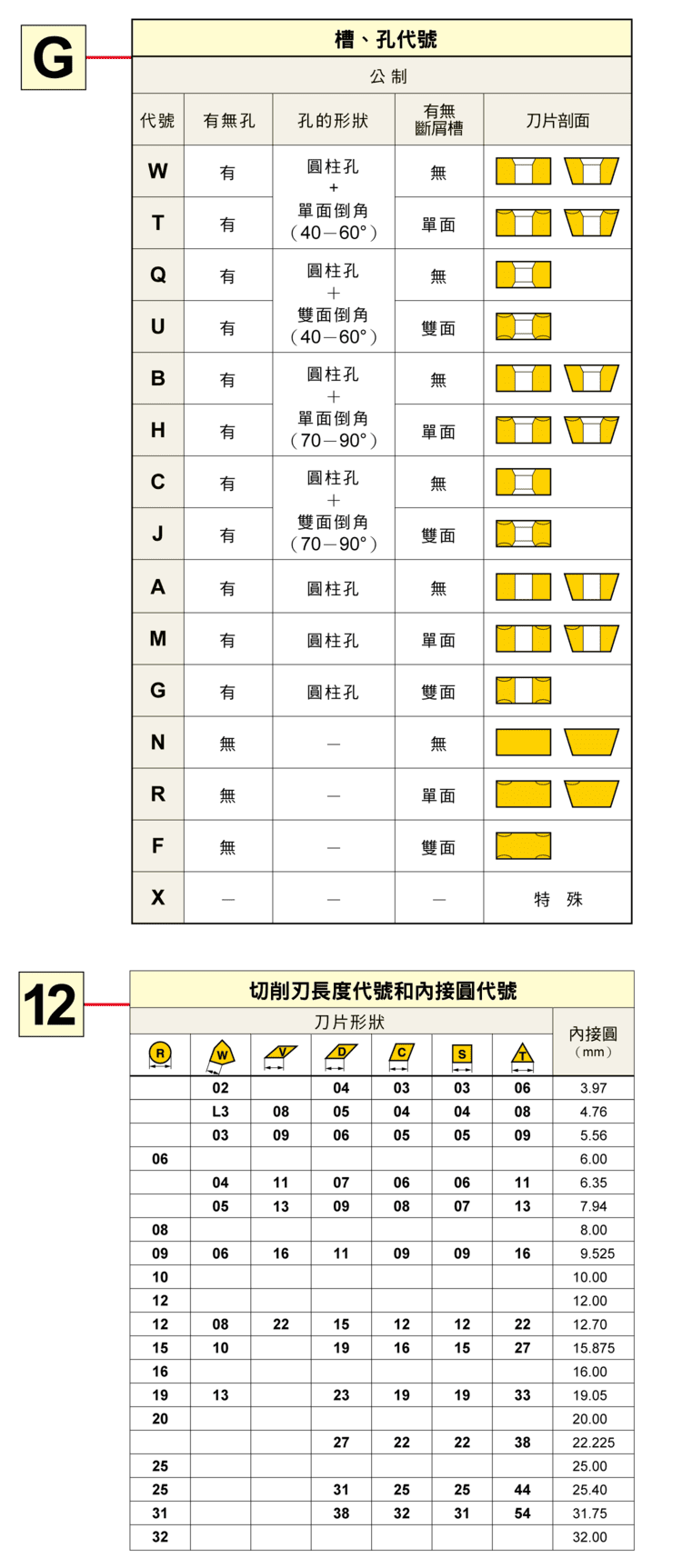
Insert designations only apply to indexable tools; for solid, brazed and clamped tools and what each is for, see Types of Turning Tools.
2. Shape and Clearance Codes
| Code | Shape | Trait |
|---|---|---|
| C | 80° rhombic | Strong and versatile |
| D | 55° rhombic | For profiling / multi-angle |
| T | Triangle | More edges |
| S | Square | High strength |
| R | Round | Heavy cut / profiling |
| V | 35° rhombic | Smallest nose angle, for profiling; lowest nose strength |
| W | 80° trigon | 80° nose angle with as many edges as a triangle |
Shape affects strength, usable edges and approach angle. Clearance codes: N=0° (none), C=7°, P=11°; small clearance is rigid, large clearance lowers cutting resistance.
3. Tolerance Class
Common M (general) and higher-precision classes (e.g. G) affect dimensional stability and machining accuracy. Finishing or tight tolerances need a higher class.
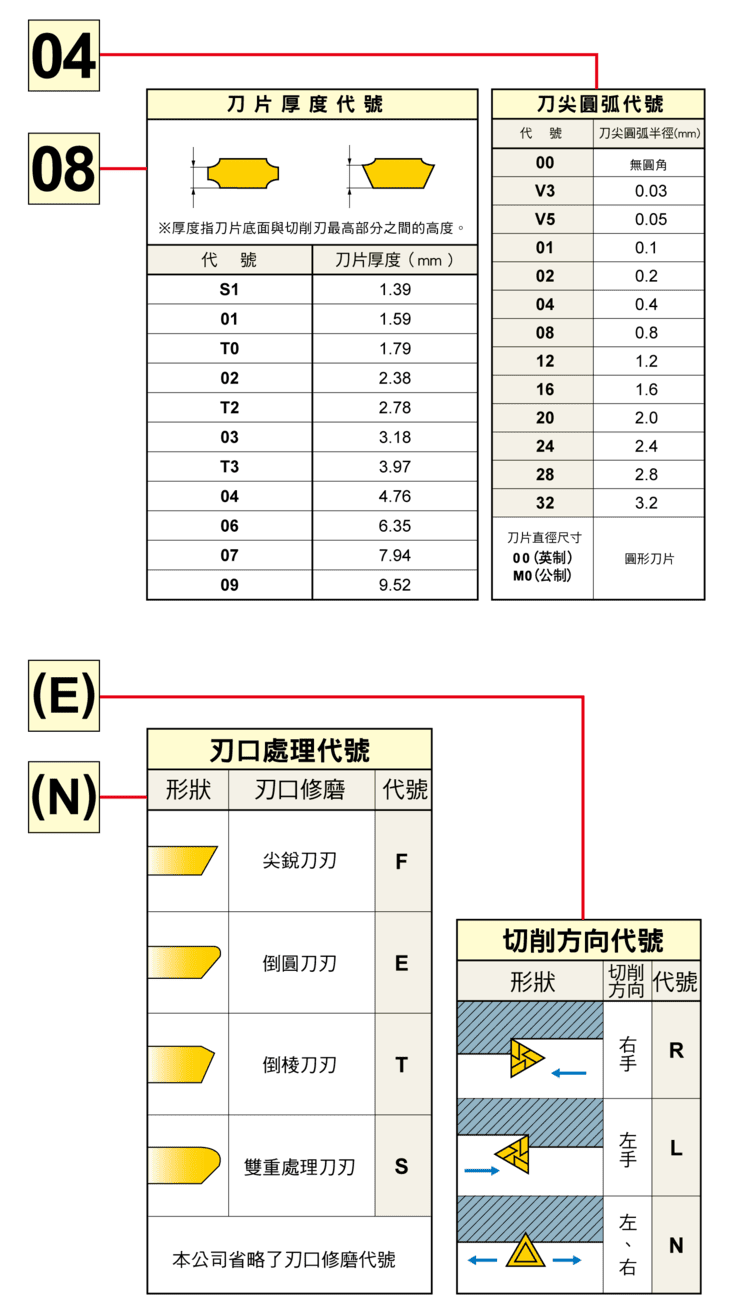
4. Hole, Chipbreaker and Nose Radius
Inserts are with/without hole and single/double-sided, with various chipbreakers (MP, GH, FV, etc.) to control chip shape and evacuation. Nose radius (Nose Radius) is commonly 0.2, 0.4, 0.8, 1.2 mm:
| Nose radius | Effect and choice |
|---|---|
| Small (0.2/0.4) | Low force, for finishing |
| Large (0.8/1.2) | Strong tip, for roughing |
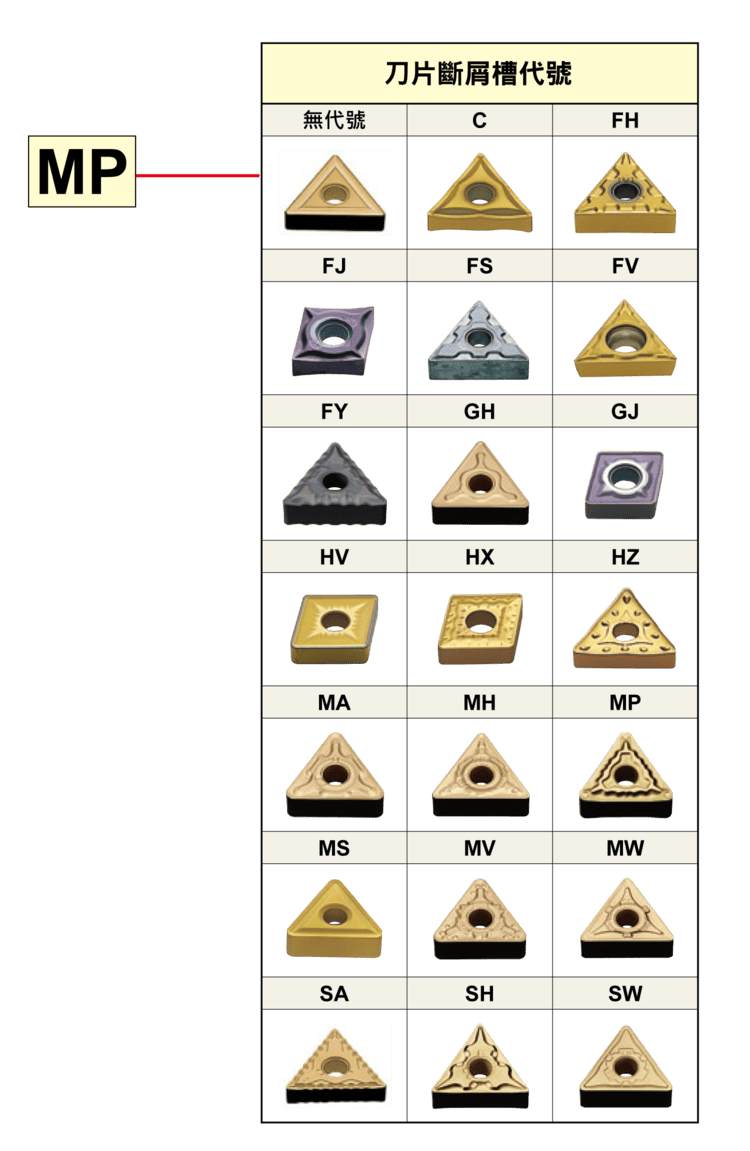
5. Size, Chipbreaker and ISO Advantages
Key size parameters are inscribed circle (IC), thickness (S) and nose-height tolerance, affecting rigidity and stability. Chipbreakers like MP are general-purpose; roughing or hard-to-cut materials often use negative-rake inserts with wear-resistant grades. ISO standardisation gives a global spec, easy substitution and selection, and better procurement — suited to CNC turning, molds and automotive/aerospace parts. For coding and angle detail see the Turning Tool Rake & Clearance Guide.
6. The Digits After the Letters: Edge Length, Thickness and Nose Radius
The six digits after CNMG come in three pairs. Taking CNMG120408 as the example:
| Position | Meaning | How to read it | Example |
|---|---|---|---|
| 5th | Cutting edge length | Edge length as a whole number, with a leading 0 for single digits | 12.70 mm → 12 |
| 6th | Insert thickness | Thickness as a whole number, with a leading 0 for single digits | 4.76 mm → 04 |
| 7th | Nose radius | Radius times 10; 00 for a sharp corner or a round insert | 0.8 mm → 08 |
When selecting, the insert edge should be longer than 1.5 times the edge length actually in cut, and a thicker insert suits larger feeds and depths. For choosing the nose radius see the Turning Tool Nose Radius Guide: Surface Finish & Tool Life.
FAQ
Q: What does CNMG mean?
In order: C = 80° rhombic (shape), N = 0° clearance, M = general tolerance class, G = hole type and chipbreaker (double-sided with hole); following digits give size, thickness and nose radius. One code identifies the insert at a glance.
Q: How to choose insert shape?
For strength and versatility pick C (80° rhombic) or S (square); for profiling and multi-angle pick D (55°); for more edges and economy pick T (triangle); for heavy cutting or large R pick R (round). Judge by strength, usable edges and approach angle.
Q: How large a nose radius?
Finishing uses a small radius (0.2/0.4) to lower force and chatter; roughing uses a large radius (0.8/1.2) for tip strength and depth capacity. R also affects theoretical roughness, so consider it with feed.
Q: Single vs double-sided insert?
Double-sided inserts have edges on both faces — more edges and more economical, usually negative type; single-sided allows positive rake for light cutting, ideal for finishing and soft material. Choose by operation and cost.
For the full reading guides on this topic, see Insert Selection: A Complete Reading Guide and Chip Control: A Complete Reading Guide.
For the full reading guide on this topic, see Turning: The Complete Guide.
Published: 2026-03-24 | Last updated: 2026-10-20









