
Types of Turning Tools: Eight by Application, Four by Construction, and How to Face and Turn the OD
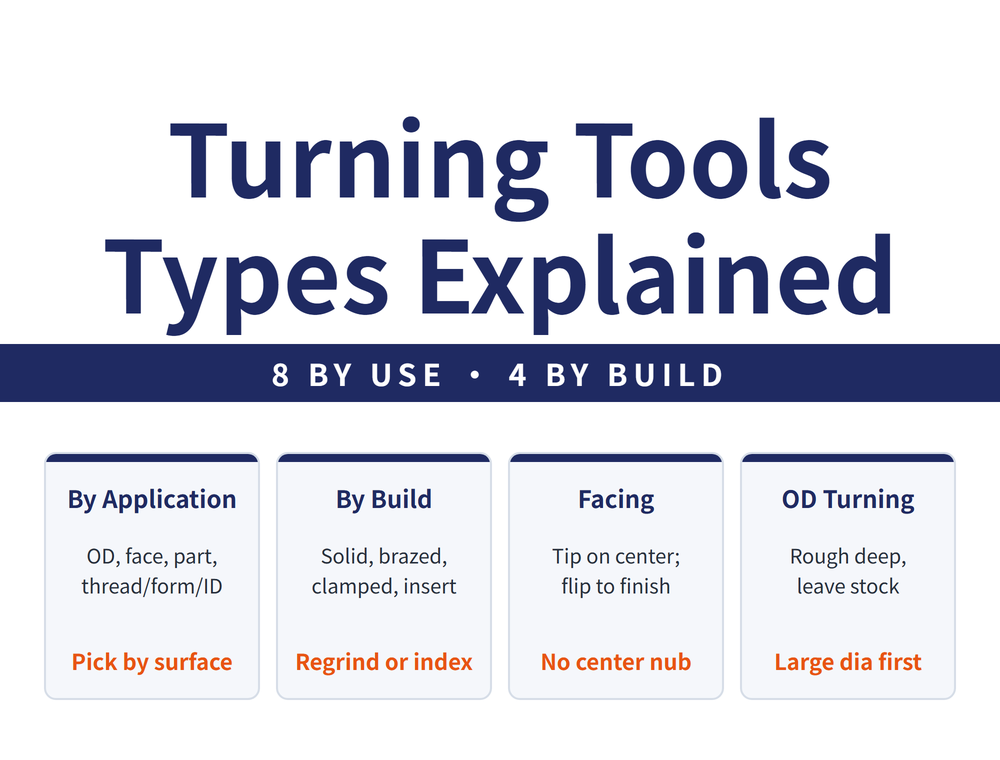
Turning tools are grouped two ways. By application there are eight: right-hand, left-hand, round-nose, facing, parting, threading, form and boring tools, chosen by the surface you turn. By construction there are four: solid, brazed, clamped and indexable, which differ in how the edge is held and whether a dull edge is reground or replaced. For facing, set the tip on the work center or a small nub is left at the center; for OD roughing, take deep cuts and leave about 0.2-0.8 mm for finishing.
1. By application: what each of the eight tools turns
Start from the surface you need to turn, then pick the tool.
| Tool | Used for |
|---|---|
| Right-hand tool | Edge faces left; OD turning feeding from right to left |
| Left-hand tool | Edge faces right; OD turning feeding from left to right |
| Round-nose tool | Radiused edge, feeds either way; tapers and radii, light roughing only |
| Facing tool | Faces and shoulders |
| Parting tool | Parting off and grooving |
| Threading tool | Threads, commonly 60° V and trapezoidal |
| Form tool | Simple curved forms |
| Boring tool | Enlarging bores to size; also internal threading and internal grooving tools |
For parting and grooving tools see How to Select Parting and Grooving Tools: Three Methods and a Process; for threading inserts see Choosing a Thread Turning Insert: Full Profile, Partial Profile or Multi-Tooth, Then Geometry and Infeed; for form tools see Form Turning Tools: Flat, Prismatic or Circular, and How to Choose Material, Rake, Clearance and Chatter Control.
2. OD tools by entering angle: 45°, 75°, 90°
All of them turn the OD, but the entering angle changes what each is good at:
| Tool | Features | Best for |
|---|---|---|
| 45° bent tool | Strong tip; turns OD, faces and chamfers | Plain shafts without shoulders |
| 75° heavy-duty tool | Strong head that takes heavy impact | Roughing large stock, hard skin or irregular blanks |
| 90° side tool | Faces and shoulders; turns the OD without pushing the part out of line | Faces, shoulders, slender shafts |
For turning slender shafts see Turning Slender Shafts: Steady Rest or Follow Rest, Plus an Elastic Center and a Large Entering Angle.
3. By construction: solid, brazed, clamped, indexable
The four constructions differ in how the cutting edge is held and whether a dull edge is reground or replaced.
| Construction | Where the edge comes from | Best for |
|---|---|---|
| Solid | One piece of high-speed steel; easy to sharpen, stiff | Small tools and non-ferrous work |
| Brazed | Carbide tip brazed to the shank and reground when dull; when the tip is ground short or comes off, the shank is scrapped with it | All kinds of tools, especially small ones |
| Clamped | Tip held by a clamp or wedge and still reground; the shank is reused | Large tools, threading and parting tools |
| Indexable | Index or replace the insert for a fresh edge, no regrinding | CNC lathes and automated lines |
The weak point of brazed tools is that tip and shank expand differently with heat, so brazing leaves internal stress and cracks; clamped and indexable tools were developed to avoid this. Indexable tools have limits too: very small tools are still often solid or brazed. For regrinding brazed tools see How to Regrind a Turning Tool: Six Steps for HSS, Seven for Carbide, and the Brazed-Tool Sequence; for reading indexable insert codes see ISO Turning Insert Guide: CNMG Designation & Selection.
4. Facing: tip on center, roughing and finishing in opposite directions
Facing is usually the first cut: it gives the datum face for later turning and measuring, and spares the tool an uneven impact when cutting starts.
| Item | How |
|---|---|
| Tip height | On the work center; too high or too low leaves a small nub at the center of the face |
| Setting angle | 3°-5° clearance between the side cutting edge and the face, tool point angle under 85° |
| Roughing | Feed from the outside towards the center |
| Finishing | Cut the clearance to 2°-5° and feed from the center outwards |
| Near the center | Set spindle speed from the outer diameter and slow the feed as you near the center |
For facing, tapers, threads, forms and parting solid stock, always set the tip on the work center.
5. OD turning: roughing removes stock, finishing holds size
OD turning is normally split into roughing and finishing:
| Item | Roughing | Finishing |
|---|---|---|
| Purpose | Remove as much stock as possible | Reach drawing size and surface finish |
| Depth and feed | Large depth, larger feed | Small depth, small feed |
| Stock | Leave about 0.2-0.8 mm for finishing | Depth of cut mostly 0.2-0.4 mm |
| Spindle speed | Lower | Higher |
| Tool | With a side cutting edge angle to spread the cutting load | Side cutting edge angle 0°, end cutting edge angle 5°-10°, edge honed with a stone |
Two common mistakes: one division on the cross-slide dial is a radius amount, so the diameter changes by twice that; and on stepped shafts turn the large diameter before the small one. For splitting the depth of cut see Turning Depth of Cut and Finish Allowance: One Pass or Two?; for shoulder turning see Shoulder Turning: Corner Types, the Reversed Rough and Finish Sequence, and Finish Allowance.
FAQ
Q: What types of turning tools are there?
By application: right-hand, left-hand, round-nose, facing, parting, threading, form and boring tools. By construction: solid, brazed, clamped and indexable.
Q: Brazed or indexable turning tool: what is the difference?
A brazed tool has a carbide tip brazed to the shank and is reground when dull; when the tip is ground short or comes off, the shank is scrapped too. An indexable insert is simply indexed or replaced with no regrinding, which suits CNC lathes.
Q: Why is there a nub at the center of a faced end?
The tool tip is not on the work center. Too high or too low, either way leaves a small nub; set the tip at center height.
Q: How much stock should OD roughing leave for finishing?
Usually about 0.2-0.8 mm, with finishing cuts mostly 0.2-0.4 mm; adjust for material and surface requirements.
Last updated: 2026-10-20
For the full reading guide on this topic, see Turning: The Complete Guide.









