
Why Internal Grinding Is the Hardest: Get the Wheel and the Quill Right First
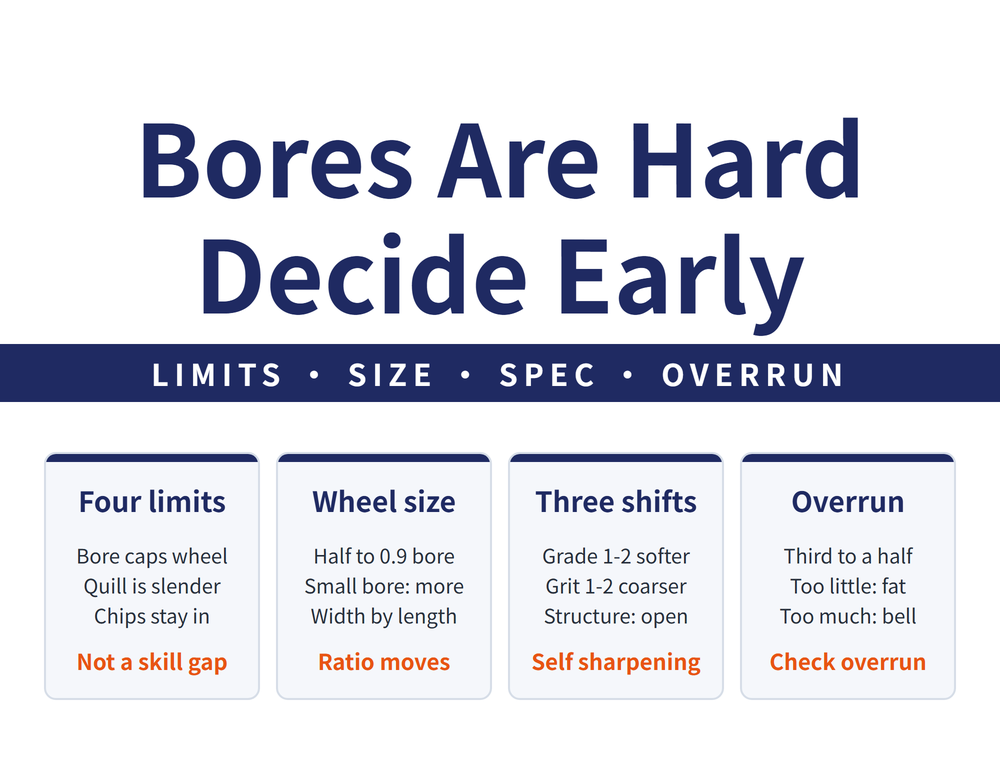
With the same machine and the same operator, a bore is still harder to grind than an outside diameter. The reason is not skill but four built-in limits: the wheel is capped by the bore, surface speed cannot be reached, the quill is slender and flexible, and a half enclosed bore will not clear chips. Those four pull against each other, so internal grinding is largely decided before the machine starts - if wheel size, wheel specification and quill are wrong, no amount of parameter tuning recovers it.
1. Four built-in limits
Accuracy, surface quality and productivity are all lower in internal grinding than in external grinding, for four reasons that feed each other:
| Limit | Consequence |
|---|---|
| Wheel diameter capped by the bore | However fast the spindle runs, surface speed stays below external work |
| Much higher wheel rpm | Each grain cuts more often, so the wheel dulls fast and needs dressing |
| Slender quill, long overhang | Low stiffness, bending and chatter, so parameters must be held down |
| Long arc, half enclosed | Coolant cannot reach the zone: heat, loading and burn |
In wheel and quill selection those four come down to one trade-off: in a small bore, low surface speed and a weak quill are the main problem, so take a larger wheel-to-bore ratio; in a large bore, grinding heat and chip clearance are the main problem, so take a smaller ratio. Keep the quill overhang as short as the job allows. Every table below is a choice within that trade-off.
2. Wheel diameter: 0.5 to 0.9 of bore, but the ratio moves
A larger diameter raises surface speed and lets the quill be thicker and stiffer, but it also lengthens the contact arc, which adds heat, worsens chip clearance and loads the wheel. So the ratio is not fixed:
| Bore | Dominant problem | Ratio |
|---|---|---|
| Smaller bore | Low surface speed, weak quill | Take the larger ratio |
| Larger bore | Heat and chip clearance | Take the smaller ratio |
| Bore mm | Wheel mm | Bore mm | Wheel mm |
|---|---|---|---|
| 12~17 | 10 | 100~125 | 80 |
| 17~22 | 15 | 125~150 | 100 |
| 22~27 | 20 | 150~175 | 125 |
| 27~32 | 25 | 175~250 | 150 |
| 32~45 | 30 | 250~350 | 200 |
| 45~55 | 40 | 350~500 | 250 |
| 55~65 | 50 | 500~750 | 350 |
| 65~80 | 60 | 750~1000 | 450 |
| 80~100 | 70 | — | — |
3. Wheel width: pick it from the ground length
A wider wheel puts more grains in cut, lowers roughness, allows a larger traverse feed and wears more slowly. But grinding force, quill deflection, contact arc and heat all rise with it.
| Ground length mm | ≤14 | ≤30 | ≤45 | >50 |
|---|---|---|---|---|
| Wheel width mm | 10 | 25 | 32 | 40 |
4. Wheel specification: three shifts from external work
Abrasive and bond selection by material follows the same rules as external grinding. The real difference is three corrections, and all three push the same way - make the wheel break down more freely and hold more swarf:
| Item | Versus external | Why |
|---|---|---|
| Grade | 1 to 2 softer | Long arc, poor heat path, must self sharpen |
| Grit | 1 to 2 coarser | More cutting ability, avoids burn |
| Structure | 1 to 2 more open | Holds swarf, delays loading |
Common grits are 36, 46 and 60, and 36 is used most. Straight and single recessed shapes are usual; the recessed shape also grinds the faces of a stepped bore. The one exception: for a long small bore the grade must not be too soft or the bore comes out tapered, so a medium soft grade is normal. For how to read these fields on the wheel marking, see Reading a Grinding Wheel Marking: Abrasive, Grit, Grade, Structure and Bond.
5. The quill: three types and two hard limits
An internal wheel normally mounts on one end of a quill, the other end going into the wheelhead spindle, so changing quills covers different bore sizes and depths.
| Type | Character |
|---|---|
| Male taper | Most common; Morse or 1:20, easy to make and accurate |
| Female taper | For small wheels; the internal taper is hard to make, so it is rare |
| Stepped cylinder | Strong joint, easy to change, resists chatter and deflection |
Two limits cannot be relaxed: taper contact with the spindle must be at least 85%, and concentricity between the diameters and the taper must be within 0.01mm, with no scoring on the taper. The usual material is 40Cr, hardened; below wheel diameter 8mm, CrWMn or W18Cr4V high speed steel is stiffer. Check the hand before dismantling - with the wheel turning counter clockwise, the quill thread is right hand.
6. Two ways of securing the wheel
| Method | Key points |
|---|---|
| Threaded (usual) | Clearance not over 0.2mm; 0.2 to 0.3mm soft washers both faces |
| Adhesive | Common below bore 15mm; leave 0.2 to 0.3mm, ready in 5min |
The threaded method carries two requirements that pull opposite ways: the clamping screw hand must oppose wheel rotation, or grinding force unscrews it; yet it must not be over tightened, or the wheel cracks. Excess clearance can be packed with paper or brass shim - too much clearance makes the wheel run out, dress unevenly and vibrate at speed. For mounting and balancing the wheel itself, see Mounting and Balancing a Grinding Wheel: Fit, Flanges, Two-Stage Balance and Amplitude Check.
7. Overrun: too little and too much fail differently
The quill only needs to be slightly longer than the bore; longer than that and it deflects and chatters. Wheel overrun L1, the amount the wheel passes the bore mouth, is normally one third to one half of wheel width. Both ends of that range fail, and they fail differently:
| Overrun | Bore becomes | Why |
|---|---|---|
| Too little | Small at both ends, fat in the middle | Less time at the mouths, so less stock comes off |
| Too much | Bell mouth | Quill deflection vanishes the instant the wheel exits |
Table stroke L = L' - B + 2L1 (L' = part length, B = wheel width).
When a customer reports a bore that is small at both ends or bell mouthed, it is worth confirming first how the overrun was set. Those two different looking defects correspond to too little and too much overrun, one parameter moved in two directions; overrun is only one of the possible causes, though.
8. Taper correction and the retract order
Correcting a tapered bore depends on the machine. On a universal cylindrical grinder the method matches external work. On a dedicated internal grinder the headstock is what you align, so that its axis of rotation is parallel to table travel.
| Taper form | Turn the headstock | Effect |
|---|---|---|
| Back taper | Clockwise | Removes more at the bore mouth (where the wheel enters) |
| Forward taper | Counter clockwise | Removes more at the chuck end |
Read the movement with an indicator on the chuck body and adjust until it is in tolerance. But not every taper is cured at the headstock: quill deflection, an overrun that was never set, a dull or loaded or unevenly worn wheel, and thermal growth of the part all produce taper, so diagnose before adjusting. Also, when withdrawing the wheel, do not pull straight out along the traverse - retract across first, then along, or you leave a spiral mark and a bell mouth at the right hand end. That is an order of operations, not a parameter, and no parameter table will show it.
9. Frequently Asked Questions (FAQ)
Q: Bore roughness is always worse than my outside diameters. Is that a skill problem?
Usually not. Wheel diameter is capped by the bore, so surface speed simply cannot reach external levels, and the long contact arc plus a half enclosed bore make chip clearance poor. Those four limits are structural. What you can do is size by bore: a larger wheel and quill ratio in small bores, a smaller ratio in large bores to keep heat and chips under control, and the shortest quill overhang the job allows.
Q: Can I use my external grinding wheel specification for bores?
Not recommended. Abrasive and bond follow the same rules, but three things shift: grade 1 to 2 softer, grit 1 to 2 coarser, structure 1 to 2 more open. All three help the wheel self sharpen and hold swarf. The exception is a long small bore, where too soft a grade produces taper.
Q: The bore came out bell mouthed. What do I adjust?
Check whether overrun is too large. With too much overrun, or the wheel fully clearing the mouth, quill deflection disappears the instant it exits and the mouth is over ground. Too little overrun does the opposite and leaves the bore small at both ends. Retracting straight out along the traverse also bells the right hand end.
Q: Which quill type should I buy?
The male taper is the most common, easy to make and accurate enough. Where accuracy matters and changes are frequent, the stepped cylinder gives a stronger joint and resists chatter and deflection. Whichever you pick, two limits hold: taper contact at least 85% and concentricity within 0.01mm.
Whether to use fluid in a bore at all, and which type, depends on bore form and material; for the oil versus water split see Choosing a Grinding Fluid: Oil or Water Based, Five Types and EP Additives. For internal grinding work holding, motions and parameters, see Cylindrical, Internal and Surface Grinding: Workholding, Motions and Grinding Data. Where a hole has to be placed by machine coordinates, the other route is Jig Grinding: Sixteen Ways to Run the Planetary Motion, and the Holes It Is For.
This article is part of Grinding Wheels and Machines: The Complete Guide - Reading the Wheel, Mounting It, Dressing It, and Tracing Defects; that guide shows how the whole topic fits together.
Published: 2026-09-19|Last updated: 2026-10-24









