
Milling Methods Overview: Face, Shoulder, Slot and Profile
Milling splits into several methods by tool path and the surface being cut — face, shoulder, slot and profile milling. Once you know what each one does and which tool it uses, you can tell which method a part needs and which class of tool to pick. This is the entry map to milling.
1. How Milling Is Classified
Milling is classified by the surface or feature produced and by how the tool engages the material. Whether you are cutting a large flat, a square shoulder, a slot or a curved surface decides which method to use.
This article focuses on the four main methods of indexable-insert milling: face, shoulder, slot and profile milling, laying out an entry-level map first.
2. The Four Main Milling Methods
Each method matches one class of surface, with its own typical tools and key point. Locate the job in the table below first, then move on to tool selection.
| Method | What it machines | Typical tools | Key point |
|---|---|---|---|
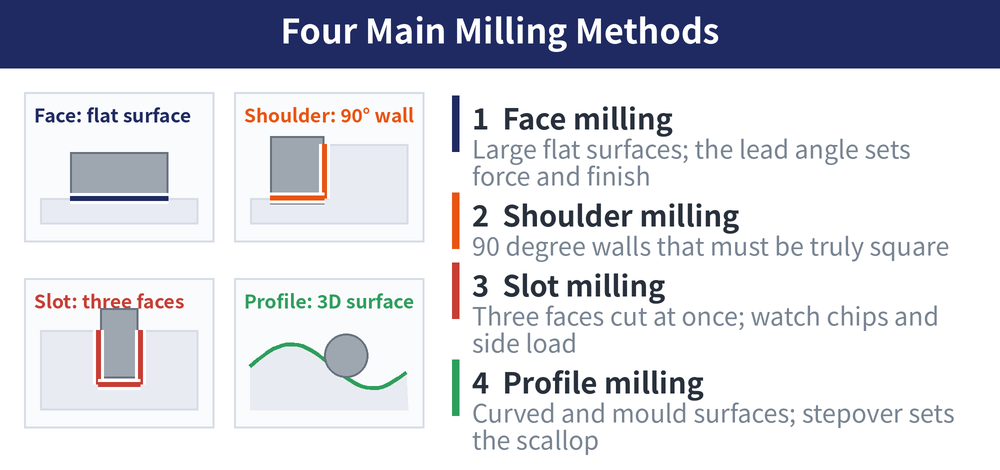
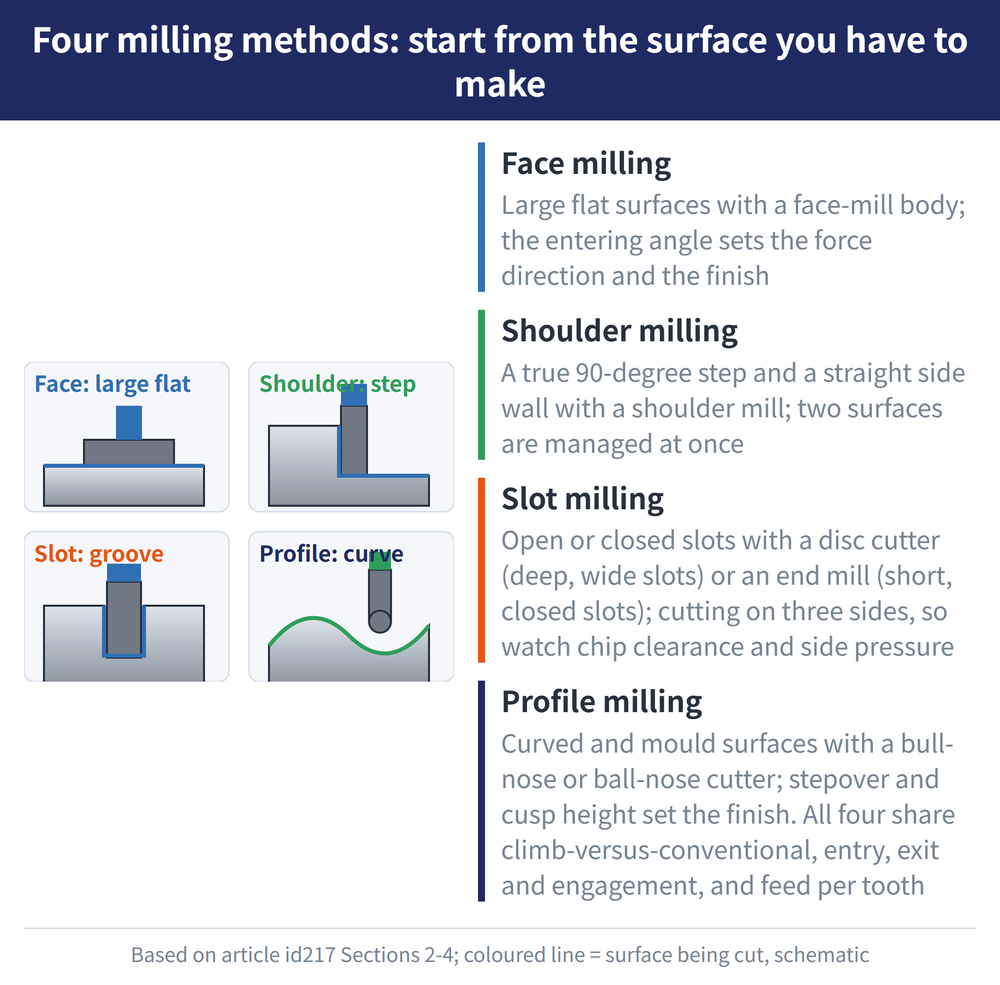
| Face milling | Large flat surfaces | Face mill (cutter body) | Entering angle drives cutting-force direction and finish |
| Shoulder milling | 90° square shoulders and side walls | Shoulder mill | Demands a true 90° and a straight side wall |
| Slot milling | Slots, open or closed | Disc cutter or end mill | Cut on three sides; watch chip evacuation and side load |
| Profile / copy milling | Curved surfaces, mould faces | Bull-nose / ball-nose end mill | Stepover and scallop height decide the finish |
From method to tool: face milling depends on entering angle (commonly 45°, 90° or round inserts); shoulder milling must cut a true 90°; slot milling divides into disc cutters (deep or wide slots) and end mills (short or closed slots); profile milling uses a ball-nose to follow the curve.
3. Choosing the Method
The order is: look at the surface or feature to be made, map it to a method, then select the tool and insert. Large flat means face milling, square shoulder means shoulder milling, slot means slot milling, curved surface means profile milling.
For tool selection, see the Face Milling Tool Selection Guide and Face Milling Geometry Guide; for clamping rigidity, the Face Milling Clamping Guide; for cut direction, Climb Milling vs Conventional Milling.
4. Three Things That Run Through All of Them
Whichever method you use, three things always have to be handled: cut direction (climb or conventional), entry/exit and engagement, and feed per tooth. The method decides which surface you cut; these three decide whether the cut is stable and the finish is good. See Milling Entry, Exit and Engagement: The Hidden Cause of Chipping for details.
| Common factor | Why it matters |
|---|---|
| Cut direction (climb / conventional) | Chip thickness varies in opposite directions, affecting insert load, finish and sensitivity to machine backlash |
| Entry/exit and engagement | The angle and position of tool-workpiece engagement affect impact, edge chipping and chatter |
| Feed per tooth | The material layer removed by one tooth directly governs chip formation, tool load and finish |
For the causes and cures of chatter, see Milling Chatter: Causes and Solutions; for common face-milling faults, the Face Milling Troubleshooting Guide.
Entering angles, insert types and the accuracy each method covers are typical values; confirm against the catalogue or standard. Specific cutting speeds and feeds are not invented here; refer actual figures to the calculation guide.
For cutting speed, feed per tooth and spindle speed calculations, see the End Mill Cutting Conditions Guide, and trim by trial cut according to material, tool and machine conditions.
Last updated: 2026-07-26
5. Frequently Asked Questions (FAQ)
Q: What is the difference between face milling and shoulder milling?
Face milling uses a cutter body on large flats, where flatness and finish matter and a 45° entering angle is common; shoulder milling cuts a 90° square shoulder and a straight side wall, managing both the flat and the wall at once. If you need a square shoulder, choose shoulder milling.
Q: Why is slotting more prone to problems than face milling?
In slotting the tool cuts on three sides and is enclosed by the slot, so the chip path is restricted and side load is high, inviting chip packing, runout and chatter. Deep and closed slots are the worst; watch chip evacuation and tool rigidity.
Q: What can I do about a poor profile-milling finish?
A curved-surface finish is set mainly by stepover (the spacing between adjacent passes) and scallop height: a smaller stepover leaves a lower scallop and a better finish but a longer cycle. Use a ball-nose, reduce the stepover, then trade off efficiency against the required finish.
Q: What should I look at first when choosing a milling method?
Look first at the surface or feature to be machined — a large flat, a square shoulder, a slot or a curved surface — map it to face, shoulder, slot or profile milling, then move on to the tool and insert. Get the method right and tool selection has a direction.
For the full reading guide on this topic, see Insert Selection: A Complete Reading Guide.









