
Solid Carbide, Exchangeable-Head or Indexable End Mill: Check Diameter First, Then Tool Change and Accuracy
Solid carbide, exchangeable-head and indexable end mills differ in what you replace when the tool goes dull: a solid carbide tool is replaced whole or sent for regrinding, an exchangeable-head tool only needs a new head, and an indexable tool only needs new inserts. Check diameter first: indexable tools are limited by insert and screw size and are usually not smaller than 8-10 mm, while most solid carbide end mills stay at or below 25 mm because carbide material cost rises sharply beyond that. In the overlapping range, compare whether a tool change may stop the machine, how much accuracy and edge sharpness you need, and how heavy the cut is.
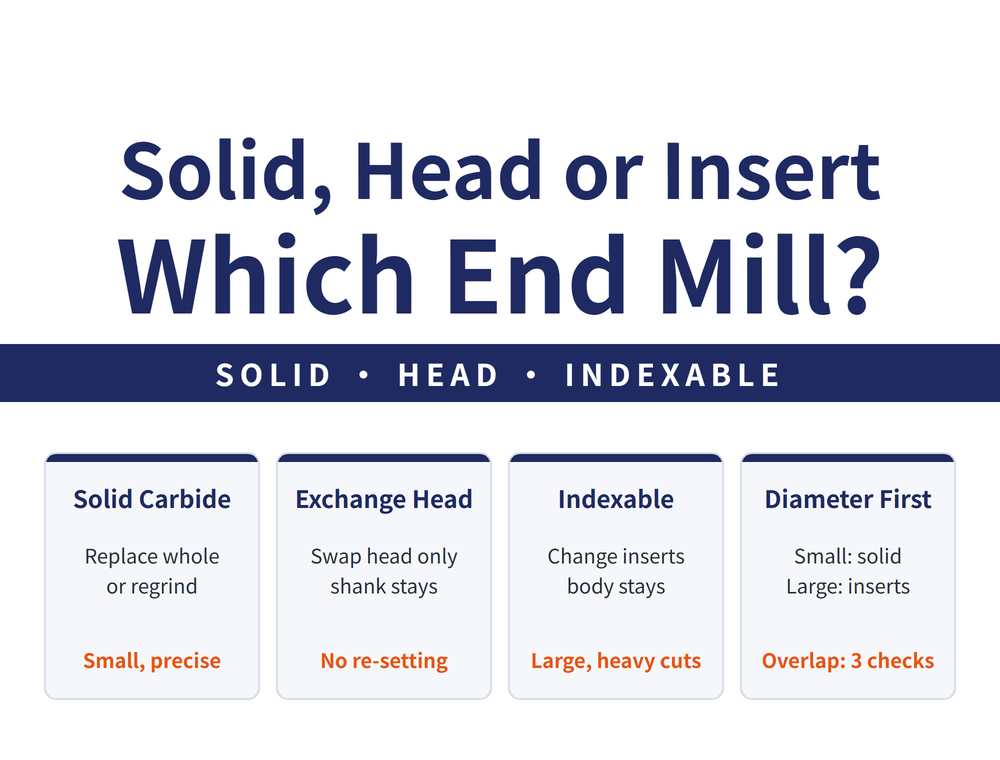
1. What Is Different: Which Part You Replace When It Goes Dull
All three use carbide cutting edges. The difference is whether the edge and the tool body are one piece.
| Type | What you replace | Strength | Cost |
|---|---|---|---|
| Solid carbide | The whole tool, or send it for regrinding | Sharpest edge, highest accuracy, very small diameters | Material cost rises sharply with diameter |
| Exchangeable head | Only the carbide head; the shank stays in the spindle | No tool removal, no new tool setting | Rigidity depends on the connection; lower than solid |
| Indexable | Only the inserts, or index to a fresh edge | Economical at large diameters, handles heavy cuts | Minimum diameter; less sharp, less accurate |
There is no fixed answer to "which is better." Follow the order below: check diameter first, then ask three questions.
2. Check Diameter First: There Is a Limit at Each End
Diameter is the first filter. Both limits come from the tool structure, not from the brand.
| Diameter | Choice | Why |
|---|---|---|
| Small | Solid carbide or exchangeable head | Inserts and screws have a minimum size; indexable is usually not below 8-10 mm |
| Large | Lean toward indexable | Most solid carbide end mills stay at or below 25 mm; beyond that material cost rises sharply |
| Overlapping range | All three exist | Go to the three questions in Section 3 |
Why the small-diameter limit does not move when you change brands is explained step by step in Do You Need an End Mill With Back Taper: When It Pays and When It Is Wasted Money.
3. In the Overlapping Range: Ask Three Questions
When all three can reach the diameter, decide by what matters most to you. A "yes" in a row points to that type.
| Question | If yes, lean toward | Why |
|---|---|---|
| When the tool is dull, do you want to avoid removing it and setting it again? | Exchangeable head | The shank stays in the spindle; machining continues right after the head change |
| Do you need high accuracy, surface finish or edge sharpness? | Solid carbide | Indexable edges are less sharp; copper, aluminum and pure titanium often need extra edge grinding |
| Is the cutting load heavy (large depth of cut, high power)? | Indexable | Heavy cutting is where indexable tools are strong; light, precise cuts favor solid |
Exchangeable-head tools have one more benefit: one shank can take many heads, so you keep less tool inventory. The small-diameter solid limit is also loosening: with high-speed milling toolpaths, small solid tools can now do roughing that used to go mostly to indexable tools. For the cutter shape, see Which Cutter for High-Speed Roughing: Why the Round-Insert (Bull-Nose) Wins. In mold work, evaluate both concepts before deciding; the order is in Three Steps for Mold Milling Tool Selection: Application, Geometry, Grade, In That Order.
4. Exchangeable-Head Rigidity: It Depends on the Connection, Not the Brand
Exchangeable heads are often assumed to be much less rigid than solid tools. How much less depends on how the head is joined to the shank. Manufacturer tests at Ø20 with an overhang of about 3 × diameter:
| Connection | Relative rigidity |
|---|---|
| Solid end mill (reference) | 100% |
| Dual contact: taper and face both seated | About 75% |
| Single contact: thread clamping only | About 57% |
So when you choose an exchangeable head, "dual contact" is not a marketing term; it is a design with a measured difference. How the interface centers and locks is covered in Section 4 of Quick-Change / Modular Tool Holder Systems: Principles, Trade-offs & Inventory Savings.
The longer the overhang, the more you must cut back. The same catalog requires the recommended conditions to be corrected for overhang: at 4 × diameter, cutting speed drops to 80% and width of cut to 70%; at 8 ×, cutting speed is down to 40% and width of cut to only 10%. For overhang length and deflection, see End Mill Length vs Deflection.
5. After It Goes Dull: Solid Carbide Has One More Option, Regrinding
Most worn solid carbide tools can be reground and recoated, but each regrind makes the diameter a little smaller. For every 1% reduction in diameter, tool performance drops by 2-3% on average, and beyond a certain point it falls off sharply; the main reason is that the flutes become shallower, so the tool cuts harder and evacuates chips less well.
For when to send a tool for regrinding, see When to Regrind an End Mill? 5 Signs It's Dull and the Correct Regrinding Process; for how to compare regrinding, outsourcing and buying new, see In-house Regrinding vs. Outsourced Grinding vs. Buying New — Which Is Cheapest?. When you compare the three types, look at the cost per part, not the tool price: the tool is often the one thing that keeps the machine from running faster.
Frequently Asked Questions (FAQ)
Q: What is the difference between solid carbide, exchangeable-head and indexable end mills?
The difference is what you replace when the tool goes dull: a solid carbide tool is replaced whole or reground, an exchangeable-head tool only needs a new head while the shank stays in the spindle, and an indexable tool only needs new inserts.
Q: Can I use an indexable end mill for small diameters?
Usually not. Inserts and their clamping screws have a minimum size, so indexable tools are generally not smaller than 8-10 mm; smaller diameters need solid carbide or an exchangeable head.
Q: How much less rigid is an exchangeable-head end mill than a solid one?
It depends on the connection. In manufacturer tests at Ø20 with about 3 × diameter overhang, a dual-contact (taper plus face) connection reached about 75% of solid rigidity, and a thread-only single-contact connection about 57%.
Q: Why not use solid carbide for large diameters?
Most solid carbide end mills stay at or below 25 mm because the carbide material cost rises sharply beyond that; large diameters and heavy cuts usually go to indexable tools.
Sources: diameter limits, indexable vs solid comparison and performance change after regrinding are based on the ISCAR technical guide; rigidity by connection type and overhang correction for exchangeable heads are based on the Mitsubishi Materials general catalog.
This article belongs to End Mills: The Complete Guide - Know the Cutter, Choose It, Set the Conditions; Toolpaths Are Another Line; see that guide for the reading order of the whole line.
Last updated: 2026-10-19









