Choosing an Abrasive: Match the Grain to Your Workpiece and Problem
Pick the wrong abrasive and at best it will not cut, at worst it heats the part until it discolours. Getting it right comes down to two questions: what material are you grinding, and what problem are you solving. This guide maps the common workpieces and shop situations straight to the grain to reach for, no theory needed.
1. Match the Grain to the Material
The quick way: look at what the part is made of and read straight across. The letter codes are PFERD examples.
| Workpiece material | Reach for this grain | Why |
|---|---|---|
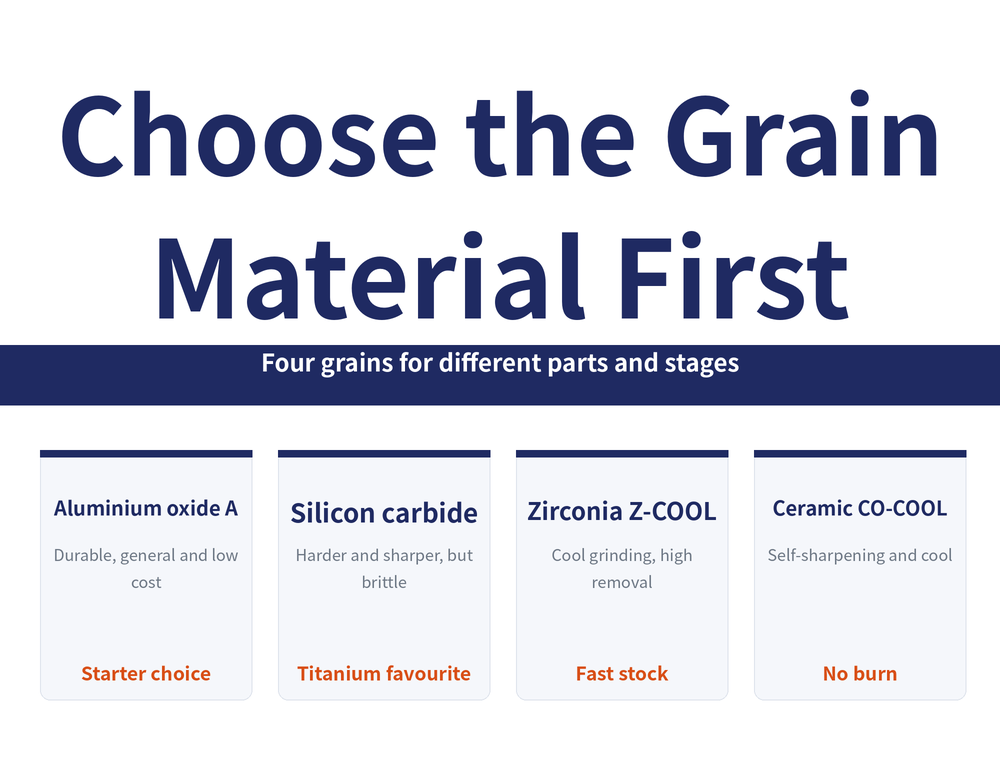
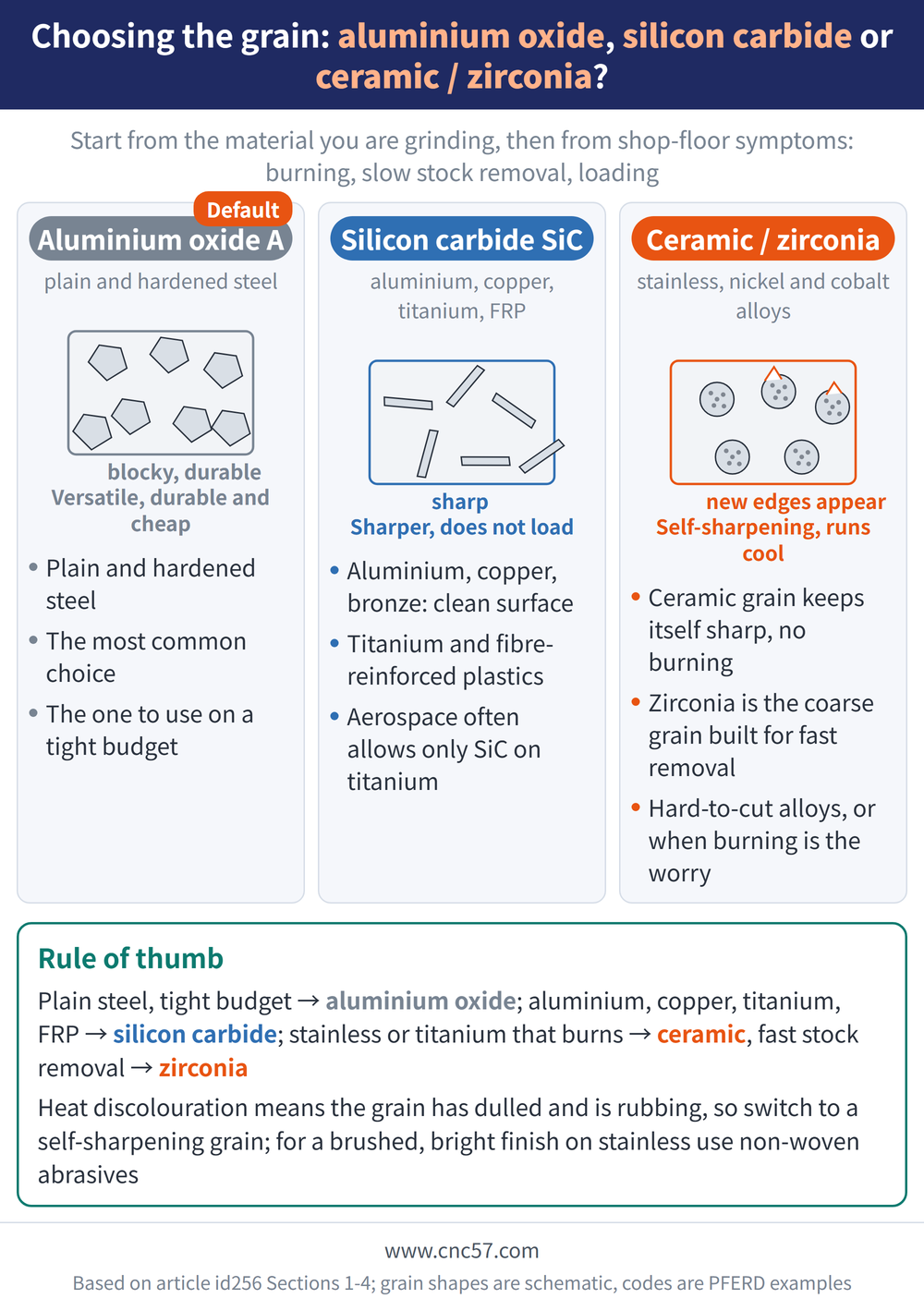
| Plain steel, hardened steel | Aluminium oxide (code A) | General, durable and cheap; the usual first pick |
| Aluminium, copper, bronze | Silicon carbide (SiC) | Sharper; on softer materials it does not load up and leaves a clean surface |
| Titanium, fibre-reinforced plastic (FRP) | Silicon carbide (SiC) | Titanium is fussy; aerospace often allows only silicon carbide |
| Stainless, nickel- and cobalt-based difficult materials | Ceramic grain (CO-COOL) | Keeps itself sharp and grinds cooler, so it is less likely to burn the part (see Section 3) |
For how those difficult materials are machined and tooled, see the stainless steel guide and the titanium and superalloy guide.
2. Hit One of These Problems? Choose Like This
If the issue is a problem rather than a change of material, match it here:
| Situation | Choose this | Reason (one line) |
|---|---|---|
| Part heats up and discolours (burning) | Switch to ceramic (CO-COOL) or zirconia (Z-COOL) | Both grind cooler, so heat does not build in the part |
| Need to take off a lot of stock, fast | Zirconia (Z-COOL) | A rough-grinding grain built for high removal |
| Abrasive dulls quickly or loads with swarf | Use a self-sharpening ceramic, or a non-woven abrasive | The ceramic keeps itself sharp; the non-woven does not load up |
| Stainless needs a bright or brushed (satin) finish | Non-woven abrasive | It gives a fine satin pattern without loading or leaving rust |
To read what number the finished surface actually is and match it to the drawing, see the Ra and Rz guide.
3. Self-Sharpening, and Why You Care
You will notice ceramic grain (CO-COOL) costs more, but it is often worth it for one reason: it keeps itself sharp as it works. An ordinary abrasive dulls with use, and once dull it rubs and heats instead of cutting, so the part burns and the job slows down. A ceramic grain breaks away where it dulls and exposes a fresh sharp edge, so it stays about as sharp from start to finish and the part is less likely to overheat.
No need to memorise the mechanism; remember one line: if burning is a worry and you are grinding stainless or titanium, choose ceramic grain. For plain steel on a budget, aluminium oxide is plenty.
4. Quick Selection
| Your need | Pick this family |
|---|---|
| Plain steel, limited budget, general use | Aluminium oxide (A) |
| Grinding aluminium or copper, or titanium and FRP | Silicon carbide (SiC) |
| Rough grinding that must remove stock fast | Zirconia (Z-COOL) |
| Stainless / titanium and other difficult materials, worried about burning | Ceramic grain (CO-COOL) |
| Stainless needing a bright or brushed finish | Non-woven abrasive |
Getting to the right family is half the battle; the grit and grade come afterwards from the maker catalogue and your stage of work.
5. Frequently Asked Questions (FAQ)
Q: What do I look at first when choosing an abrasive?
What material you are grinding. Use the first table to pick the grain family, then choose grit and grade from the catalogue. The wrong material cannot be fixed by the right grade.
Q: The part keeps burning and discolouring, what now?
Usually the abrasive is dull and rubbing instead of cutting. Switch to a self-sharpening, cooler-grinding ceramic (CO-COOL) or zirconia (Z-COOL), which keeps the heat out of the part.
Q: Ceramic grain costs more; is it worth it?
Worth it when grinding stainless or titanium and burning is a risk: it keeps itself sharp, so the rate stays steady and the part runs cooler. For plain steel, aluminium oxide is enough.
Q: What gives stainless a brushed, satin finish?
A non-woven abrasive. It produces a fine satin brush pattern without loading with swarf or leaving rust on the stainless.
This article is part of Deburring and Surface Finishing: The Complete Guide - Which Tool, Which Material, and What to Do in Volume; that guide shows how the whole topic fits together.
Published: 2026-08-11 | Last updated: 2026-08-11