Reading Coating Structure: Thickness, Adhesion and Nano Multilayers
When choosing a coating most people look at the material — TiN or TiAlN. But the same material performs very differently depending on how many layers it has, how thick they are, and what sits underneath. This guide covers the structural side: the thickness trade-off, what adhesion actually rests on, why layer counts keep rising, and what nano multilayers solve.
1. How Thick Is a Coating, and Why Thicker Is Not Better
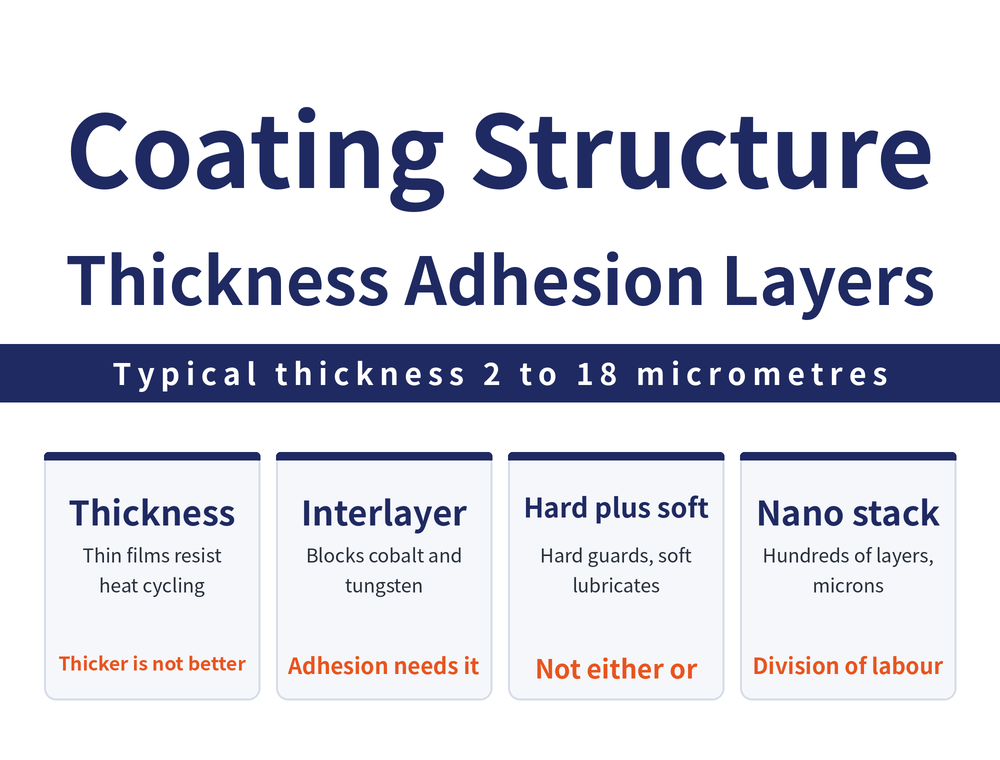
Typical coating thickness falls in the 2 to 18 µm range. Intuition says thicker means more wear resistance, but there is a trade-off in the other direction: thin coatings resist thermal cycling better, and hold up better where temperature swings repeatedly. The source records that thin coatings can extend tool life by around 40%.
Thickness also differs by process. Among common physical vapour deposition families, a single hard coating typically runs 1 to 5 µm, a hard-plus-soft composite around 2 to 6 µm, and oxide multilayers around 3 to 4 µm (manufacturer example values; use the catalogue as the governing reference).
For choosing the coating material itself see Common Tool Coating Materials; for process differences see PVD vs CVD Coating Guide.
2. From Single Layer to Multilayer: Why Layer Counts Keep Rising
Coated carbide tools have passed through four generations since the 1960s. The first used a single TiC layer; the second began controlling the thickness of the brittle phase between coating and substrate and introduced double and triple layers; the third brought structures of three or more layers along with matched substrates; the fourth moved into superhard coatings such as diamond, cubic boron nitride and carbon nitride.
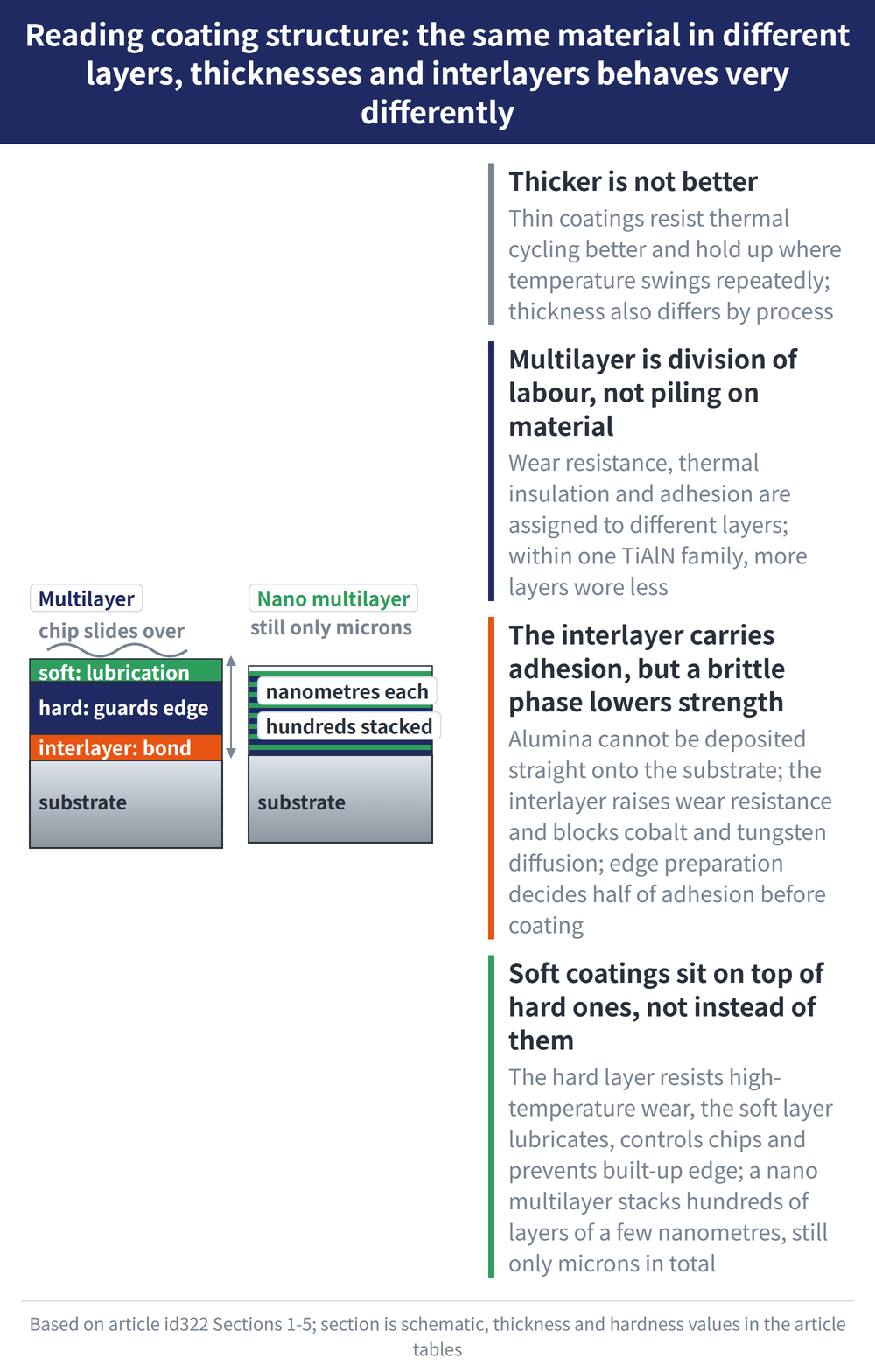
Multilayer is about division of labour, not piling on material. One dry drilling comparison in the source makes the point: within the same TiAlN family, the double-layer coating showed the highest wear rate while the seven-layer structure performed best. What layers add is not just thickness — it is assigning wear resistance, thermal insulation and adhesion to different layers.
3. The Interlayer: What Adhesion Actually Rests On
Aluminium oxide coatings offer excellent heat resistance and chemical stability, but they cannot simply be deposited straight onto the substrate. In practice a TiN, TiC or TiCN interlayer is placed between substrate and alumina, serving two purposes: raising wear resistance, and blocking cobalt and tungsten in the substrate from diffusing outward.
The interlayer carries its own trade-off, though — a TiC interlayer is a brittle phase and reduces the strength of the film as a whole. Adhesion is not a matter of "add another layer and it improves"; it depends on whether that layer's properties suit the job.
There is also a prerequisite that is easy to overlook: half of adhesion is decided before the coating is applied. The condition of the edge preparation directly affects the result — see How Edge Honing Affects Coating Adhesion and Tool Life.
4. Hard and Soft Coatings: Used Stacked, Not Chosen Between
This is where structural thinking shows most directly: soft coatings are normally deposited on top of hard ones, not chosen instead of them.
| Layer | Typical microhardness | What it does |
|---|---|---|
| Hard coating (TiN, TiCN, TiAlN families) | About 2300 to 3500 HV | Protects the cutting edge, resists high-temperature wear |
| Soft coating (WC/C) | About 1000 HV | Sliding lubrication, controls chip formation |
| Soft coating (molybdenum disulfide family) | About 500 HV and below | Lowers friction, prevents built-up edge, aids evacuation |
Which friction-reducing material suits depends on temperature. Below roughly 400 °C, sulphide solid lubricants work well, with friction coefficients as low as 0.1 to 0.2; at higher temperatures soft metals perform better. These are typical ranges compiled from the source; actual values depend on the catalogue and the cutting conditions.
5. Nano Multilayers: Hundreds of Layers, Still Only Microns Thick
Nano coatings are those with grain sizes below 100 nm. Their structure is extreme: each layer is only a few nanometres, hundreds can be stacked, and the total is still only 2 to 5 µm.
By the hardness pairing of adjacent layers there are four families: hard on hard, hard on soft, soft on soft, and lubricating soft on soft. The usual process is closed-field unbalanced magnetron sputtering, which compared with ordinary sputtering yields denser and cleaner coatings, higher bond strength and more stable friction behaviour.
One dry cutting comparison in the source: in medium carbon steel, a nano multilayer coated tool showed clearly lower flank wear and cutting force than uncoated, single-layer and triple-layer references. A second, in titanium alloy dry drilling, recorded roughly a third less drilling force for the nano multilayer drill than for an uncoated one, with no seizure.
6. Coating Structure Affects Surface Finish
Coatings do not only affect tool life, they affect the workpiece surface. Coating grain size shows up directly in surface quality; the source further records that within a single multi-element coating family, differing element ratios produce measurably different roughness.
That leads to a practical point: when surface quality is not what was expected, the coating specification is a variable alongside cutting parameters. For roughness definitions and measurement see Surface Roughness Ra, Rz and RzJIS Explained.
7. Frequently Asked Questions (FAQ)
Q: Does a thicker coating last longer?
Not necessarily. Typical thickness is 2 to 18 micrometres, and thin coatings resist thermal cycling better, performing more consistently where temperature swings.
Q: Why are coatings built from many layers?
For division of labour: wear resistance, thermal insulation and adhesion are handled by different layers. In one dry drilling comparison a seven-layer structure outperformed a double layer.
Q: If soft coatings are that soft, what use are they?
They sit on top of a hard coating and handle lubrication and chip control, not wear resistance. The hard layer guards the edge, the soft layer lowers friction.
Q: What does the interlayer do?
It raises wear resistance and blocks cobalt and tungsten from diffusing out of the substrate. Note that a TiC interlayer is a brittle phase and lowers film strength.
This article is part of Tool Materials and Coatings: The Complete Guide - Separate Substrate From Coating, Then Work Back From the Workpiece; that guide shows how the whole topic fits together.