
Truing and Dressing Superabrasive Wheels: Methods, Grit, Concentration and Grinding Data
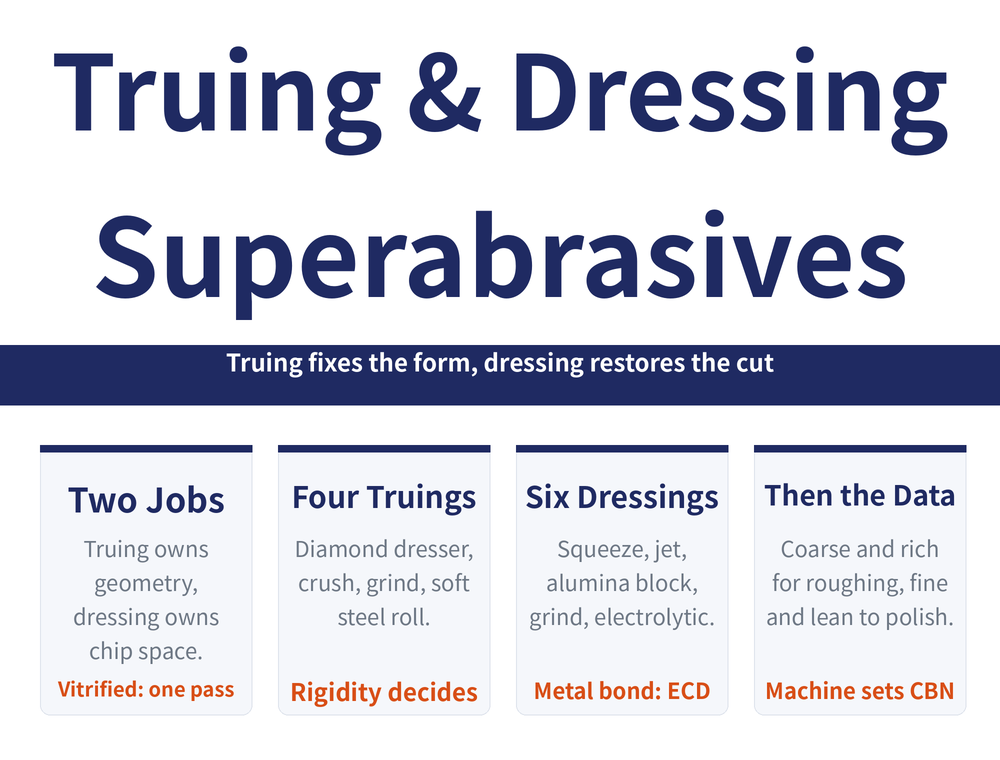
A dull diamond or CBN wheel is not conditioned the way a conventional wheel is: the form is corrected in one operation and the sharpness in another, and on dense bonds the two cannot be combined. This guide sets out four truing methods and six dressing methods as selection tables, then follows with grit, concentration and grinding data.
1. Truing and dressing are two different jobs
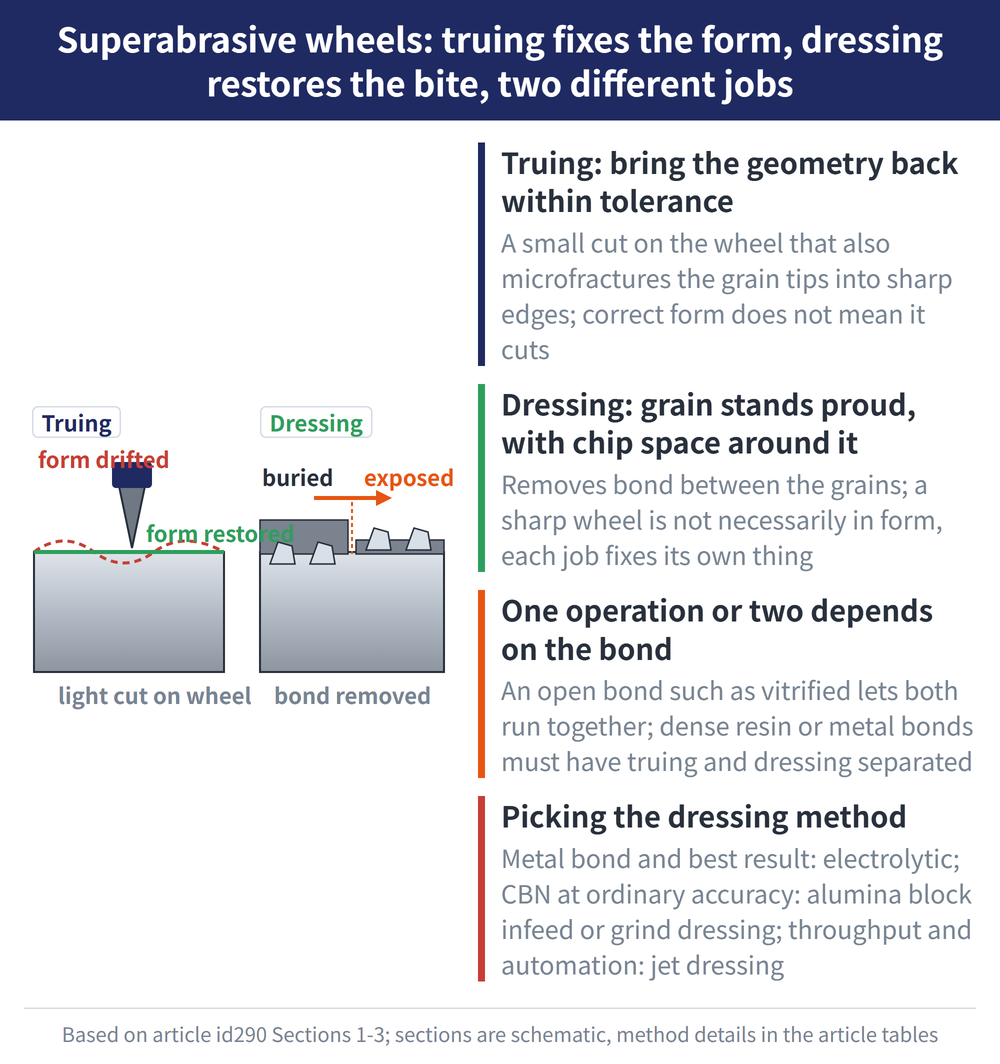
Truing takes a small cut off the wheel to bring the geometry back within tolerance while microfracturing the grain tips into sharp edges. Dressing removes bond material between the grains so the grain stands proud and there is chip space around it. Correct form does not mean the wheel cuts, and a sharp wheel is not necessarily in form.
Check the bond first, then decide whether it takes one operation or two. An open bond such as vitrified lets truing and dressing run together in one operation with a single-point diamond or a roll. A dense bond such as resin or metal must have them separated, and most of the methods below exist for that case. Conventional abrasive wheels are conditioned differently — see How to Dress a Dull Grinding Wheel.
2. Choosing among four truing methods
| Method | How it works | Cost and application |
|---|---|---|
| Diamond dresser | Wheel turns slowly while the diamond dresser cuts | Smooth surface but poor cutting and low form accuracy; dresser wears fast; use only with no better option |
| Crush truing | Vitrified green silicon carbide or white alumina roll fractures grain by pressure | Needs high force and a rigid machine; suits wheels under 200mm and coarser than 200#; resin bonds over-true easily |
| Grind truing | Silicon carbide or alumina stick, or a powered truing wheel (also dresses) | Most used. Conventional grain: lower accuracy, wheel cuts well. Diamond: better accuracy, duller wheel. Can run both in sequence |
| Soft steel roll | Soft steel roll grinds the wheel (also dresses), single roll or twin roll | Grain loss is higher, so not for high form accuracy; the twin roll version runs more steadily |
In one line: accuracy calls for grind truing with a diamond truing wheel; throughput and cost call for crush truing, provided the machine is rigid enough; with neither available you fall back on the diamond dresser. The twin roll method runs two soft steel rolls at different speeds so the truing forces are equal and opposite, avoiding an extra disturbing moment.
3. Choosing among six dressing methods
| Method | Principle and character |
|---|---|
| Loose grain squeeze roll | Green silicon carbide or alumina grain is injected under pressure into the gap (about 60μm) and rolls the grain edges clear |
| Jet dressing | Compressed air blasts grain or glass beads at the turning wheel to remove bond; pressure follows grain size, done in minutes |
| Alumina block infeed | An alumina block feeds in radially and cuts resin bond between CBN grains; keep normal force under 250N/mm at the start |
| Grind dressing | Dressed with a silicon carbide or alumina wheel; the dressing wheel wears fast and copies its form onto the wheel |
| Electrolytic dressing | Metal bond only. Costly equipment but excellent result with almost no grain pull-out; bad parameters corrode the bond locally |
| Hydro jet dressing | High-pressure coolant draws air in a vortex chamber, mixes with loose grain and sprays through a ceramic nozzle |
The choice is direct: a metal bond wheel that needs the best result and has the budget takes electrolytic dressing; a CBN wheel at ordinary accuracy takes alumina block infeed or grind dressing; throughput and automation take jet or hydro jet. For choosing the abrasive and bond in the first place see Diamond or CBN Wheel.
4. Grit: bond sets the ceiling, the operation sets the rest
| Bond | Grit range | Operation | Suggested grit |
|---|---|---|---|
| Resin | Up to 100# | Roughing | 80#~120# |
| Vitrified | 100#~180# | Semi-finishing | 120#~180# |
| Metal | 80#~240# | Finishing | 180#~W40 |
| — | Weaker bond, finer grit | Lapping and polishing | W40~W10 |
Two rules run together. For the same surface roughness a superabrasive should be one or two grades finer than a conventional abrasive; but within that roughness target, go as coarse as you can. Too coarse and wheel wear rises while the grinding ratio falls, most visibly on resin bonds; too fine and cutting ability drops, the face loads up and temperature climbs. Every bond has its own optimum grit band. Form grinding needs a finer grit than plain grinding to hold the profile.
5. Concentration: by operation, and by wheel form
Baseline concentration follows the bond: resin 50%~75%, vitrified 75%~100%, metal 100%~150% — the stronger the bond holds the grain, the higher the optimum band. Within one bond, CBN can run slightly higher than diamond, because CBN mostly grinds tougher steels and its grain is multi-edged and self-sharpening; resin bond CBN wheels commonly use 100%.
| Operation | Concentration | Why |
|---|---|---|
| Roughing | High, with coarser grit | More grains per unit area, higher removal |
| Semi-finishing and finishing | Medium | Balances roughness against cutting ability |
| Polishing, low roughness | Low, as low as 25% in some cases | Fine grit resin bond, helps drive roughness down |
| Form faces, face and slot grinding | Higher | Wide working face relies on grain density to hold form |
6. Grinding data: reference ranges for diamond wheels
| Item | Reference value |
|---|---|
| Speed (bronze bond) | Dry 12~18 m/s, wet 15~22 m/s |
| Speed (resin bond) | Dry 15~20 m/s, wet 18~25 m/s |
| Speed (by operation) | Surface 25~30, cylindrical 20~25, internal 12~15, tool grinding 12~20 m/s |
| Depth of cut (by operation) | Surface and cylindrical 0.005~0.015mm, internal 0.002~0.01mm, tool grinding 0.01~0.03mm |
| Depth of cut (by grit) | Finer grit takes less; 270/325 and finer all run 0.002~0.005mm |
| Work speed | 10~20 m/min; internal work and fine grit can go a little higher, but not far |
| Feed rate | Cylindrical traverse 0.5~1 m/min, infeed 0.5~1 mm per pass; surface traverse 10~15 m/min |
All of the above are the typical ranges given in the source and still need adjusting to the machine, the wheel and the part. The higher the feed rate, the more sharply wheel wear and surface roughness rise, and resin bonds suffer most; work speed that is too high increases wheel wear, worsens vibration and generates noise.
7. How fast CBN can run depends on the machine
A CBN wheel can run faster than a diamond wheel, and the higher the speed the better the surface finish, the lower the grinding force, wear and heat. The source records CBN speeds rising from 60 m/s to 80, 120, 160 and 200 m/s. The same source also notes an earlier recommended range of 15~35 m/s, limited chiefly by the machine tool. Before promising the catalogue speed, confirm the rigidity and rating of the machine. On depth of cut, sharp self-sharpening CBN grain allows a little more than a diamond wheel; axial feed generally runs 0.45~1.8 m/min, higher for roughing and lower for finishing.
8. Frequently Asked Questions (FAQ)
Q: Do truing and dressing always have to be separate operations?
It depends on the bond. An open bond such as vitrified allows both in one operation with a single-point diamond or a roll. Dense resin and metal bonds must be separated: true the form first, then dress so the grain stands clear of the bond.
Q: A metal bond wheel will not dress — what are the options?
Electrolytic dressing, the one method that applies only to metal bond superabrasive wheels, with an excellent result and almost no grain pull-out. The trade-off is complex, expensive equipment, and badly controlled parameters dissolve the bond locally and shorten wheel life.
Q: Is a finer grit always better on a superabrasive wheel?
No. Too fine and cutting ability drops, the working face loads up and temperature climbs; on resin bonds the heat also accelerates bond breakdown. Go as coarse as the roughness target allows — for the same roughness as a conventional abrasive, one or two grades finer is enough.
Q: For the same operation, do CBN and diamond take the same concentration?
Within one bond CBN can be slightly higher than diamond, because it mostly grinds tougher steels and its grain is multi-edged and self-sharpening. Resin bond CBN wheels commonly use 100%. Wide working faces in form or slot grinding go higher again.
This article is part of Tool Regrinding: The Complete Guide — Decide Whether to Grind, Then Look Up How, With What, and How to Check; that guide shows how the whole topic fits together.
This article is part of Grinding Wheels and Machines: The Complete Guide - Reading the Wheel, Mounting It, Dressing It, and Tracing Defects; that guide shows how the whole topic fits together.
Published: 2026-08-17|Last updated: 2026-08-17