What Is Electrostatic Cooling: Ionised Air, Material Fit and Residual Stress
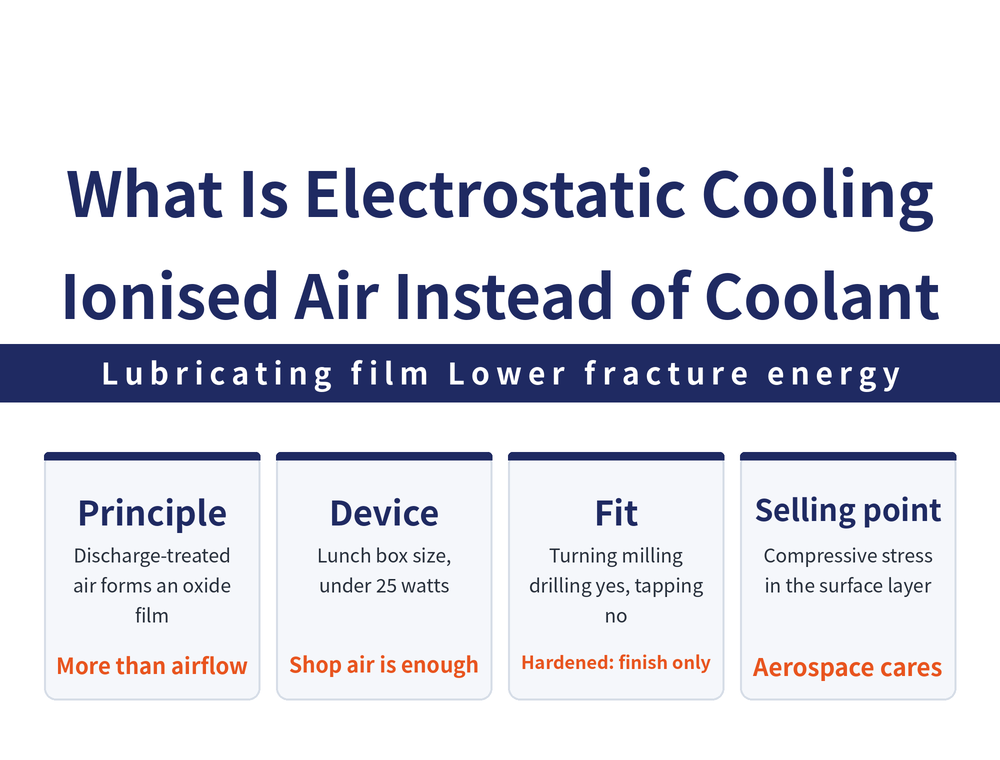
Electrostatic cooling uses neither chilled air nor oil mist, but air that has been passed through a discharge unit and ionised. It works on two counts: forming an oxide film with lubricating action at the tool–work interface, and lowering the energy needed to break down the material. The device is the size of a lunch box and draws under 25 watts — but its real interest lies in the residual stress left in the machined surface.
1. It is not chilled air, and not oil mist
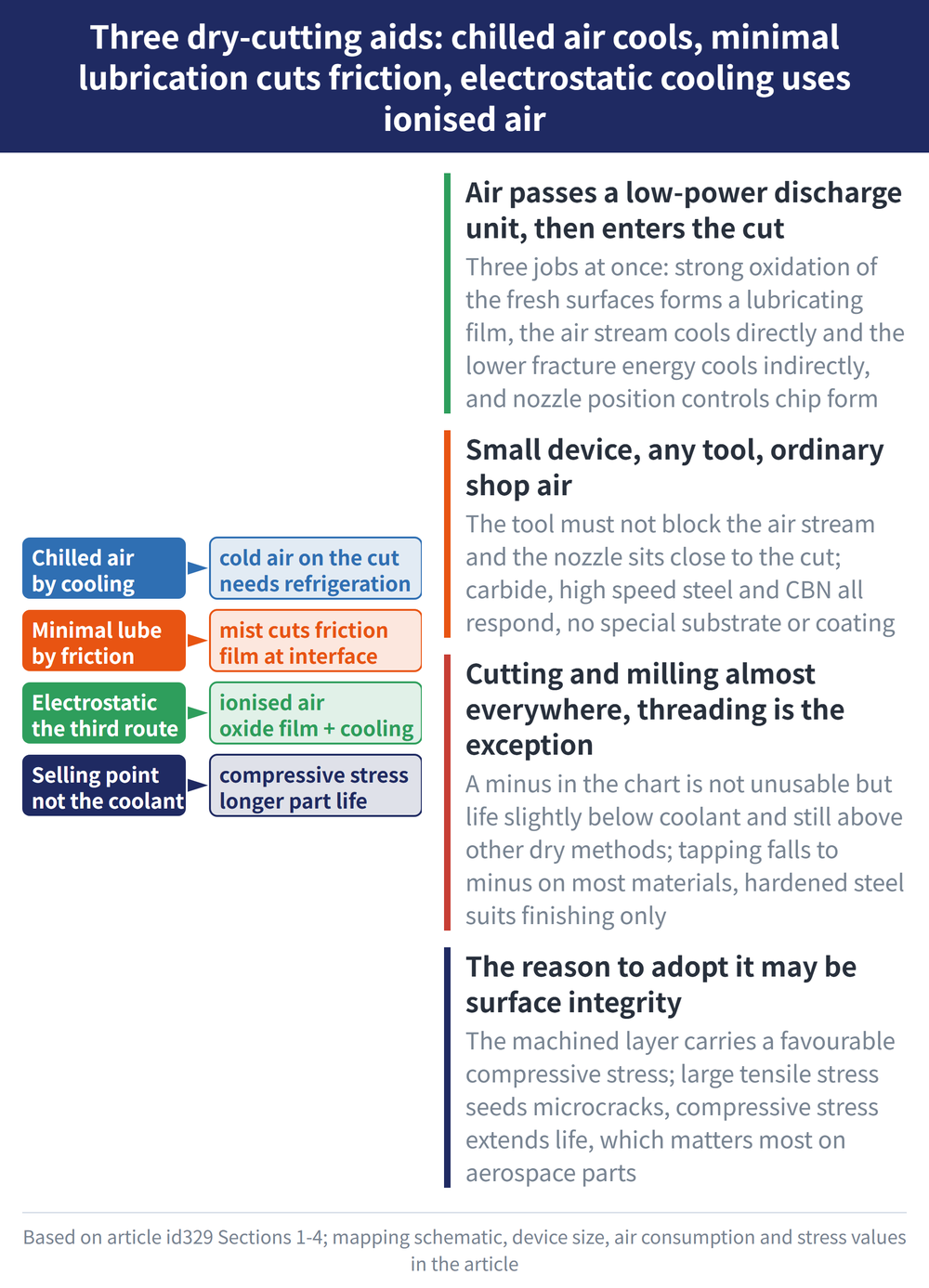
Among dry cutting aids, chilled air works by temperature and minimal quantity lubrication works by friction (for the positioning of both see how to choose cutting fluid). Electrostatic cooling takes a third route: air is first passed through a low-power discharge unit into an ionised state, then delivered into the cutting zone in place of coolant.
It performs three functions during cutting:
| Function | Mechanism |
|---|---|
| Lubrication | Strong oxidation of the initial workpiece and tool surfaces forms a film with lubricating action |
| Cooling | Direct cooling by the air stream, plus indirect cooling as the energy needed to break the material falls |
| Chip control | Chip formation can be adjusted through device settings and nozzle position |
The indirect cooling in the second item involves the Rebinder effect (surface-active media adsorbing onto a solid surface, lowering the energy required for its deformation and fracture) — which is why this is more than simply blowing air.
2. The device and shop requirements
The equipment is smaller than most expect: roughly 240×228×85 mm, under 5 kg, drawing no more than 25 W (single phase 220 V / 50 Hz). Each ioniser consumes about 1 m³/h of air at 0.3–0.6 MPa, and places no special demands on the compressed air — ordinary shop supply will do.
How many ionisers depends on the operation:
| Ionisers | Suits |
|---|---|
| One | Most turning operations |
| Two | High-power or high-speed turning, milling of all kinds, drilling |
| Several | Gear milling, gear shaping and similar |
Two installation points matter: the tool must not block the air stream entering the cutting zone, and the nozzle should sit no more than 100 mm from it; on the machine side, guarding should route chips away from the interior. Tool material is not a constraint — carbide, high speed steel and CBN all respond, and no special substrate or coating is required.
3. Which materials and operations suit it
Below is a material-by-operation suitability table. Its rating definition comes first, because misreading it leads to the opposite conclusion: "+" means tool life equal to or better than with coolant; "−" does not mean unusable, but life at roughly 0.8–0.9 times that with coolant — still better than other dry methods.
| Material | Turning, boring, planing, milling | Threading | Gear cutting and drilling |
|---|---|---|---|
| Carbon and alloy steel | + throughout | +, except tapping which is − | + |
| Heat-resistant steel, titanium, cast iron | + throughout | − for all four threading methods | + |
| Brass, bronze | + throughout | +, except single-point threading which is − | + |
| Hardened steel | + for finishing and fine finishing only | Not marked in source | Not marked in source |
The table condenses the original suitability chart (source: Dry Cutting, ch. 4); cells left unmarked in the original are left unmarked here and have not been inferred. Confirm against the supplier's stated scope and a trial cut before adopting.
Two readings can be used directly: cutting and milling operations suit it almost universally; threading is the main exception, with tapping falling to − on most materials — consistent with the enclosed chip space that makes dry tapping difficult in the first place. Hardened steel has a clearly limited scope, confined to finishing and fine finishing.
4. The real selling point is residual stress
The magnitude and sign of residual stress in the machined surface layer strongly affect service life: large tensile stress induces microcracks and part failure, while compressive stress extends life. This matters especially for aerospace components.
Source measurements after electrostatic-cooled dry machining show a favourable compressive stress in the surface layer, peaking at roughly 300–350 MPa within 20 μm and extending to around 200 μm depth; tangential residual stress is tensile, peaking at roughly 200–400 MPa within the surface to 40–50 μm range (single-source measurement, for order-of-magnitude reference).
In other words, the reason to adopt it may not be saving coolant at all, but that it improves surface integrity along the way. For reading surface roughness see surface roughness Ra vs Rz, and for achievable ranges by process see the surface roughness chart by process.
Cryogenic cooling and laser assist take a different path — changing the material's instantaneous properties rather than interface lubrication — and hard turning relies on tool heat resistance; see the hard turning guide.
5. Frequently Asked Questions (FAQ)
Q: How does electrostatic cooling differ from chilled air?
Chilled air works by low temperature. Electrostatic cooling works by ionised air forming a lubricating oxide film at the interface and lowering the energy needed to break the material. It needs no refrigeration equipment.
Q: Does "−" in the table mean it cannot be used?
No. The original defines "−" as tool life around 0.8–0.9 times that with coolant, still better than other dry methods. It is a gap against wet machining, not unsuitability.
Q: Are special tools or coatings needed?
No. Carbide, high speed steel and CBN all work. What matters is that the tool must not block the air stream into the cutting zone, and the nozzle should be within 100 mm of it.
Q: Why is it said to be valuable for aerospace parts?
Because it leaves compressive rather than large tensile stress in the surface layer. Tensile stress tends to induce microcracks and failure, whereas compressive stress helps extend part life.
This article is part of Manufacturing Process: The Complete Guide - Set the Datum First, Then Sequence, Allowance and Dry Cutting; that guide shows how the whole topic fits together.
This article is part of Dry Machining: The Complete Guide - Losing the Coolant, and How Five Processes and Three Techniques Cope; that guide shows how the whole topic fits together.