
Manufacturing Process: The Complete Guide - Set the Datum First, Then Sequence, Allowance and Dry Cutting
This category holds 10 articles on one subject: how a drawing becomes a sequence of operations that can be made, and costed. The order is fixed - see the whole route and set the datum, then decide how many passes and how much stock to leave, then pick the machine and work out the time, and last whether to run dry. Reverse it and you keep missing the problem: a part machined off the wrong datum will never be explained by checking the machine.
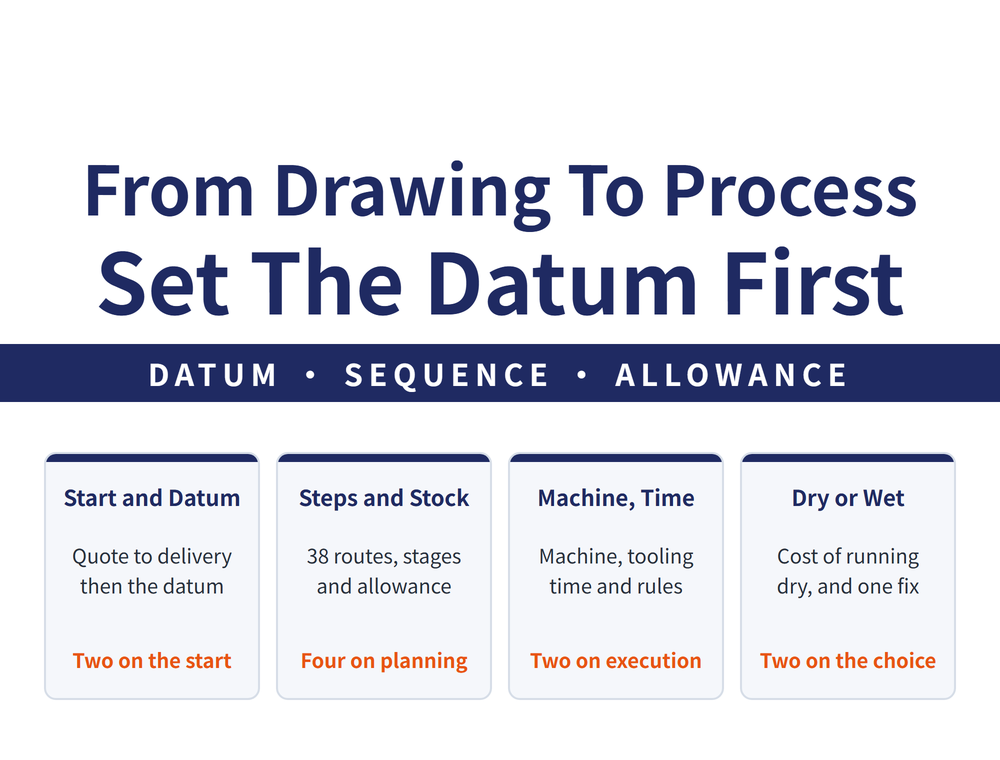
1. The order here is fixed: see the whole route, then set the datum
Process planning does not start with choosing a machine. First know which stages a part passes through, then decide which face the first cut references. Only then can the rest of the operations be laid out.
| Article | When to read it |
|---|---|
| From Quote to Delivery | The entry point. The whole route before the detail |
| Choosing a Locating Datum | When two machinists plan the same drawing differently |
One line from the second article is worth remembering up front: pick the wrong datum and every later operation is compensating for it. This is also where process problems part company with machine problems - no amount of machine maintenance will explain this kind of error. To read what the drawing is actually asking for, see Reading Tolerance and Fit in the fundamentals category; hole tolerance and runout form their own line, in Hole Accuracy: A Complete Reading Guide.
2. How many passes, in what order, and how much to leave
With the datum set, three things get decided together: how many passes this surface needs, how those passes are ordered, and how much stock sits between them. These four articles are the core of the line.
| Article | When to read it |
|---|---|
| Machining Route Selection | Use it as a lookup. 38 chains, read backwards |
| Sequencing Machining Operations | Deciding on stages, and concentration vs division |
| Roughing, Semi-Finishing and Finishing | When you want to know why one pass will not do |
| How Much Machining Allowance | When allowance is still a number picked by feel |
How to read the four: the first decides which passes, the second and third decide their order, the fourth decides what sits between them. The last one carries an idea that often gets missed - the allowance for this operation cannot be smaller than the error left by the one before it, so it is not this operation's decision alone. Where heat treatment belongs in the sequence is in the second article.
3. Machine, time, and a list you can tape to the machine
Once the sequence is set, what remains is which machine with what tooling, how long the batch will take, and the rules the shop floor actually follows.
| Article | When to read it |
|---|---|
| Machine, Tooling and Time Standards | When quoting, or planning capacity |
| General Machining Practice Rules | When you want a list to tape beside the machine |
The first article contains one order that must not be reversed: set depth of cut first, then feed, and speed last - do it the other way round and tool life drops quickly. The second draws on an industry standard published in mainland China, and the article marks which clauses need local judgement in Taiwan. Holding the part so it neither moves nor distorts is a complete line of its own - locating pins, clamping force, pneumatic or hydraulic power - all of it in Workholding and Fixtures: The Complete Guide.
4. The last decision: whether to take the coolant away
This belongs to the planning stage, not to someone reaching over and closing the nozzle. It drives tool material, tool geometry and chip evacuation, so it has to be settled while the method is still being chosen.
| Article | When to read it |
|---|---|
| The Cost of Dry Cutting | Read it before you decide. It only argues against |
| What Is Electrostatic Cooling | When weighing dry cutting and looking for a middle way |
The first article holds a counter-example that is easy to misread: in the same aluminium alloy, drilling and boring point the opposite way, so "this material can be cut dry" cannot be applied across the board. Dry cutting itself is a longer line - dry milling, dry drilling, dry tapping, and how tool material and geometry have to change - spread across the end mill, drill, tap and tool material categories. These two are its entry point at the planning level, not the whole of it.
5. Frequently Asked Questions (FAQ)
Q: Where should I start with these 10 articles?
It depends on the problem in front of you. New to this, start with From Quote to Delivery in section 1; it gives the whole route. Drawing in hand and ready to plan, read Choosing a Locating Datum, the first real decision. If the drawing itself is unclear, fill in Reading Tolerance and Fit first. To decide how many passes, go straight to the route chart in section 2. Quoting or planning capacity, jump to section 3. Already weighing dry cutting, read section 4.
Q: A part is out of tolerance - is it the sequence or the machine?
Look at what the error tracks. Same batch, same machine, and the error appears in the same place or the same direction every time - that usually points at the datum or the sequence, and the fixes live in this line: change the datum, add a semi-finishing pass, leave more stock. If the same program gives different results at different times, or accuracy drifts with temperature and hours, look at the machine and the shop floor instead, where the fixes are geometric checks, chip clearing and maintenance. The two sets of fixes are not interchangeable, and searching the wrong side means never reaching the cause.
Q: How much allowance should I actually leave?
Allowance has a hard lower bound rather than a feel for it: the allowance for this operation cannot be smaller than the error left by the previous one, or this pass will not reach what it is meant to cut. In practice you take a starting figure from a table, then adjust it against four factors - and only one of those four comes from this operation, the rest from the previous pass and the stock. Too much costs cycle time and tool life; too little means the part cannot be finished or has to be reworked. The last article in section 2 takes the four factors apart.
Q: Why does dry cutting sit in the process planning category?
Because it is decided when the method is chosen, not a setting you change halfway through. Whether coolant is used goes on to determine tool material and coating, tool geometry, chip evacuation, and sometimes whether the sequence has to be rearranged. Leave it until the program is written and the tools are loaded, and closing the nozzle is exactly how you land in one of the cases that article warns against. How each tool type is run dry is a separate line crossing several categories; what sits here is only the judgement the planning stage has to make.
Published: 2026-09-10|Last updated: 2026-09-10