Mounted Points and Flap Wheels: Choosing and Using Them Safely
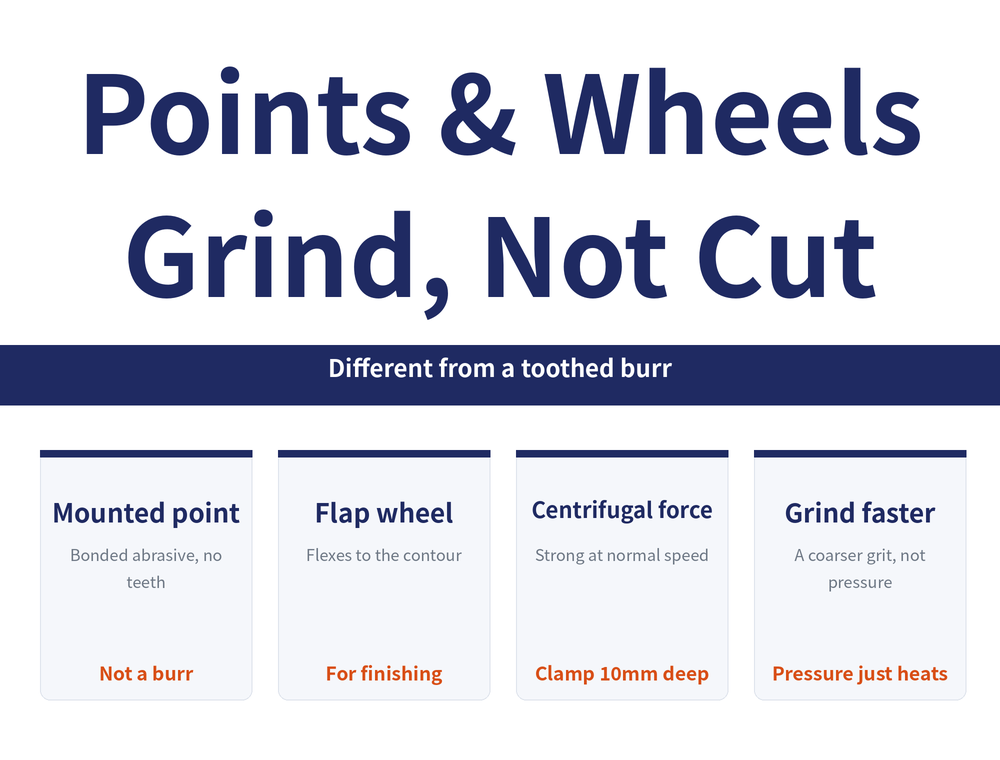
Mounted points and flap wheels are small abrasive tools on a straight shank, but unlike a toothed carbide burr they grind with abrasive rather than cut with teeth. This guide covers how to choose and use them safely, plus one thing often missed: centrifugal force is already strong at normal speed.
1. Mounted Point vs Flap Wheel vs Burr
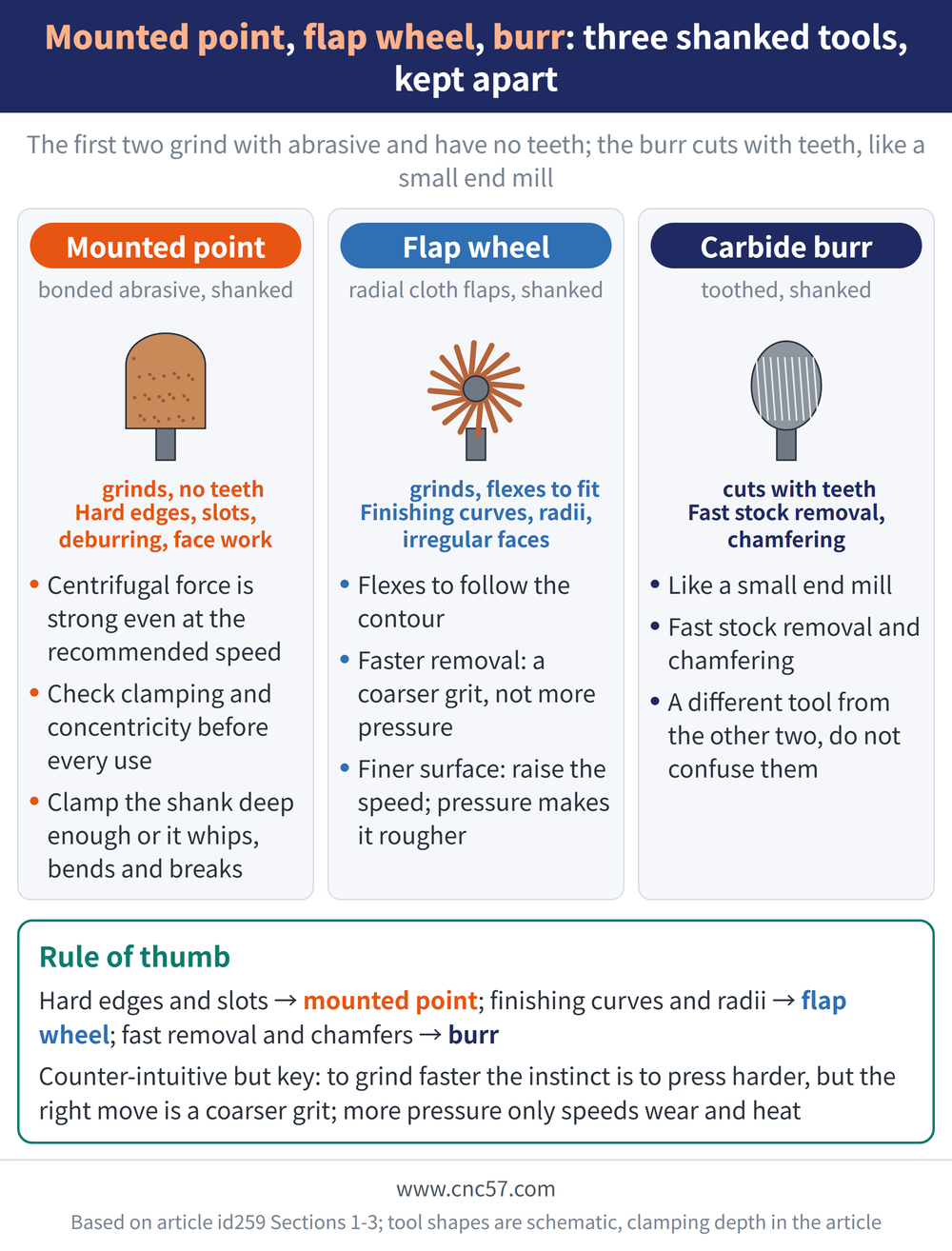
| Tool | How it works | Good for |
|---|---|---|
| Mounted point (bonded abrasive, shanked) | Grinds with abrasive, no teeth | Hard edges, slots, deburring, face work |
| Flap wheel (radial cloth flaps, shanked) | Grinds with abrasive, flexes to fit | Finishing curves, radii and irregular faces |
| Carbide burr (toothed) | Cuts with teeth, like a small end mill | Fast stock removal, chamfering |
These are different tools; do not confuse them. The burr has teeth and cuts, see reading a carbide burr. For which abrasive grain a point or wheel should use, see choosing an abrasive.
2. Centrifugal Force: Dangerous Even at Normal Speed
The key safety point for a mounted point: centrifugal force is already strong at the recommended speed, not only when overspeeding. Before every use, check it is clamped tight and check the concentricity (any runout).
The shank must be clamped at least 10 mm deep; too shallow and at high speed it whips, even bends and breaks and injures someone. Wear eye, ear, dust and hand protection.
3. Getting the Best From a Flap Wheel
| To achieve | Do this |
|---|---|
| Less wear and heat | Lower the contact pressure and peripheral speed, add grinding oil |
| Faster removal | Step up to a coarser grit, not more pressure |
| Finer surface | Raise the cutting speed; more pressure makes it rougher |
The key counter-intuitive point: to grind faster the instinct is to press harder, but the right move is a coarser grit; more pressure only speeds wear and heat.
4. Quick-Change Discs: Why the Backing Pad Has Cooling Slots
What makes an angle-grinder quick-change disc (such as PFERD COMBICLICK) worth noting is not the fast swap but the cooling slots in the backing pad: spinning creates airflow that actively cools the abrasive and the part. The maker claims, versus a traditional slot-less disc, up to 30% lower part temperature, 25% higher removal and 30% longer life (the maker’s own relative claim, not a cross-brand result).
One rule for the pad: the backing pad is usually a size smaller than the disc (a 125 mm disc with a 115 mm pad), so the disc edge stays flexible and hugs the contour; only for stiff, heavy grinding do you use a pad near the disc size.
5. Frequently Asked Questions (FAQ)
Q: How does a mounted point differ from a carbide burr?
A mounted point grinds with abrasive and has no teeth; a burr has teeth and cuts, like a small end mill. Use a burr for fast removal, a mounted point for surfaces and hard edges.
Q: Can a mounted point fly off?
Centrifugal force is already strong at normal speed, so check clamping and concentricity before use; clamp the shank at least 10 mm deep, or at high speed it can bend, break and injure.
Q: How do I make a flap wheel cut faster?
Step up to a coarser grit, not more pressure. Pressure will not cut faster; it only speeds wear and heat.
Q: Do the cooling slots on a quick-change disc really help?
The slots create airflow that cools as it spins; the maker claims up to 30% lower part temperature and 30% longer life (the maker’s own relative claim).
This article is part of Deburring and Surface Finishing: The Complete Guide - Which Tool, Which Material, and What to Do in Volume; that guide shows how the whole topic fits together.
Published: 2026-08-11 | Last updated: 2026-08-11