Rough Boring Tool Selection: Edges, Rake and Entering Angle
Rough boring enlarges an existing hole and leaves an even allowance for finishing, chasing a high metal removal rate rather than final tolerance. Choosing a rough boring tool means answering three questions: how many cutting edges (two or three), positive or negative rake slide, and how large the entering angle is; plus one overhang threshold that decides whether to switch to a dampened tool.
1. The role of rough boring: enlarge and pave the way for finishing
Rough boring enlarges an existing hole to prepare it for finishing, while fine boring holds the specified tolerance and surface finish — two stages in series, not an either/or. Rough boring's goal: the highest metal removal rate the machine power and stability allow, leaving an even allowance. For the four boring methods and the rough-to-fine division, see boring basics: four boring methods and the rigidity-first rule.
2. Three roughing methods: high-productivity, stepped, single-edge
Rough boring has three plays; pick one by shop conditions:
| Method | Character | When to use |
|---|---|---|
| High-productivity boring | Multiple edges at one height, high metal removal rate | The first choice when removing a large allowance with ample power |
| Stepped boring | Edges axially offset, splitting the chip in two across its width | Large radial depth of cut, or soft long-chipping material with poor evacuation |
| Single-edge boring | Just one cutting edge, the lowest power demand | Limited machine power, or especially demanding chip control |
The logic: fast means high-productivity, poor evacuation or large depth means stepped, low power means single-edge. The rake, entering angle and overhang decisions below mostly revolve around the multi-edge tools — high-productivity and stepped.
3. Two edges or three: read power, diameter and stability
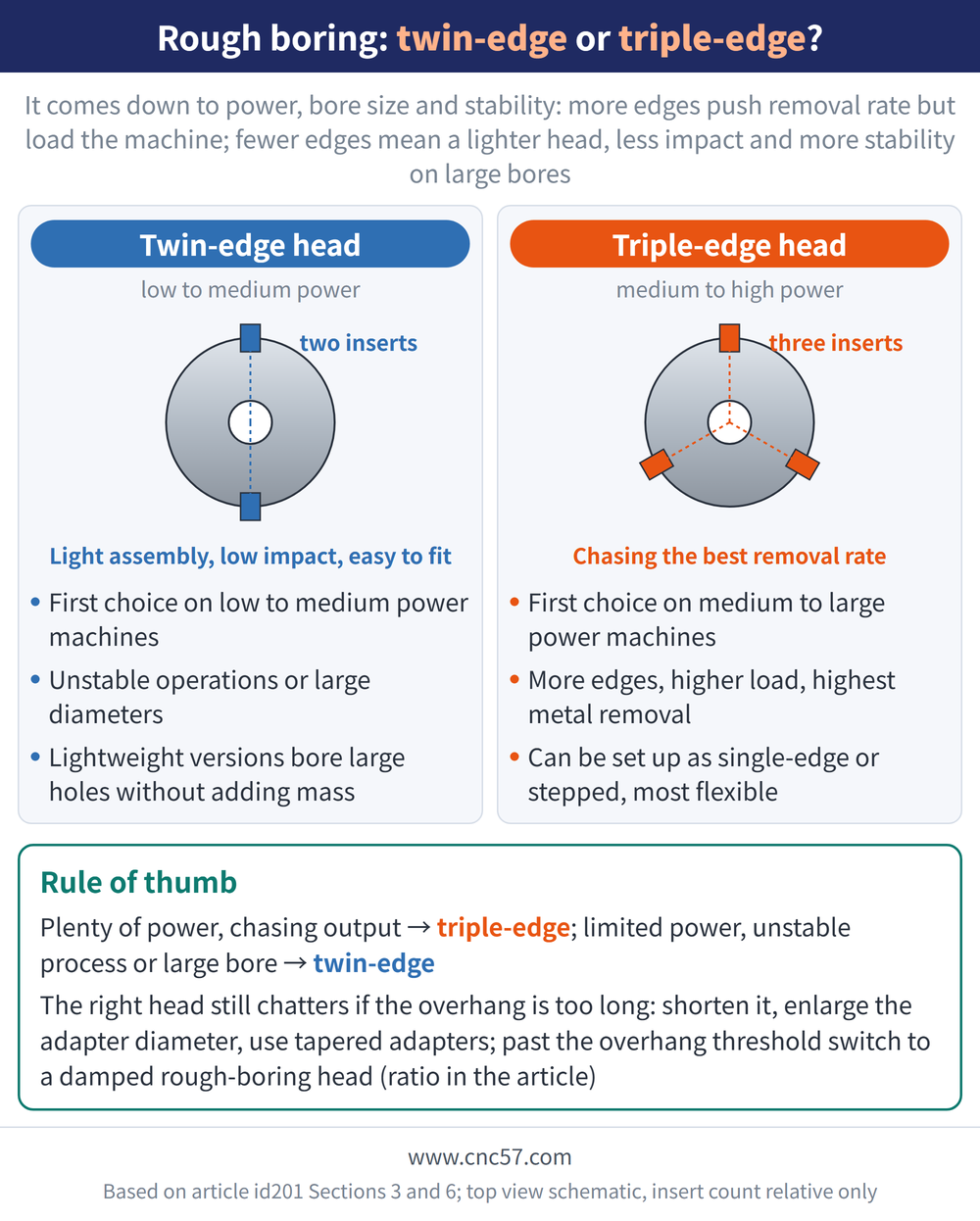
The common trade-off among multi-edge rough boring tools is two edges or three: ample power chasing productivity means three edges; limited power, an unstable operation or a very large diameter means two edges.
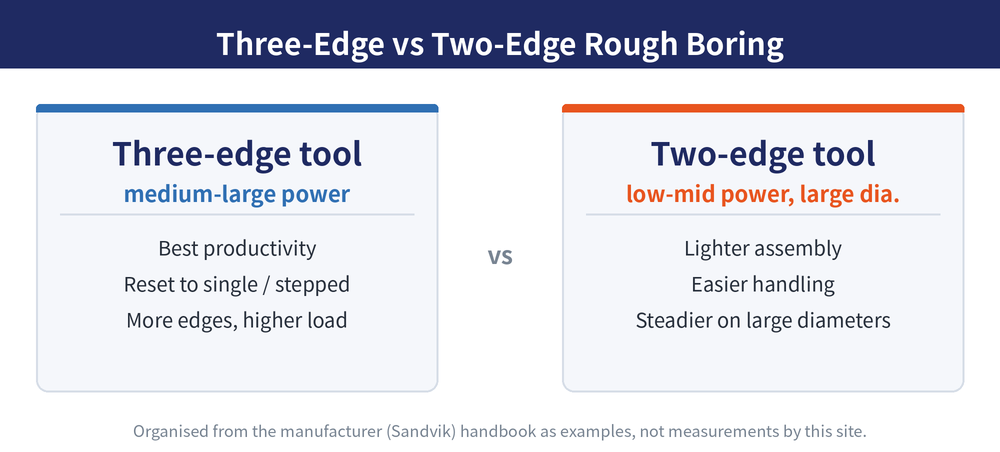
| Item | Three-edge rough boring tool | Two-edge rough boring tool |
|---|---|---|
| Suited machine | Medium-to-large power, first choice for best productivity | Low-to-medium power, unstable operations or large diameters |
| Flexibility | Can also be reset to single-edge and stepped | — |
| Weight and impact | More edges, higher load | Lighter assembly, less impact, easier handling, steadier on large diameters |
There are also dedicated lightweight rough boring tools extending the two-edge weight advantage — bore large diameters stably without adding tool weight; for long overhang, a dampened rough boring tool is available (see section 6).
4. Slide rake: positive or negative
A rough boring tool's insert slide comes in positive and negative rake, with the trade-off below:
| Slide type | Suited conditions | Notes |
|---|---|---|
| Negative-rake insert slide | Better insert economy in stable conditions; demanding jobs needing a strong insert and high process safety | Interrupted cutting, sand inclusion, overlapped boring; often through holes only |
| Positive-rake insert slide | Lower cutting force, an advantage in rough boring | A small point angle and small nose radius help keep the force low |
In short, stable stock wanting a durable, economical insert leans negative; wanting to cut cutting force, power and vibration load leans positive. In stable conditions, adding a Wiper insert can buy a higher feed rate or a better finish.
5. Entering angle: the tug-of-war between axial and radial force
The entering angle (lead angle) is easily overlooked yet directly drives vibration. The manufacturer rule: a larger entering angle (smaller lead angle) produces a larger axial force; a smaller entering angle (larger lead angle) produces a larger radial cutting force.
A boring bar is a cantilever with poor lateral rigidity, and radial force is the main driver of vibration and deflection, while axial force runs along the bar with far less effect. So boring prefers "axial force greater than radial force," and a smaller entering angle — with its large radial force — tends to trigger vibration.
6. Overhang and damping: remember the "4×" threshold
However well the tool is chosen, too much overhang still vibrates. The manufacturer's easy threshold: once overhang exceeds 4× the interface diameter, switch to a dampened rough boring tool. This 4× threshold matches fine boring and milling — a cross-operation warning value for overhang.
The "switch to a dampened tool once overhang exceeds 4× the interface diameter" figure and the specific entering-angle values (such as 84°, 90°, 95°) are general recommendations and catalogue examples from the manufacturer (Sandvik) handbook, not a measurement by this site; they vary with workpiece, machine and material, so follow the manufacturer's specification when selecting.
Before that, keep the overhang short, the adapter diameter large, and use a tapered adapter to raise rigidity and suppress vibration. For the boring bar's own model, specification and dimension selection, see the boring bar model guide: ISO boring bar selection and specifications.
Last updated: 2026-07-26
7. Frequently Asked Questions (FAQ)
Q: Should I choose a two-edge or three-edge rough boring tool?
It depends on machine power, hole diameter and process stability. A medium-to-large power machine chasing the highest productivity takes a three-edge tool (which can also be reset to single-edge or stepped for the most flexibility); a low-to-medium power machine, an unstable operation or a large diameter takes a two-edge tool — lighter assembly, less impact, easier handling, steadier. If overhang is long, consider a dampened version.
Q: How do I choose positive or negative rake slides for rough boring?
A negative-rake slide gives better insert economy in stable conditions and suits demanding jobs needing a strong insert and high process safety (interrupted cutting, sand inclusion, overlapped boring, often through holes only); a positive-rake slide has lower cutting force, an advantage in rough boring. Lean negative for a durable, economical insert on stable stock, lean positive to cut cutting force and power load.
Q: Why does the entering angle affect boring vibration?
The entering angle sets how cutting force splits into axial and radial components: a smaller entering angle produces a larger radial force, and radial force is the main driver of vibration and deflection on a cantilever boring bar, while axial force matters far less. So boring prefers axial force greater than radial force, and a smaller entering angle tends to trigger vibration.
Q: When must I switch to a dampened rough boring tool?
The manufacturer's general threshold: once tool overhang exceeds 4× the interface diameter, switch to a dampened rough boring tool — fine boring and milling use the same warning value. Before reaching it, keep the overhang short, the adapter diameter large, and use a tapered adapter to raise rigidity. The real threshold varies slightly with workpiece, machine and material, so 4× is a starting reference rather than an absolute.
For the full reading guides on this topic, see Insert Selection: A Complete Reading Guide and Vibration and Chatter: A Complete Reading Guide.