
Vibration and Chatter: A Complete Reading Guide
Vibration and chatter span milling, turning, boring and tapping, and this site has 19 articles on reading and damping them. This page is a reading guide. It does not repeat what those articles say; it answers one question: what is vibrating, and which article should you open first.
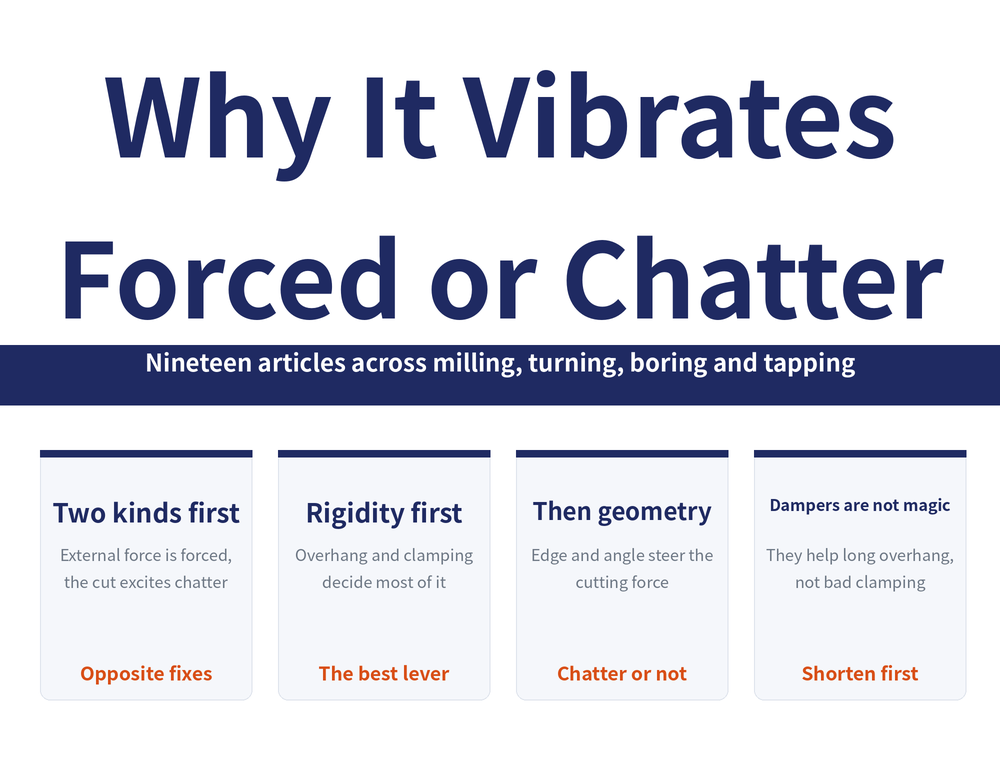
1. Understand Chatter First: What It Is, How to Read It, How to Damp It
First separate forced vibration from an external source and chatter the cut excites itself; the fixes differ entirely.
| Article | When to open it |
|---|---|
| What Milling Chatter Is | The main entry point: forced vibration versus self-excited chatter |
| Anti-Vibration Tool Holder Guide | How a dynamic damper works and seven setup points |
| Face Mill Pitch Selection Guide | Differential pitch is the cheapest way to break up chatter |
2. Rigidity, Overhang and Clamping: The Root of Vibration
Nine times out of ten, start with overhang and clamping rigidity. It is the first and most effective thing to check.
| Article | When to open it |
|---|---|
| Face Milling Clamping Guide | Nine times out of ten, start with overhang and clamping rigidity |
| Fine Boring and Overhang | Double the overhang and the vibration grows several-fold |
| Boring Basics and Methods | The rigidity rules of boring, before you go deep |
| Boring Bar Guide | Long boring bars rely on anti-vibration construction |
3. The Effect of Geometry and Edge
Edge sharpness and angle set the direction of the cutting force, and with it whether the tool chatters.
| Article | When to open it |
|---|---|
| Turning Tool Edge Preparation | Too sharp and it chatters; too dull and the force climbs |
| Turning Tool Lead Angle | Lead angle shifts the force components, and the vibration with them |
| Milling Entry, Exit and Engagement | A swinging engagement angle excites periodic vibration |
4. Vibration in Boring and Roughing
Boring and roughing run at long overhang and high force, where vibration shows up most.
| Article | When to open it |
|---|---|
| Boring Troubleshooting Guide | Point-by-point fixes for boring vibration and feed marks |
| Rough Boring Tool Selection | Rough boring spreads the force across edges and lead angle |
| Boring Chip Control and Coolant | Packed chips also trigger vibration; handle them together |
5. Vibration and Finish in Milling
In milling the chatter is usually written on the surface; read it back from runout and feed.
| Article | When to open it |
|---|---|
| Face Milling Surface Finish | If the surface shows chatter marks, check runout and feed first |
| End Mill Failure Troubleshooting | Vibration and chatter among end mill failure modes |
| Face Milling Troubleshooting Guide | Symptom, cause and fix for face-milling chatter |
6. Vibration in Threading and Tapping
Threading and tapping fear resonance and brittle breakage; read depth and grade together.
| Article | When to open it |
|---|---|
| CNC Thread Cutting Depth Guide | A poor depth split makes single-point threading resonate |
| Carbide Tap Guide | A brittle carbide tap breaks outright once vibration rises |
| Parting and Grooving Troubleshooting | Parting runs at long overhang and vibrates easily; check here |
7. Frequently Asked Questions (FAQ)
Q: Are chatter and ordinary vibration the same thing?
No. Forced vibration comes from an external periodic force such as imbalance; chatter is excited by the feedback between cut and structure. Read What Milling Chatter Is to separate them before choosing a fix.
Q: It vibrates from the start; do I change speed or the holder first?
Check rigidity and overhang first (Section 2). Shortening overhang and stiffening the clamp often beats tuning parameters; only then consider an anti-vibration bar.
Q: Does an anti-vibration bar stop vibration outright?
It is not a cure-all. It targets self-excited chatter at long overhang, but with the wrong clamping, engagement or depth it still vibrates.
Q: A bored hole keeps showing chatter marks, how do I trace it?
Check overhang ratio, edge and chip, in Sections 2, 3 and 4; the Boring Troubleshooting Guide has point-by-point fixes.
Published: 2026-08-11 | Last updated: 2026-08-11