Thread Milling Guide: Helical Feed, Selection & Conditions
A thread mill is a highly flexible internal-thread tool: one cutter can make different diameters and both left- and right-hand threads, greatly lowering breakage risk and raising accuracy. Versus a tap, thread milling uses multi-axis control and helical feed, leaving no internal-thread stop line — ideal for precision and high-value parts. This guide covers the principle, differences from tapping, tool selection and cutting conditions (reference).
1. Core Advantages
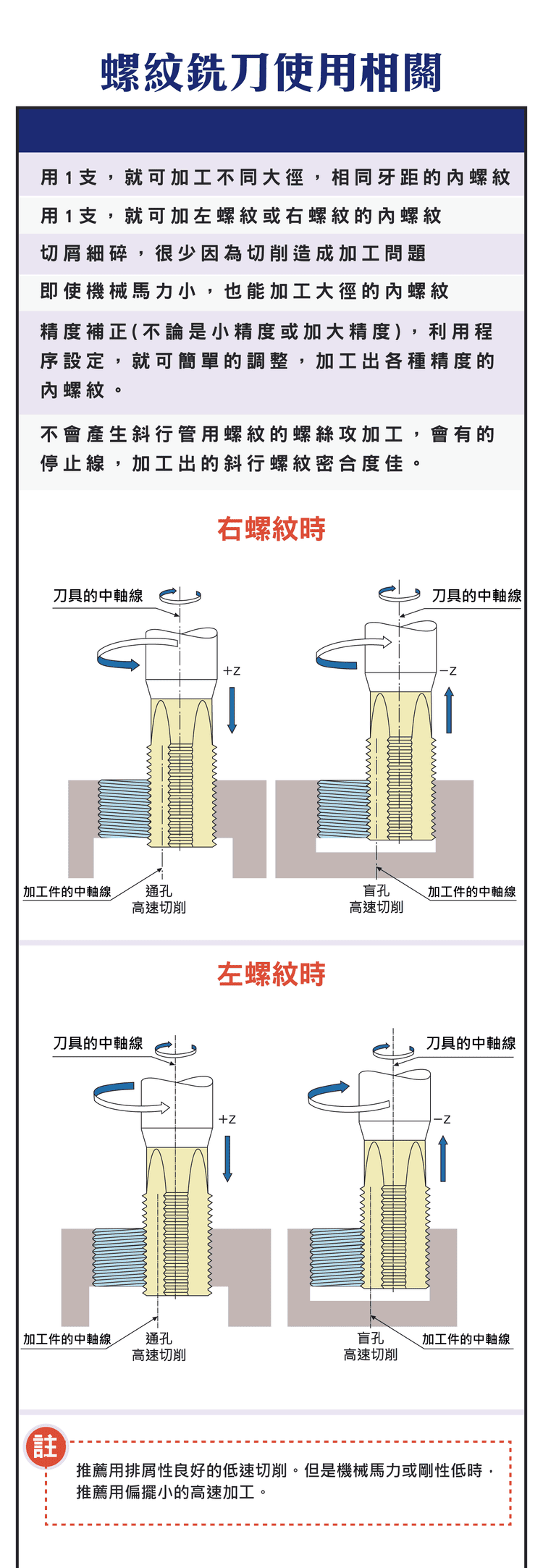
| Advantage | Description |
|---|---|
| One tool, many diameters | Same cutter makes several diameters (same pitch) |
| Left or right hand | The CNC program sets direction; one tool cuts both |
| Small chips | Less clogging, steadier evacuation |
| Large diameters on low power | Progressive cutting suits low-power machines on big diameters |
| Program compensation | Thread accuracy adjustable via radius offset |
| No stop line | Helical feed leaves no stop line; tight fit, stable surface |
2. Thread Milling vs Tapping
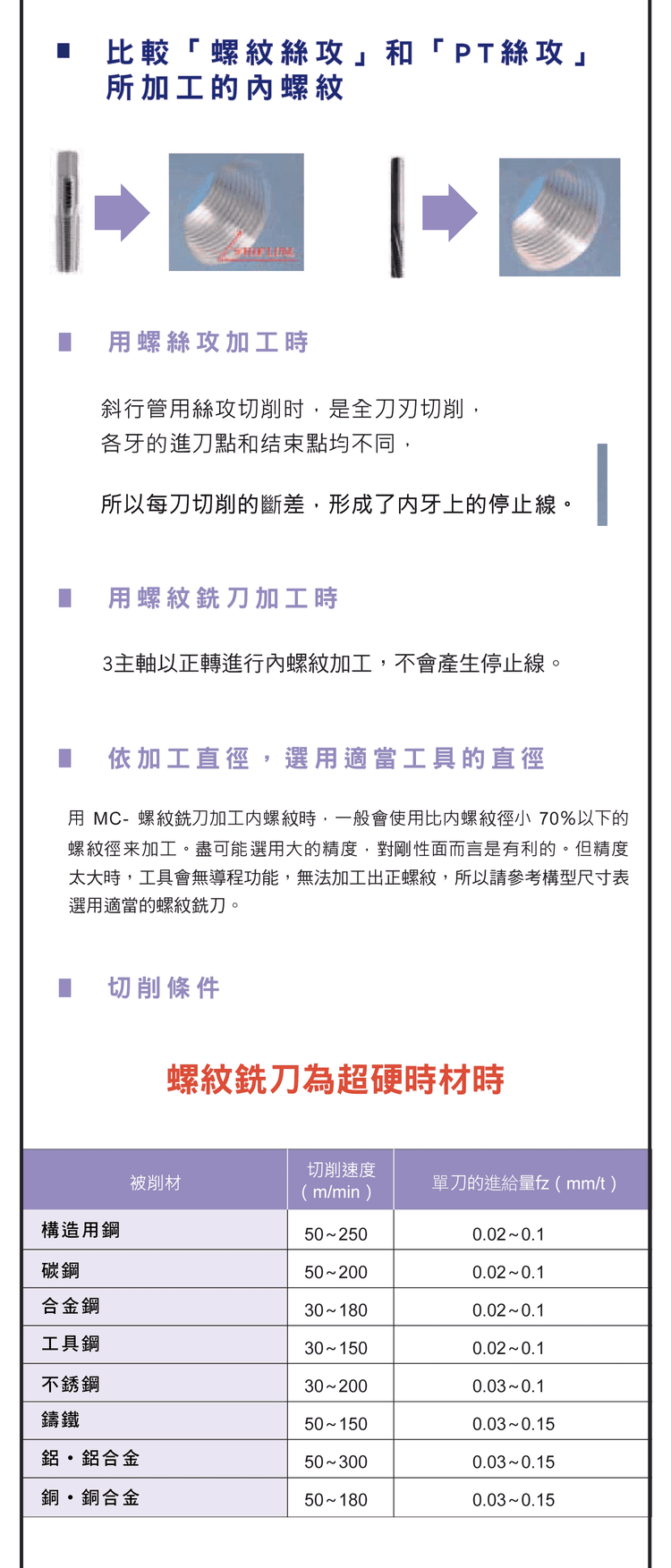
| Item | Tap | Thread mill |
|---|---|---|
| Cutting | Full-edge contact | Helical feed, progressive |
| Stop line | Prone to internal stop line | None |
| Breakage risk | Higher | Lower, more stable |
| Best for | Fast work, standard threads | Precision, high-value parts, big diameters |
3. Hand of Thread and Tool Selection
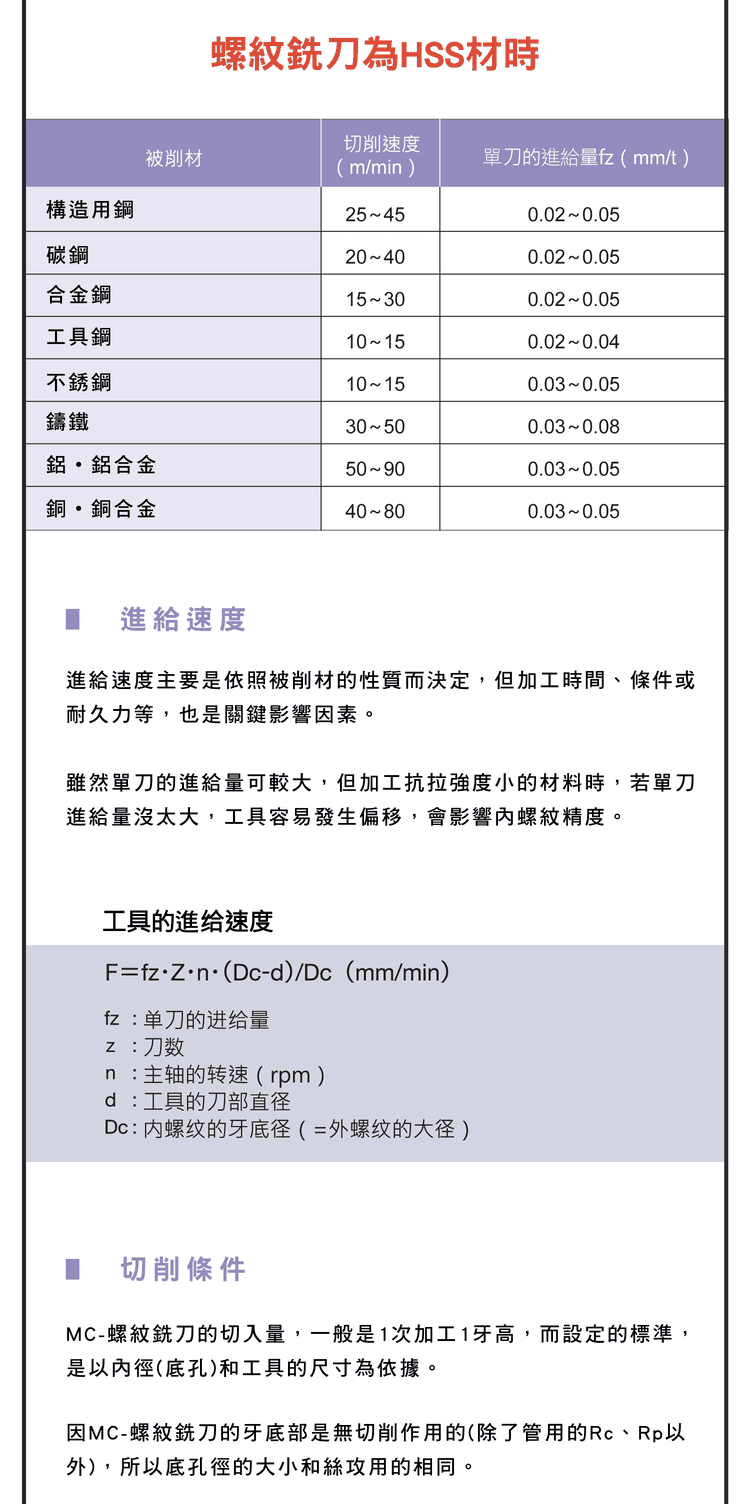
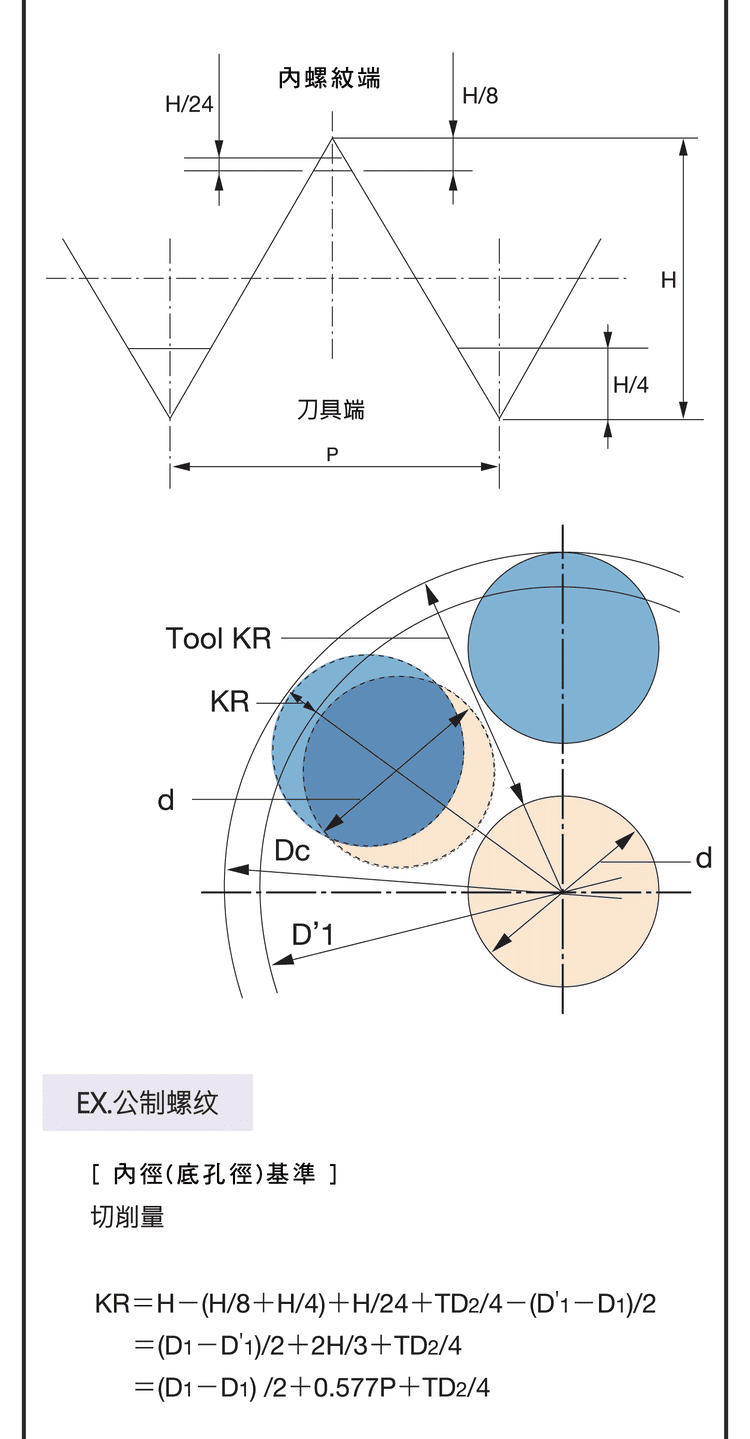
Right-hand threads turn clockwise, left-hand counter-clockwise, with opposite feed, all set by the CNC program — one tool cuts both. Tool-diameter rule:
| Rule | Description |
|---|---|
| Tool dia < 70% of thread dia | Raises rigidity, keeps cutting space, avoids interference |
| Tool dia too large | Cannot form a complete thread |
4. Cutting Conditions (Reference)
Reference cutting-speed ranges for a carbide thread mill; follow the tool maker's catalog for actual values:
| Material | Cutting speed (ref., m/min) |
|---|---|
| Structural steel | about 50–250 |
| Carbon steel | about 50–200 |
| Alloy steel | about 30–180 |
| Stainless | about 30–200 |
| Cast iron | about 50–150 |
| Aluminium alloy | about 50–300 |
Feed per tooth about 0.02–0.15 mm/t (reference); carbide runs at roughly 3-6 times the HSS speed (i.e. HSS is about 1/3 to 1/6 of carbide).
※ These are thread-mill reference values — follow the tool maker's catalog, material and machine; do not apply directly.
5. Selection Advice
Thread mills suit precision, high-value parts, large diameters, deep holes or hard materials where a broken tap is hard to remove, and cases needing left/right flexibility; for standard-thread production where speed matters, a tap is still faster. Confirm pitch, thread diameter and hand, then choose by the diameter rule and material.
For forms and codes see the Thread Designation Chart and Standard Thread Form Guide; for the tool overview see the Thread Tool Chart; for sizes see the Thread Size Chart.
FAQ
Q: Thread mill or tap?
For high precision, big diameters, left/right flexibility, or where a broken tap is hard to remove, choose a thread mill; for standard-thread production focused on speed and cost, a tap is faster and cheaper. Decide by precision, diameter and production type.
Q: Why can one thread mill make several diameters?
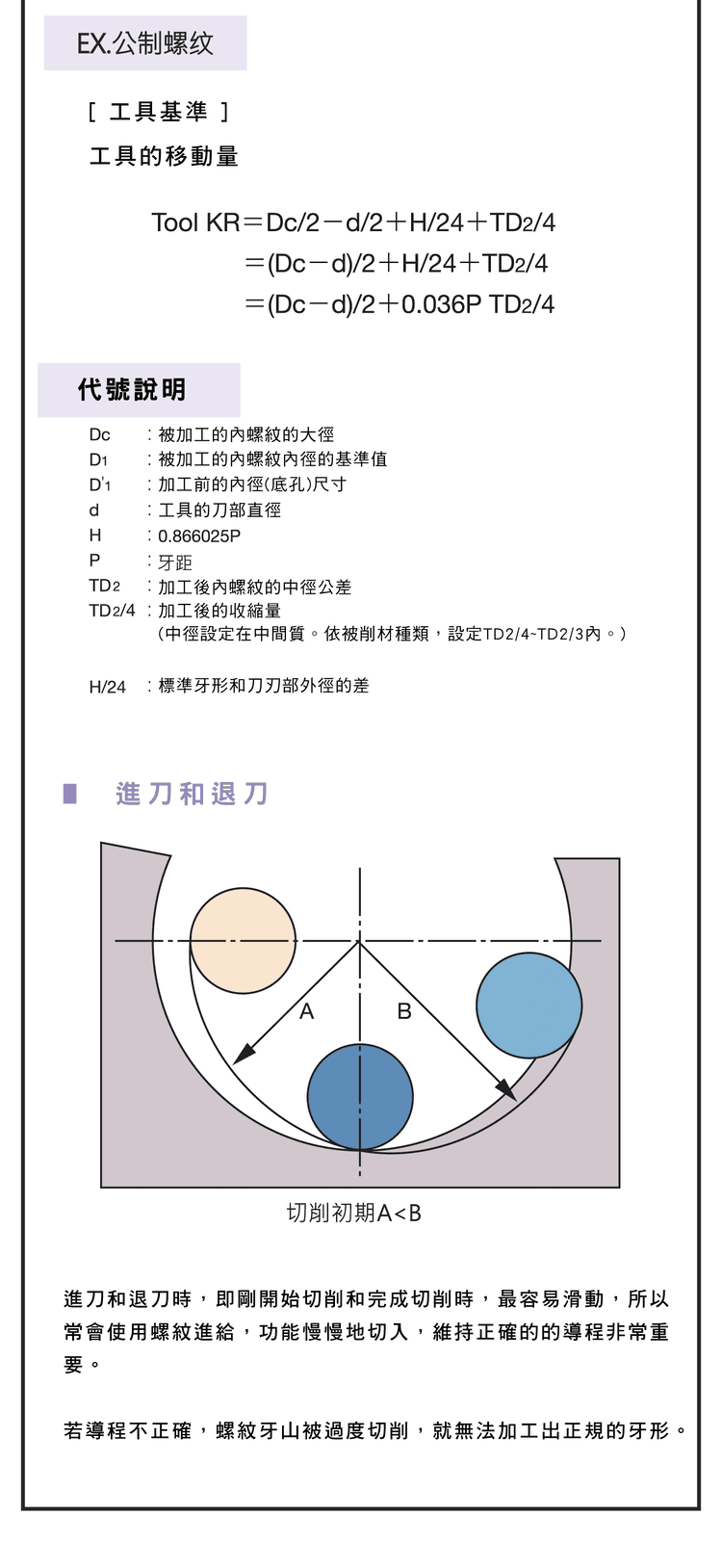
Thread milling traces the thread by CNC helical interpolation: the pitch comes from the cutter's tooth form and the diameter from the program path. As long as the pitch matches, one tool can mill internal threads of different diameters.
Q: How big should the tool be?
Keep the tool diameter below 70% of the thread diameter to preserve cutting space, avoid interference and raise rigidity. Too large can't form a full thread; too small lacks rigidity and takes longer.
Q: What is an internal stop line?
When a tap reverses out, the flank often leaves a joining mark (stop line) that affects fit and appearance. Thread milling forms with continuous helical feed and leaves no stop line, so the thread is smoother and tighter.
Last updated: 2026-07-24
For the full reading guide on this topic, see Thread Machining: A Complete Reading Guide.