Standard Thread Form Guide: Metric, Pipe & Trapezoidal Angles
This guide organizes standard thread forms — metric, Unified (UNC/UNF), pipe (G, R, NPT), bicycle and trapezoidal (Tr, TW) — and explains their thread angles (60°, 55°, 29°, etc.), height ratios and geometry formulas. Understanding the standard form and dimensional relationships supports thread design, tool selection and tapping-parameter setup, a key foundation for CNC machining and mechanical design.
1. Common Thread Forms Compared
| Standard | Angle | Traits and use |
|---|---|---|
| Metric M / Unified UN (UNC/UNF) | 60° | Symmetric V thread; general fastening, CNC, standard taps |
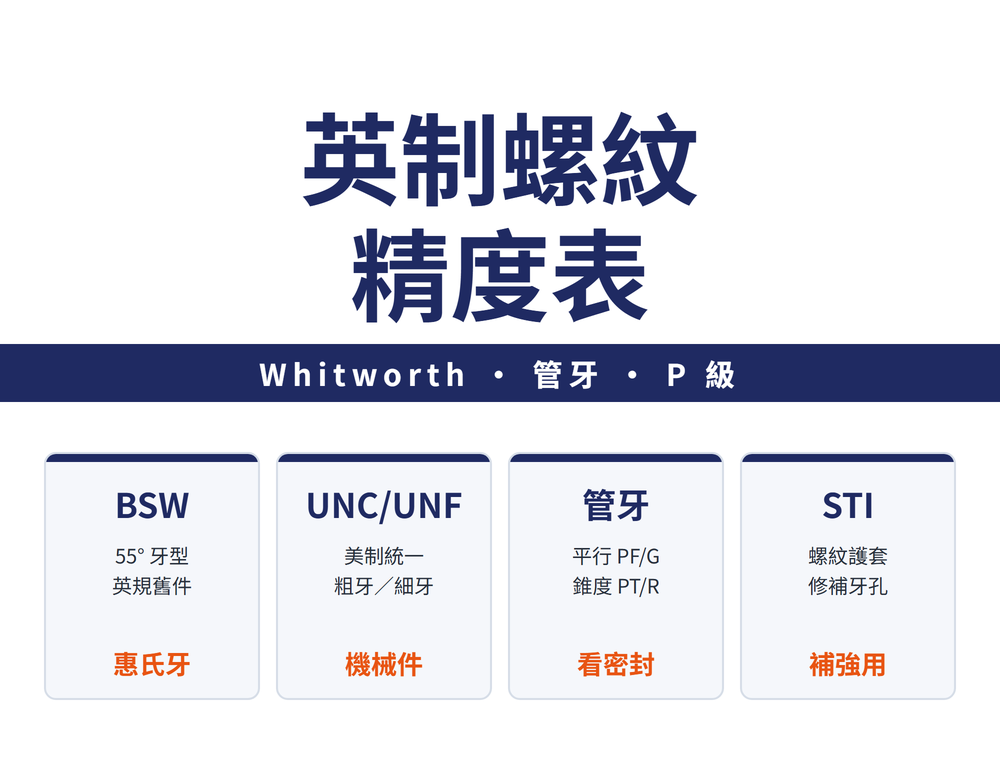
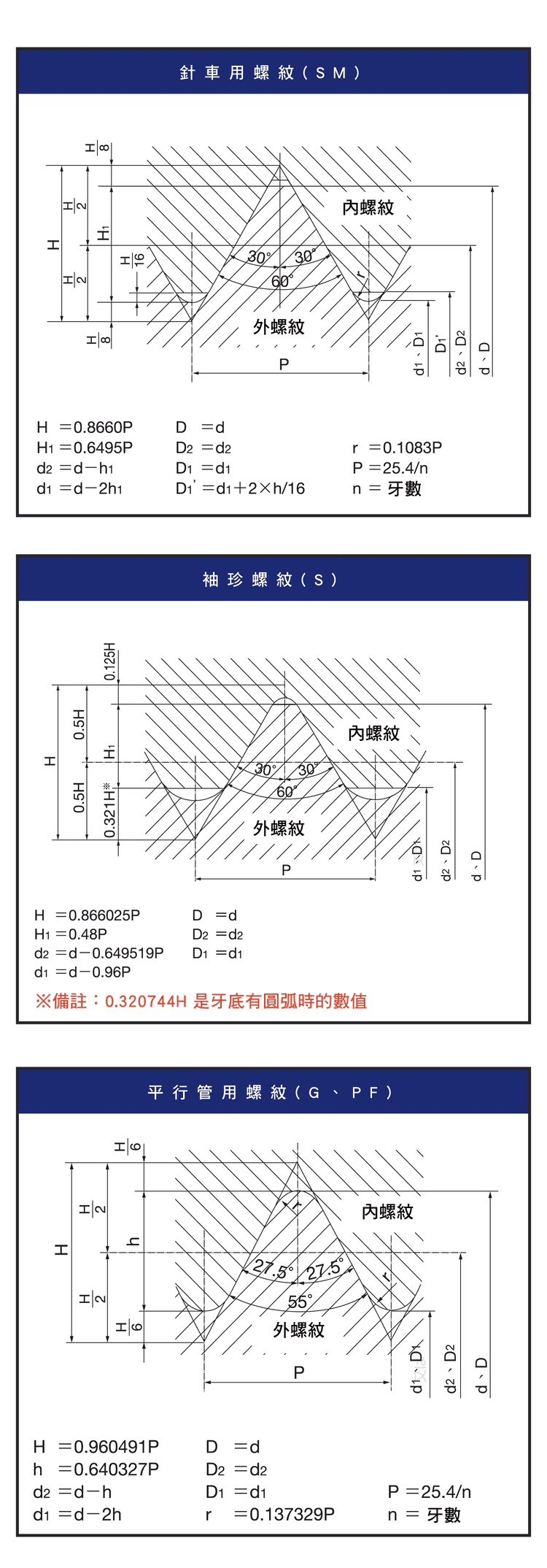
| Whitworth (BSW) | 55° | Rounded crest/root, better sealing; common in pipe threads (27.5°×2 = 55°) |
| Pipe NPT / R / G | 55° or 60° | Taper (NPT) for sealing and fluid systems; piping, pneumatic/hydraulic |
| Trapezoidal Tr (metric) | 30° (15°×2) | Power transmission, high load; slides and lead screws |
| Trapezoidal TW / Acme (US) | 29° | US transmission thread; low friction, high efficiency |
| Bicycle SM / Bearing S | 60° / rounded root | Special size ratios; bearing thread rounded root boosts durability and load |
2. Geometry of the 60° V Thread
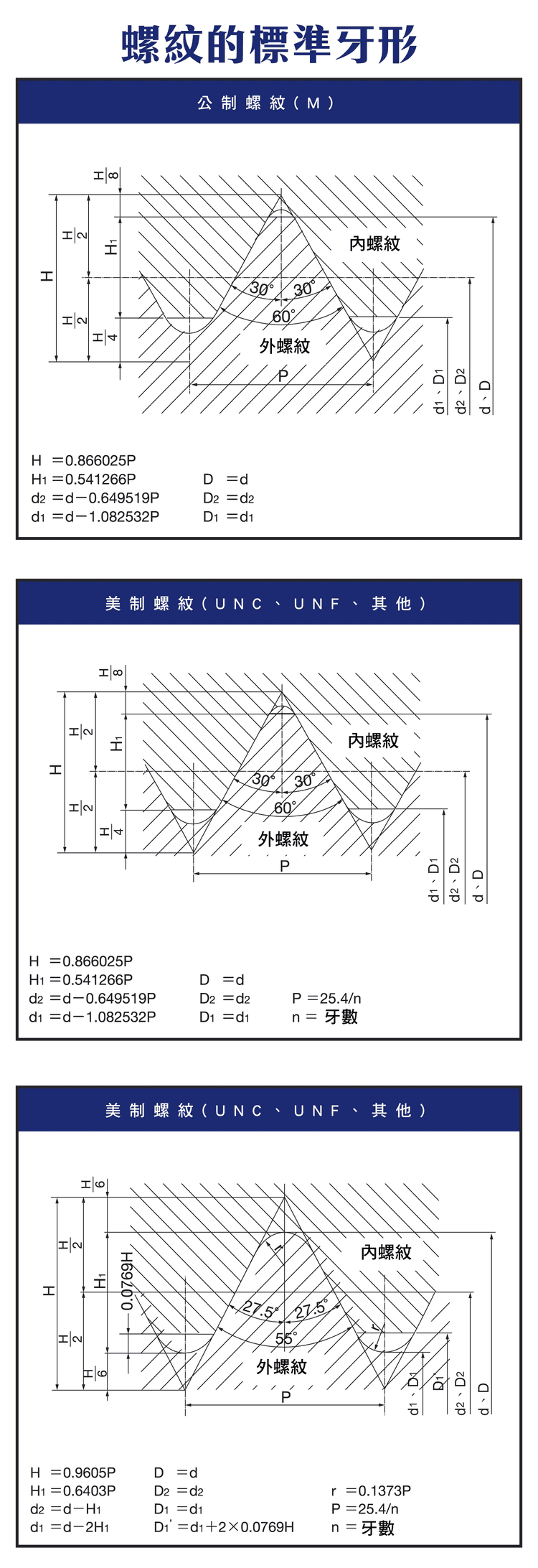
Metric and Unified threads are both 60° symmetric V forms; height scales with pitch. Common relationships (P = pitch):
| Item | Relation | Note |
|---|---|---|
| Fundamental height H | H = 0.866 × P | Theoretical height before truncation |
| Working height H1 | H1 ≈ 0.541 × P | Effective height after truncating crest/root |
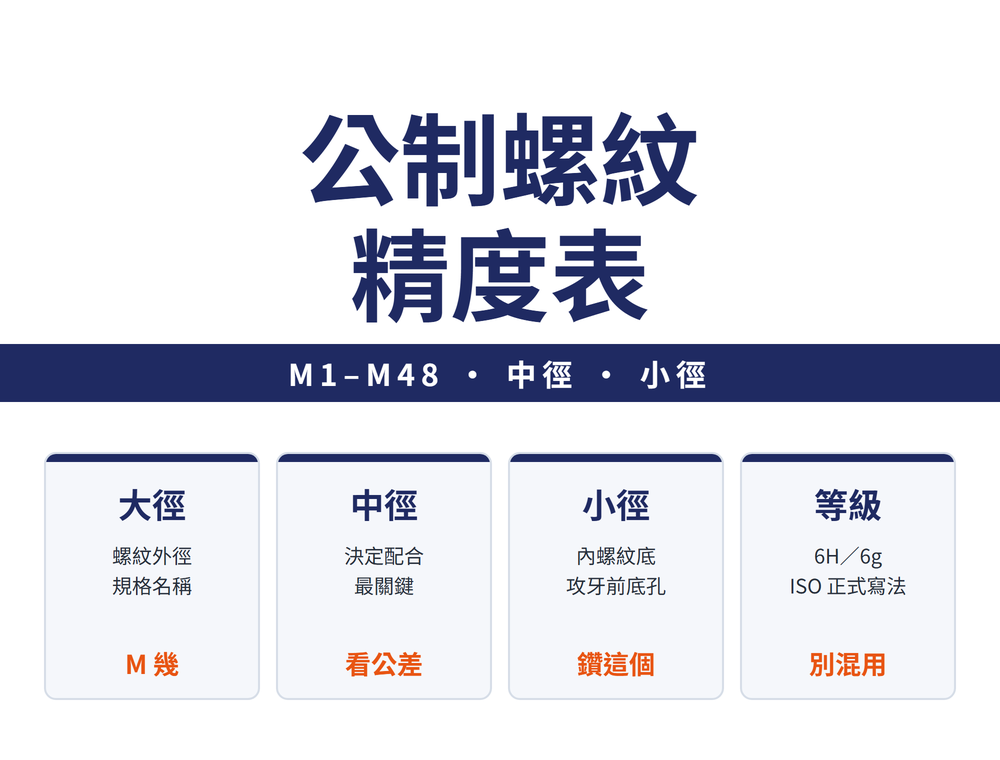
| Major / pitch / minor dia | d, d2, d1 | From major dia and pitch; sets fit and pilot hole |
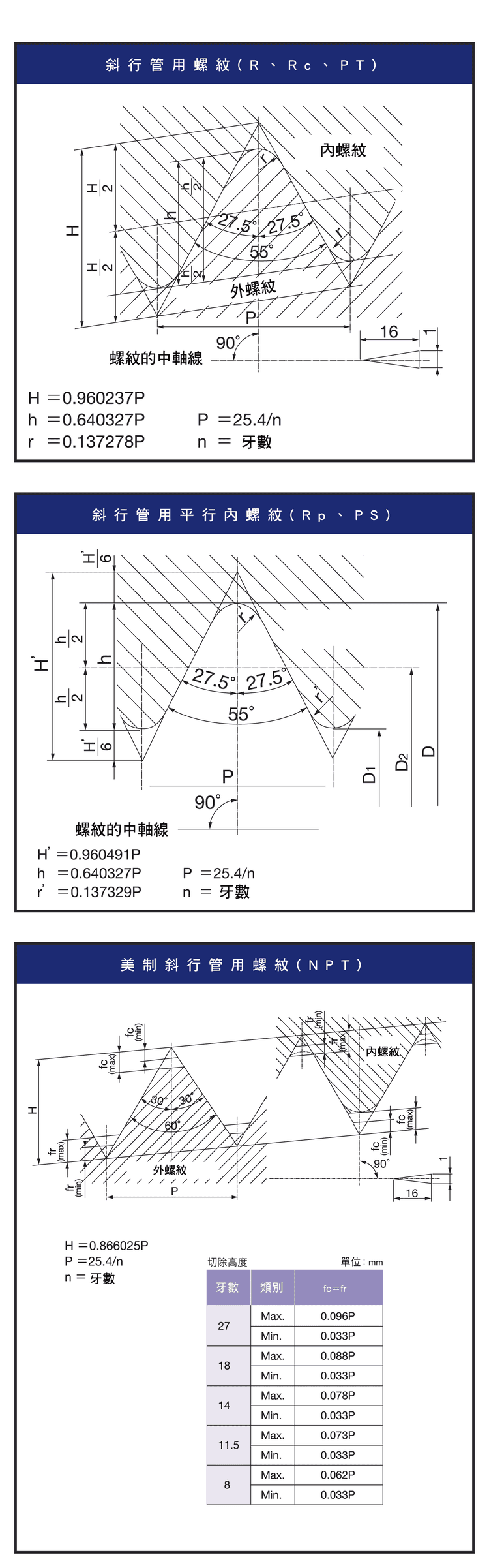
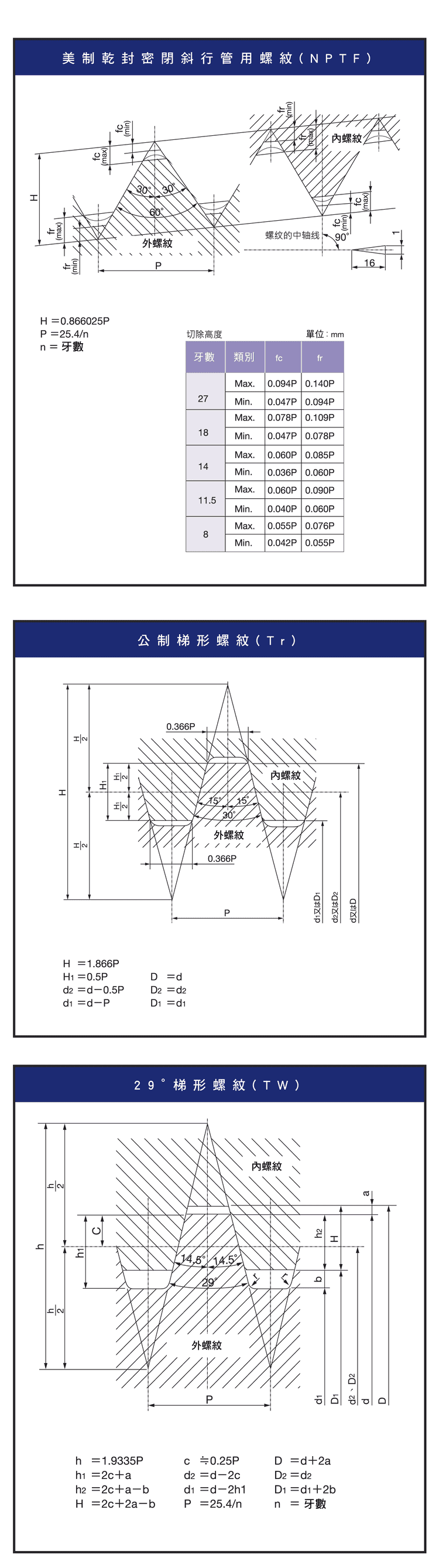
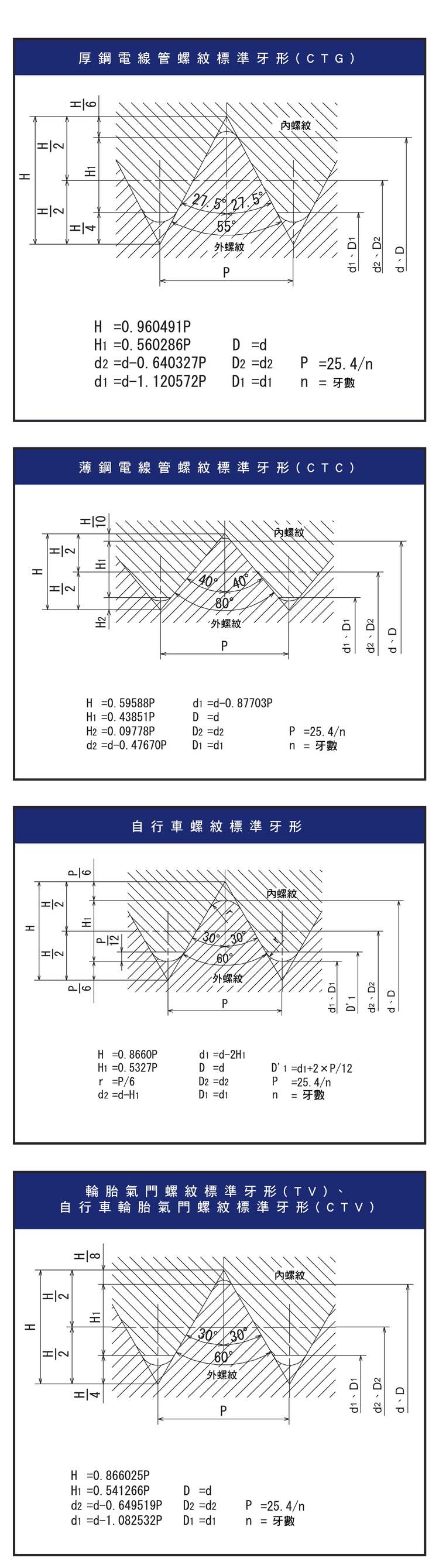
※ Full form drawings above; detailed geometry per the original images.
3. Form and Machining
The thread angle and form set both the fit and the required tool: 60° V threads use standard metric/Unified taps and dies; 55° pipe threads focus on sealing; trapezoidal threads serve transmission and need dedicated tooling. After choosing the form, check pitch, TPI and tolerance by standard.
For thread codes see the Thread Designation Chart; for pitch and TPI see the Thread Size Chart; for tolerances see the Metric / Unified / Imperial charts.
FAQ
Q: Are metric and Unified thread forms the same?
The angle is the same 60° symmetric V, but metric uses mm pitch while Unified uses threads per inch (TPI). The size systems differ and are not interchangeable — confirm metric vs Unified before designing or tapping.
Q: Why do pipe threads often use 55°?
The 55° Whitworth form has rounded crest and root; combined with a taper (e.g. NPT/PT) it improves flank contact and sealing for piping and fluid systems. Some US pipe threads use 60°.
Q: How do trapezoidal threads (Tr, TW) differ from V threads?
V threads (60°) are for fastening; trapezoidal threads (Tr 30°, TW/Acme 29°) have a flatter form, high load and low friction for transmission (lead screws, slides). Their use and tooling are entirely different.
Q: What does H = 0.866P mean?
It's the theoretical height of a 60° V thread — H is the fundamental (un-truncated) height and P is pitch; the working height is about H1 ≈ 0.541P. These relations are used to derive pitch, minor diameter and pilot-hole size.