Reading Variable Pitch and Helix: Angular Pitch, Hand and Three Term Traps
A cutter labelled variable helix may be one of two completely different designs, and a cutter labelled right hand may not be the right hand you assume. This guide explains how to read angular pitch, pitch classification, helix angle and hand, and points out the three terms most often misread.
1. Angular Pitch: Start With 360 Divided by z
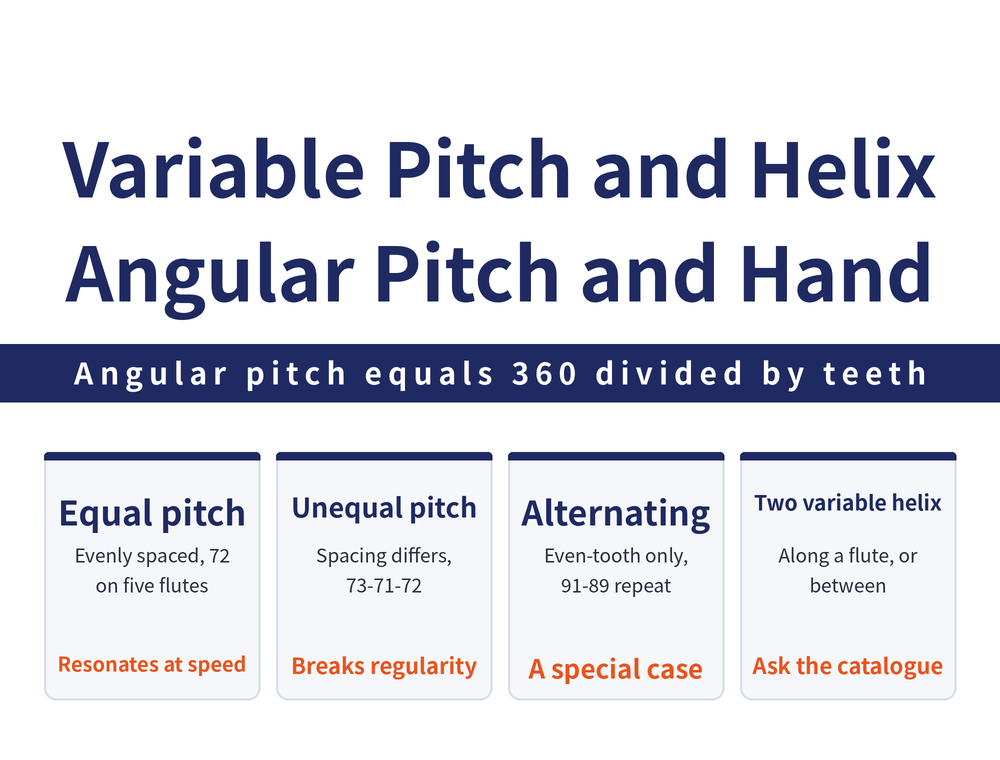
Angular pitch is the arc distance between corresponding points on two neighbouring teeth, measured about the tool axis. When teeth are evenly distributed the arithmetic is simple: φ = 360° ÷ z, where z is the number of teeth. A five-flute cutter therefore has 72° between teeth.
By tooth density, cutters are classified as coarse, fine and extra fine — also called high-density mills. Note that the naming varies between manufacturers: some use coarse-regular-fine, others normal-close-extra close. When reading a catalogue, check that maker's own definition rather than relying on the label alone.
2. Equal, Unequal and Alternating Pitch
| Pitch type | How teeth are spaced | Purpose |
|---|---|---|
| Equal pitch | All teeth evenly spaced, 72° each on five flutes | Simple structure, but resonates at certain speeds |
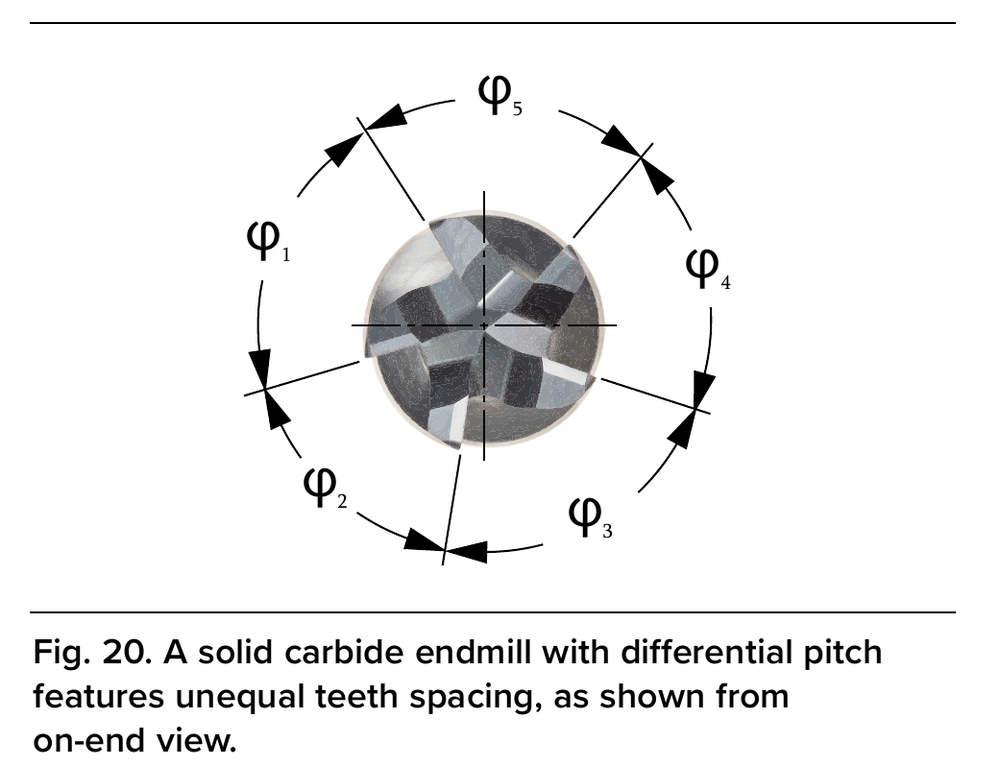
| Unequal pitch | Spacing differs tooth to tooth, such as 73-71-72-73-71° | Deliberately breaks regularity to damp chatter |
| Alternating pitch | Even-tooth cutters only, repeating every other tooth, such as 91-89-91-89° | A special case of unequal pitch, simpler to manufacture |
Unequal pitch actually violates the axial symmetry principle of a cutting tool. That is a deliberate trade — some structural regularity is given up in exchange for dynamic stability. It runs in the opposite direction to balancing design, which pursues symmetry, so "more symmetrical is always better" cannot be applied to every tool.
For the causes of chatter and how to identify it, see What Milling Chatter Is.
3. There Are Two Kinds of Variable Helix
The helix angle determines the inclination of the cutting edge, and with it the direction of cutting force, chip flow, and how gradually the cutter enters the material. A right-hand helix is positive, left-hand negative, and a straight flute is zero. Most endmills are right-hand helix while reamers often use left-hand; designs combining both directions also exist.
The problem is that the term variable helix is used loosely. It actually covers two different designs:
| Design | What it actually is | More precise English term |
|---|---|---|
| True varying helix | The helix angle changes continuously along a single flute | varying helix |
| Different helix combination | Each flute has a fixed angle, but angles differ between flutes | variable helix / different helix |
Both damp chatter, but the geometry is not the same. It is worth asking which one a given tool uses, especially when comparing two catalogues to establish whether they describe the same thing.
4. Helix Hand Is Not Cutting Direction
This is the pair most often assumed to be linked. Hand must be judged by looking at the flute, not inferred from cutting direction.
Viewed from the tool end face, flutes spiralling outward clockwise are right hand (RH); counter-clockwise are left hand (LH). Cutting direction is judged separately: a right-hand cutting tool rotates counter-clockwise to cut, a left-hand cutting tool rotates clockwise.
All four combinations exist: RH cutting with RH helix, RH cutting with LH helix, LH cutting with RH helix, and LH cutting with LH helix. The most common is RH cutting with RH helix, but the other three all have their own applications.
Helix angle and hand influence four things: the proportion of cutting force components, the axial force — that is, whether the tool tends to be pulled into or out of the spindle — whether chips evacuate properly, and the effective rake angle of the cutter itself.
5. More Teeth Is Not Always Better: The Flute Space Cost
More teeth means higher theoretical productivity. The cost is that flute volume necessarily shrinks, and chip evacuation capacity falls with it.
There is also a limit often overlooked on the shop floor: at the same diameter and speed, more teeth demand more cutting power and more feed drive load, which may exceed what the machine itself can deliver. Tool selection has to account for the machine, not only the tool.
In addition, solid endmills — carbide ones in particular — usually run at a higher overhang-to-diameter ratio than indexable tools, and the flutes themselves weaken the cross-section. Vibration therefore deserves particular attention, which is exactly why unequal pitch and variable helix designs exist. On length and deflection see End Mill Length vs Deflection.
6. Serrated Edges and Two-in-One Designs
Serrated roughing endmills use a chip-splitting design to cut a wide chip into short segments, improving evacuation while increasing damping capacity — suitable for high removal rate roughing.
One further design is worth knowing: a two-in-one arrangement in which two of four flutes are serrated for roughing chip control while the other two are continuous for surface quality, letting a single tool reach semi-finish or even finish quality at roughing parameters and saving a tool change.
As a side note, most solid carbide endmills do not exceed 25 mm (1 inch) in diameter — a practical economic ceiling set by material cost, above which other tool types are normally used.
7. Frequently Asked Questions (FAQ)
Q: Is an unequal pitch cutter better for every job?
No. It trades structural regularity for dynamic stability, which helps where chatter is likely but is not worth paying for in stable cutting.
Q: The catalogue says variable helix — which kind is it?
Ask. It may vary continuously along one flute, or each flute may be fixed but differ from the others. The geometry is not the same.
Q: How do I tell right-hand from left-hand helix?
Look at the flute from the end face: spiralling outward clockwise is right hand, counter-clockwise is left hand. Do not infer it from cutting direction.
Q: What separates alternating pitch from unequal pitch?
Alternating pitch is a special case of unequal pitch, applicable only to even-tooth cutters, where the pitch value repeats every other tooth, such as 91-89-91-89 degrees.
This article is part of End Mills: The Complete Guide - Know the Cutter, Choose It, Set the Conditions; Toolpaths Are Another Line; that guide shows how the whole topic fits together.