What Is Milling Chatter: Causes, Diagnosis and Suppression
When a milling cutter starts vibrating, the machined surface shows regular wavy tool marks accompanied by a harsh screeching noise - this is chatter. The first thing to understand is that chatter is not a machine fault: it is inherent to milling, because the teeth cut in and out one after another and the cutting force naturally fluctuates. This article explains in plain terms why chatter feeds on itself and gets worse, and how it can be suppressed from the cutter side through geometry, chip-splitting edges, internal dampers, and tool body material.
1. Why Chatter Gets Worse on Its Own
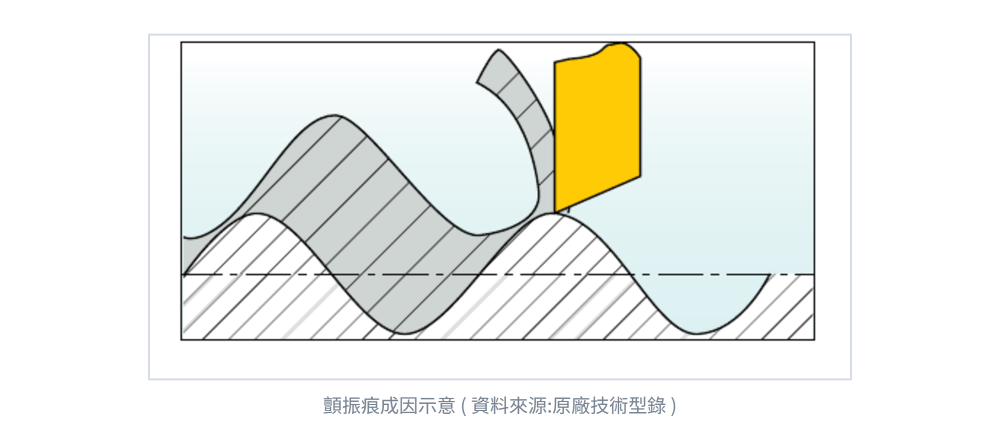
The troublesome part of chatter is that it amplifies itself. A vibrating tool leaves a ring of waviness on the workpiece surface; on the next pass the cutting edge lands right on that waviness, the chip thickness fluctuates, the cutting force is amplified again, and the vibration grows with every revolution. This self-feeding behaviour is called self-excited vibration, which is why chatter usually escalates suddenly instead of dying out.
2. Suppressing Chatter Without Just Slowing Down
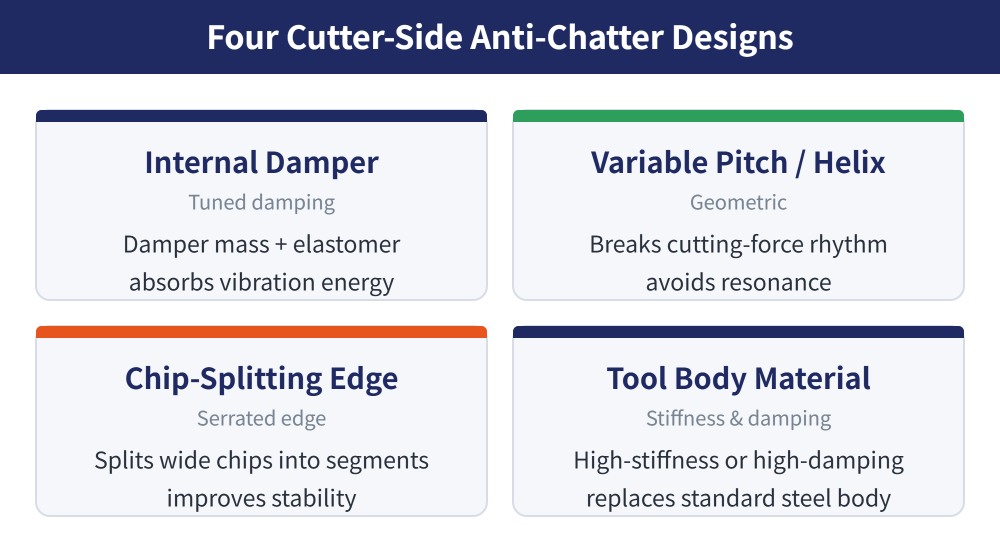
The most intuitive shop-floor fix is lowering speed and feed. It works, but it directly sacrifices productivity. The cutter itself offers four design approaches that can suppress chatter without always paying that price; for how to set speed and feed, see the End Mill Cutting Conditions Guide:
| Method | What it actually does | Best for |
|---|---|---|
| Internal damper | A damping mass hidden inside the holder absorbs the vibration energy | Long-overhang boring, deep cavities |
| Variable pitch / variable helix | Unequal tooth spacing breaks the rhythm of the cutting force and avoids resonance | Solid carbide end mills |
| Chip-splitting (serrated) edge | Splits one wide chip into small segments, reducing force fluctuation | Round-insert cutters, large overhangs |
| Tool body material | Replaces the standard steel body with a stiffer or better-damping material | Light-to-medium cuts under unstable conditions |
3. How an Anti-Vibration Holder "Absorbs" Chatter
Inside an anti-vibration holder sits a damper mass supported by elastomer elements. Its natural frequency is tuned close to the tool's own natural frequency, so the mass swings in counter-phase and soaks up the tool's vibration energy - a tuned damping mechanism. Longer overhang chatters more easily; on the relationship between tool length and stiffness see the End Mill Length vs Deflection guide, and for workpiece-side rigidity and clamping see the Face Milling Clamping Guide. The figure below shows how the tool leaves waviness on the surface and is re-excited by it on the next pass:
4. Summary
Chatter is inherent to milling; the goal is to keep it within an acceptable range, not to eliminate it. It is self-amplifying, so it escalates suddenly once it starts. You are not limited to lowering speed and feed - variable pitch/helix, chip-splitting edges, internal dampers, and body material are four cutter-side levers; for long overhangs and deep holes, consider a tuned anti-vibration holder first.
Last updated: 2026-07-24
FAQ
Can chatter be eliminated completely?
No. Cutting-force fluctuation is inherent to milling. What you can do is keep vibration below the level that affects the machined surface, rather than chase zero vibration.
Why does a longer overhang chatter more easily?
The longer the overhang, the more the tool behaves like an extended fishing rod - stiffness drops and it sways more easily. Round-insert cutters are especially affected once the overhang exceeds three times the cutter diameter; switch to an anti-vibration holder or chip-splitting inserts in that case.
Is lowering speed and feed enough?
It works and is the most common shop-floor fix, but it sacrifices productivity. If the same part chatters repeatedly, addressing cutter geometry, the holder, or the body material pays off better than permanently running reduced parameters.
Is all vibration harmful?
No. Oscillation cutting deliberately adds a small oscillation to break chips actively, which is useful in turning and drilling. Vibration itself is neutral - what damages machining is uncontrolled chatter.
For the full reading guide on this topic, see Vibration and Chatter: A Complete Reading Guide.
This article is part of End Mills: The Complete Guide - Know the Cutter, Choose It, Set the Conditions; Toolpaths Are Another Line; that guide shows how the whole topic fits together.