
Edge Preparation After Regrinding: Land Width, What to Use, and What to Check
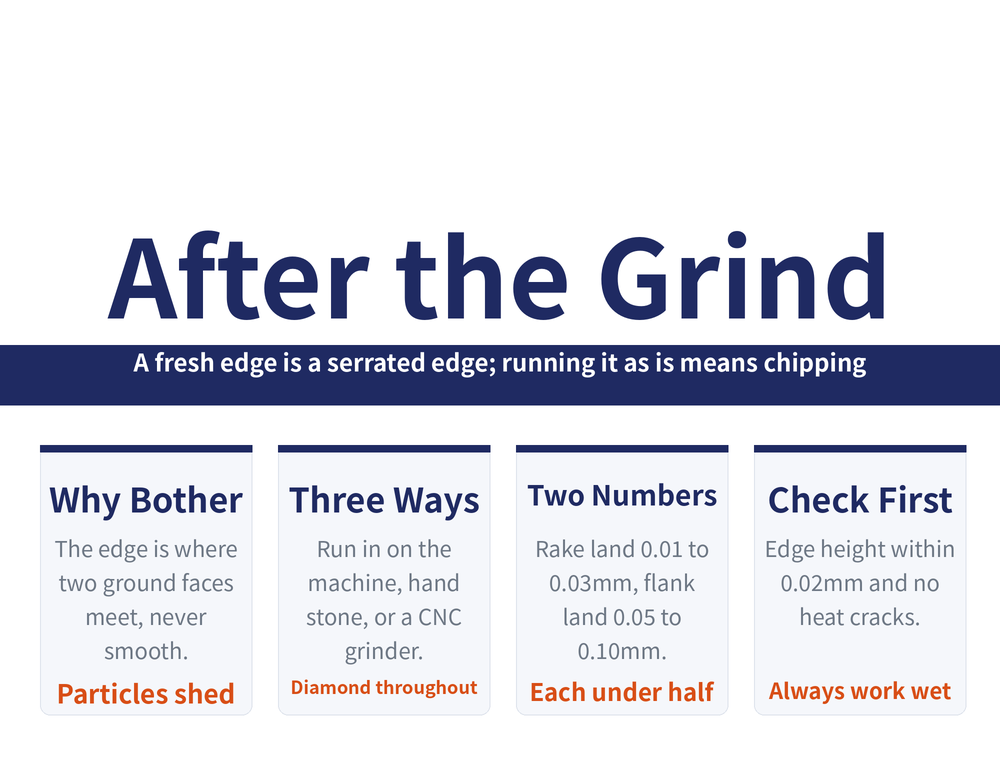
A freshly ground tool is not ready to run. The edge always carries fine serrations, and putting it straight to work invites chipping. This guide covers edge preparation done by the user: how wide a land belongs on the rake face and on the flank, which diamond consumable and grit to use, and the two things to measure first.
1. Why a freshly ground edge is not ready
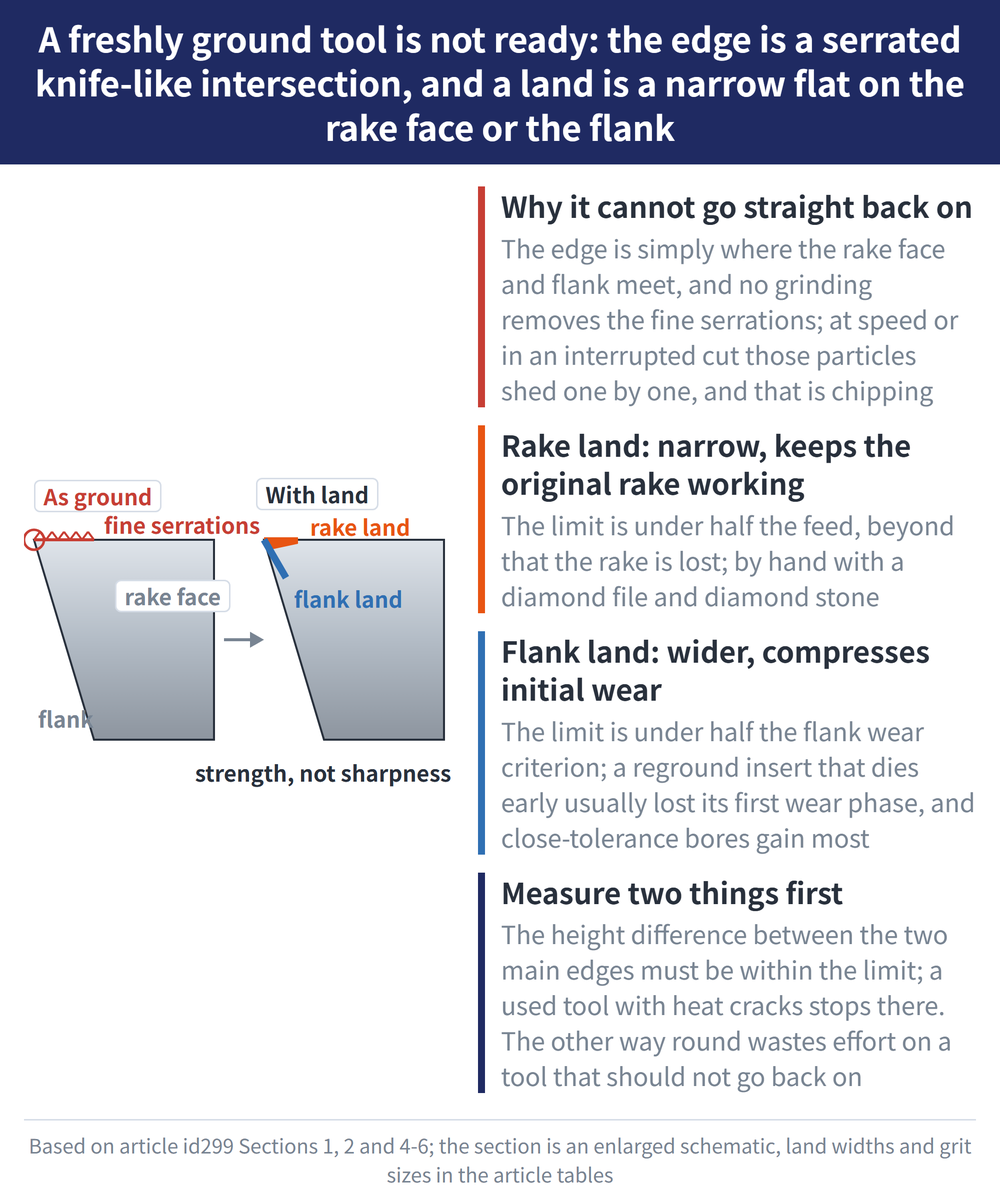
The cutting edge is simply where the rake face and the flank meet. No amount of grinding makes it perfectly smooth, and carbide edges always carry fine serrations. At speed, or in an interrupted cut, the main cutting force sheds those particles one by one — and that is what chipping is. Edge preparation buys strength, not sharpness.
Most tools arrive with the edge already prepared by the supplier. The ones that need the user to do it are the reground ones — turning tools, drills and reamers after resharpening. Grinding the angles themselves is covered in How to Regrind a Turning Tool and How to Regrind Thread Turning Tools; this guide is the step after that.
2. Five things a land does for you
| Effect | Where it comes from |
|---|---|
| Stronger edge | A narrow flat replaces a fragile knife-like intersection |
| Shorter initial wear phase | Steady-state wear starts sooner, so size holds better |
| Less low-frequency chatter | More contact area and flank damping |
| Better surface finish | The land burnishes the machined surface |
| Less built-up edge | A smoother edge gives material less to cling to |
3. Why a reground insert dies before 200 parts
Tool wear runs in three phases, and in the first one the flank wear VB of a reground insert climbs fast, taking the bore size with it. On the same operation a new insert runs 1,000 parts without trouble, while a reground one is already at the lower limit after 100–200.
The fix is to put a land on the flank before the tool goes back on, which compresses that first phase. Close-tolerance bore work is where the gain shows most clearly. Wear patterns themselves are covered in Tool Wear Analysis, and whether regrinding pays in Is Tool Regrinding and Recoating Worth It.
4. Three ways to do it, and what they consume
Tool makers have many methods — vibratory, blasting, tumbling, brushing, PVD treatment — and the resulting edge falls into four states: sharp, rounded, landed, or a combination. A workshop has none of that equipment, so the user's version is a land: a narrow flat worked onto the rake face or the flank.
| Method | How | Consumable |
|---|---|---|
| Run-in on the machine | Cut at reduced feed for a few minutes, then go to normal | None |
| By hand | Land or round the rake face | 140 grit diamond file, 400–800 grit diamond stone |
| CNC grinder | Grind the land on the flank | 250–400 grit diamond wheel |
Edge preparation is normally done wet. The rule on finish is the smoother the better; in practice that means a very fine stone worked to the specified width and kept even along the whole edge.
Stating the gap plainly: the range notation for the feed per tooth and run-in time of the machine method cannot be verified, so those figures are not reproduced here — only the practice of cutting at reduced feed first.
5. How much: two numbers
| Location | Land width | Upper limit | Purpose |
|---|---|---|---|
| Rake face | 0.01–0.03mm | Under half the feed | Keeps the original rake working while strengthening the edge |
| Flank | 0.05–0.10mm | Under half the VB limit | Compresses initial wear; suits close-tolerance bores |
The two limits matter more than the absolute figures: the same tool wants a different land at a different feed or a different wear criterion. Work out the cutting data itself with Turning Cutting Conditions.
6. Measure two things first
| Check | Standard |
|---|---|
| Edge height difference | Between the two main edges (a drill, for example) within 0.02mm |
| Edge defects | A used tool may carry heat cracks; if it does, stop there |
Do it the other way round and you spend the effort on a tool that should not go back on the machine at all.
7. How this differs from the edge preparation guide
The two articles are two layers of the same subject. Turning Tool Edge Preparation Explained is the design layer: honed versus chamfered, and how the amount relates to cutting force and tool life. This one is the shop-floor layer: after you have reground the tool yourself, what to use, how wide, and what to check. Choose with that one, work with this one.
8. Frequently Asked Questions (FAQ)
Q: Isn't edge preparation just dulling the tool?
It trades a sliver of sharpness for strength. Kept under half the feed, the original rake still does its job, but the edge is no longer a fragile intersection of two faces.
Q: Does every reground tool need it?
High speed, interrupted cuts and close-tolerance bore work benefit most. On slow, light or roughing passes the gain is small and you can skip it.
Q: Rake face or flank?
Rake face if chipping is the worry and you want to keep the rake working; flank if you want to compress initial wear and hold bore size. The width rules differ, so do not mix them.
Q: Can 0.01mm really be done by hand?
It comes from the consumable rather than the feel: a 400–800 grit diamond stone, light and repeated, kept wet. Evenness along the whole edge matters more than getting there in one go.
This article is part of Tool Regrinding: The Complete Guide — Decide Whether to Grind, Then Look Up How, With What, and How to Check; that guide shows how the whole topic fits together.
Published: 2026-08-17|Last updated: 2026-08-17









