
How to Regrind Thread Turning Tools: Six Steps, Trapezoidal Roughers and Finishers, and Tool Height
A threading tool is not an ordinary OD turning tool: the included angle, the two side clearance angles and the mounting height all follow their own rules. This guide covers the six regrinding steps for a 60° tool, how trapezoidal roughers differ from finishers, how to pick the insert grade and rake by material, and how to set the tool afterwards.
1. Three routes, not one
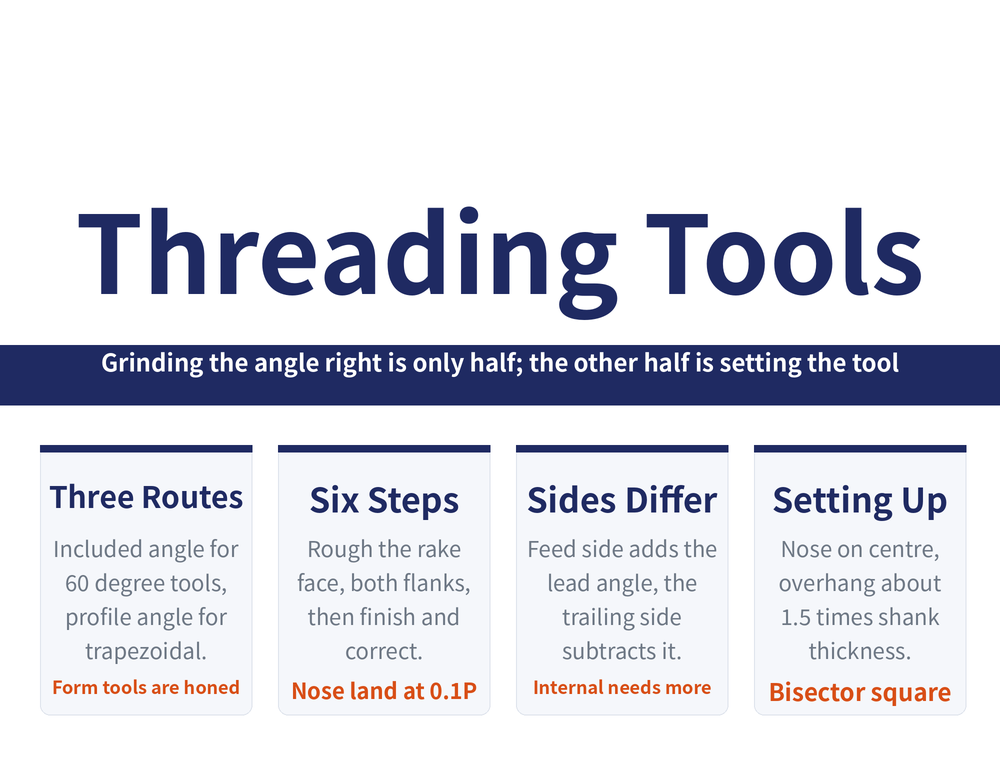
Threading tools are not all reground the same way. A 60° tool is ground to an included angle, a trapezoidal tool to a profile angle and root groove width, and a multi-point form tool is not taken to a wheel at all — it is restored by honing. Profile differences are covered in Thread Profiles Explained, and the whole threading map is in Thread Machining: A Complete Guide.
Machines and stance are the same as for any turning tool — see How to Regrind a Turning Tool. This guide covers only what is specific to threading tools.
2. Fix three angles first
| Angle | Value | Watch out for |
|---|---|---|
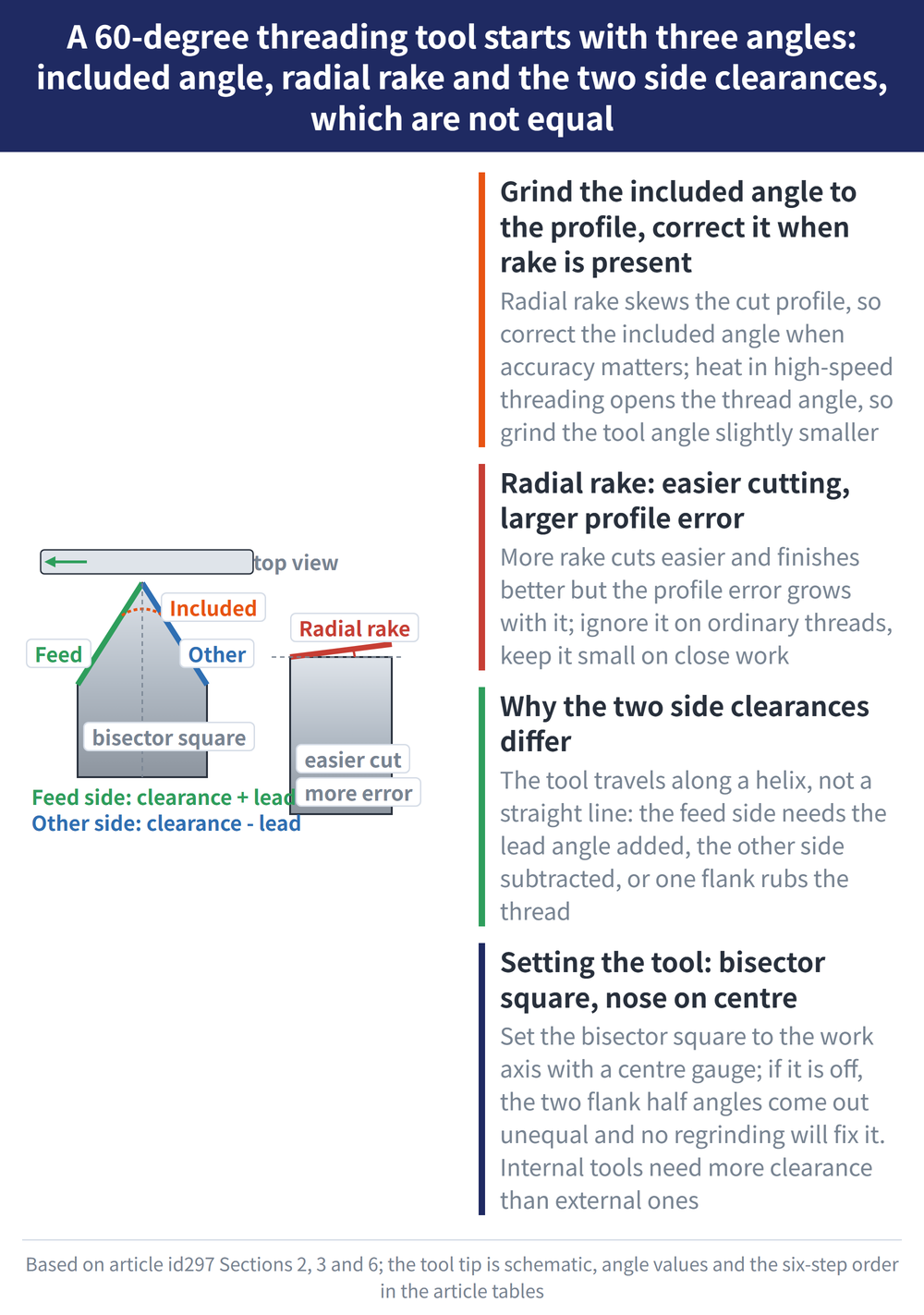
| Included angle | 60° | Radial rake skews the cut profile; correct the angle when accuracy matters |
| Radial rake | 0°–15° | More rake cuts easier and finishes better, but the profile error grows with it |
| Working clearance, both sides | 3°–5° | The two sides are not symmetrical — see below |
Why the two sides differ: the tool travels along a helix, not a straight line. On the feed side the ground clearance is the working clearance plus the lead angle; on the other side it is the working clearance minus it. Calculating the lead angle is covered in Thread Lead Angle and Shim Selection.
3. Six steps, in this order
| Step | What it does |
|---|---|
| 1. Rough the rake face | Get the face flat; leave the angle for the finishing pass |
| 2. Grind both side flanks | Feed side first, then the trailing side; the included angle takes shape |
| 3. Finish the rake face | Form the radial rake |
| 4. Finish the flanks | Measure, then correct the included angle |
| 5. Dress the nose | Land width 0.1P, where P is the pitch |
| 6. Stone the edge | Lap rake and flank faces to keep the edge keen |
Grind HSS threading tools with light pressure and quench often, or the nose anneals. Move the tool slowly and parallel along the edge so it comes out straight; internal threading tools skew easily on the inboard side. Whether the fresh edge needs further treatment is covered in Edge Preparation After Regrinding.
4. Insert grade and rake by material
| Application | Grade as printed | Rake | Notes |
|---|---|---|---|
| High-speed threading | YT15 | 0° | Chips come off ball-shaped and break well |
| Softer steels | YT14 | 4°–6° | Low carbon grades |
| Brittle materials | YG8, YG6 | 0° | Cast bronze, cast aluminium, cast iron |
| Harder steels | YT15 | 3° | Above 2mm pitch, add a negative land on both side edges; not required at 2mm and below |
| Rough and finish | YT15 | — | Chip groove about 1–1.5mm deep, nose clearance 0° |
YT grades are tungsten-titanium-cobalt and map to ISO P (steel); YG grades are tungsten-cobalt and map to K (cast iron and non-ferrous). Reading grades is covered in Carbide Grades Decoded and Insert Material Codes Explained. One more rule: at high speed the workpiece heats and the thread angle opens, so grind the included angle 1°–2° small.
5. Trapezoidal tools: profile angle and groove width
A trapezoidal tool is not a 60° tool with a different number. Both side edges must be symmetrical and the body square; with radial rake you need a thicker centre gauge to correct it. The usual route is to cut the groove square with a narrow parting-type tool first, then form the flanks with the trapezoidal tool.
| Item | Rougher | Finisher |
|---|---|---|
| Included angle | About 29°, leaving finishing stock | 30°, checked against the centre gauge |
| Left edge side clearance | 8°–10° | Same as rougher |
| Right edge side clearance | 3°–5° | Same as rougher |
Actual values follow the hand of the thread and the lead angle. Do not stone the faces if you are new to it — it is easy to create negative clearance. On an internal trapezoidal tool the bisector must be square to the shank.
6. Setting the tool: height and overhang
| Item | Standard threading tool | High-speed threading tool |
|---|---|---|
| Nose height | On the spindle axis, checked against the tailstock centre | M16–M30: 0.5–0.8mm high; M36–M42: 1–1.5mm high |
| Overhang | About 1.5× shank thickness (25–30mm) | Only the cutting portion clear of the holder |
| Orientation | Bisector square to the work axis, set with a centre gauge | As left |
If the bisector is off, the two thread flank half angles come out unequal — that is a setting fault, and no amount of regrinding will fix it. Internal threading tools need more clearance than external ones, and on deep bores above a 5:1 depth ratio shank rigidity decides everything; otherwise you get chatter and drifting size, as in Thread Machining Troubleshooting.
7. Multi-point form tools: restored by honing
Carbide multi-point thread form tools are not taken to a grinding wheel. A cast iron lap wheel is threaded first, the insert is shimmed to height, aligned and clamped, and the wheel is run in reverse against the tooth form while honing compound (200 grit silicon carbide powder mixed with cutting fluid into a paste) is applied. Restoring one insert takes a single-segment wheel and roughly 3–5 minutes; forming a blank insert takes 2–3 segments and about 15 minutes. Honed faces reach Ra6.3µm or better.
Stating the gap plainly: the figure attached to “take less radial rake when finishing” contradicts the 0°–15° given in the same paragraph, so it is not quoted here; the lap wheel speed carries an irregular unit and is likewise omitted. Work out real cutting data for your material and machine using Turning Cutting Conditions.
8. Frequently Asked Questions (FAQ)
Q: Why are the two side clearance angles ground differently?
Because the tool follows a helix. The feed side needs the lead angle added and the other side needs it subtracted, so both flanks clear the work instead of rubbing.
Q: More radial rake cuts better, so why limit it?
Rake makes the cut profile deviate from the ground included angle. On ordinary threads you can ignore it; on close-tolerance work you must correct the included angle to compensate.
Q: Why is a high-speed threading tool set above centre?
The shank deflects downward under load, so setting it high brings the nose back to centre while cutting. Larger threads need more: M36–M42 sits 1–1.5mm high.
Q: Why grind a trapezoidal rougher at 29° rather than 30°?
To leave finishing stock. A small gap against the template is normal on the rougher; only the finisher must measure a true 30°.
This article is part of Tool Regrinding: The Complete Guide — Decide Whether to Grind, Then Look Up How, With What, and How to Check; that guide shows how the whole topic fits together.
Published: 2026-08-17|Last updated: 2026-08-17









