
Too Many Items in the Tool Crib? Trimming Cutting Tool Inventory with Standardization, Dead-Stock Checks and Safety Stock
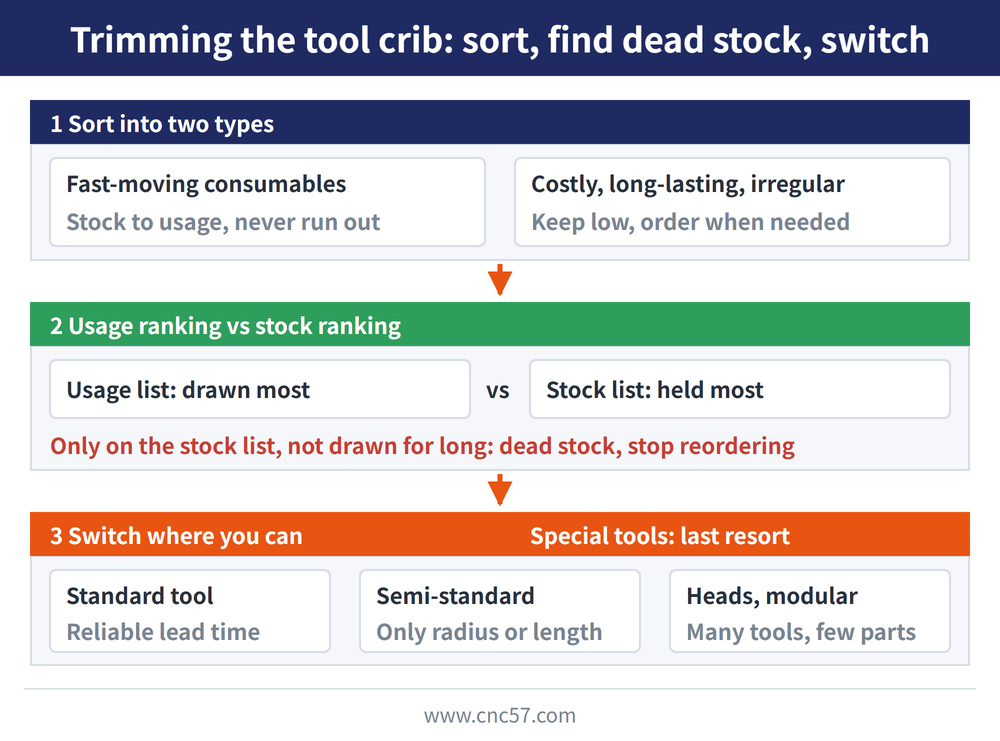
To trim a tool crib, work in this order: first sort the items into two types, the consumables you draw every day and the items that are expensive, long-lasting and bought irregularly; then put the usage ranking next to the stock ranking to find what is sitting idle; then switch whatever you can to standard, semi-standard or modular tools. How much of a regular tool to keep is not a formula: it comes from three numbers, monthly usage, supplier lead time and the cost of one stock-out, taken from your own records.
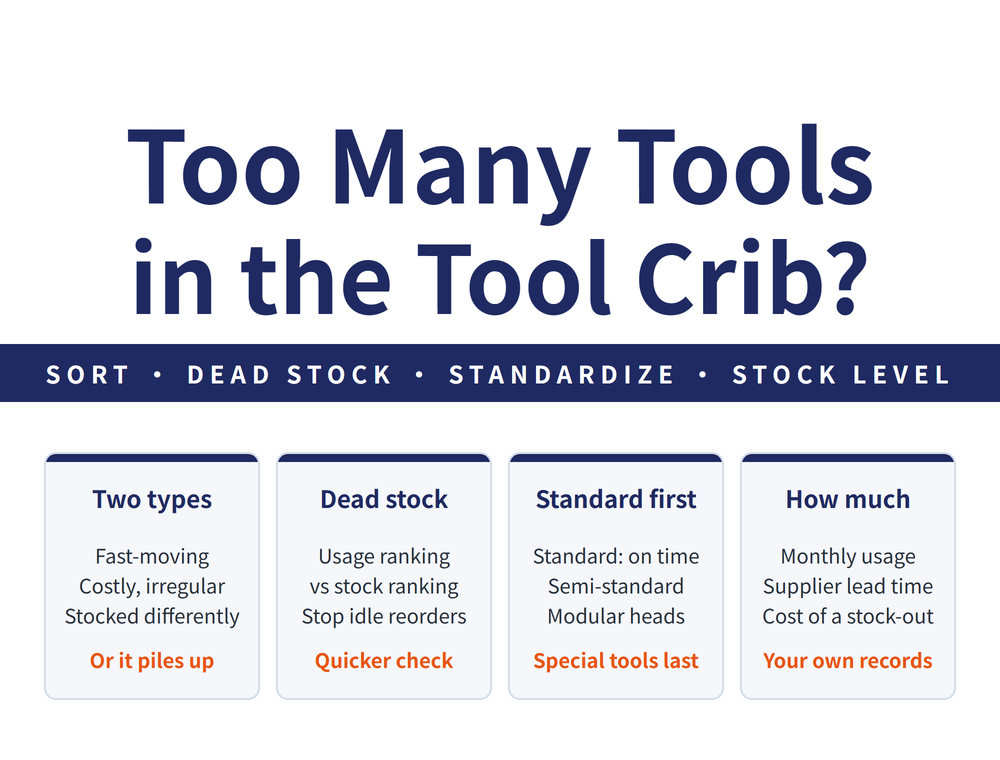
1. Sort into Two Types First: Fast-Moving, and Costly but Irregular
The first step is not cutting items, it is sorting them, because the two types are stocked in opposite directions:
| Type | What it looks like | Stocking direction |
|---|---|---|
| Fast-moving consumables | Drawn often, steady usage | Stock to actual usage; the goal is never running out |
| Costly, long-lasting, irregular | High unit price, one tool lasts a long time, no telling when you will buy again | Keep stock low and order when needed |
🔑 Stock the second type the way you stock the first, and what you buy becomes the next batch of idle stock: the trimming is half done and the item list grows back on its own.
2. Usage Ranking vs Stock Ranking: Find What Is Not Moving
Dead stock (tools nobody has drawn for a long time, sitting in the crib) does not have to be judged item by item. Within one tool category, put two rankings side by side:
| Step | What to do |
|---|---|
| 1 | List the ten items drawn most often |
| 2 | List the ten items with the most stock |
| 3 | Compare: items that appear only on the stock list and have not been drawn for a long time are dead stock |
📌 What the comparison looks for is where the two lists do not match: the items drawn most hold little stock, while the items with the most stock are rarely drawn. Finding dead stock this way is faster than judging item by item.
Stop reordering the items it turns up; inserts can often be passed to another operation and used up, see section 6.
3. Switch to Standard Tools Where You Can: Standard, Semi-Standard, Special
Part of the unused stock in a crib is left behind by special tools. The three kinds differ like this:
| Kind | What it is | Effect on inventory |
|---|---|---|
| Standard tool | A tool maker's mass-produced item | Versatile, reliable lead time; the basis of a shop's tool inventory management |
| Semi-standard tool | A simple modification of a standard tool, such as a different corner radius or length | Can be made relatively quickly, but the change is limited |
| Special tool | Designed for a specific operation on a specific part | Does not fit once the part changes, long lead time; used mainly in mass production |
🔑 The question to ask when trimming: if a standard tool cannot do it, see whether a semi-standard tool can; if you really need a special tool, think ahead: once that part stops running, the tool stays in the crib. For how to compare two brands' spec sheets when the same size is stocked from both, see Comparing Cutting Tool Brands: Which Spec Fields Line Up, and Which Only Count Within One Catalog.
4. Modular and Exchangeable-Head Tools: Many Tools from a Few Parts
The other route is to make one tool or one holder do more:
| Approach | How it cuts the item count |
|---|---|
| One tool, several operations | A tool that can shoulder mill, ramp and plunge means fewer tool changes and fewer tools on the shelf |
| Exchangeable head | One shank takes many heads and becomes a general-purpose holder; changing the head does not mean taking the tool off the machine |
| Modular | Standardized components are assembled into the tool you need, shortening lead time and cutting inventory and storage cost |
⚠ The price of modular tooling is that an assembled structure is less rigid than a one-piece tool and accuracy may suffer, so operations that demand rigidity and accuracy still need their own evaluation.
For how far modular tooling can cut the part count in a real case, see Quick-Change / Modular Tool Holder Systems: Principles, Trade-offs & Inventory Savings; for choosing between solid, exchangeable-head and indexable end mills, see Solid Carbide, Exchangeable-Head or Indexable End Mill: Check Diameter First, Then Tool Change and Accuracy.
5. How Much of a Regular Tool to Keep: Three Numbers from Your Own Records
There is no universal figure for how much of the first type to keep. It comes from three numbers:
| Number | Where it comes from | What it answers |
|---|---|---|
| Monthly usage | Tool issue records | How many you use up in a month |
| Supplier lead time | Actual days from order to receipt | How many the floor still uses while you wait |
| Cost of one stock-out | Machine downtime, a substitute tool, a rush purchase | Whether to keep more, or whether you can wait |
📌 Take all three numbers from your own records, not from another shop; the second type does not use this method and stays at low stock. Being forced into a high-priced purchase by a sudden shortage is also what Tungsten Prices Are Surging — How Do Machine Shops Defend Tooling Costs? 2025–2026 Market Intel says inventory management should prevent.
Whether a dull tool is replaced, sent out for grinding or reground in-house also changes how many new tools you keep: buying new means holding stock, sending out means building up a batch; see In-house Regrinding vs. Outsourced Grinding vs. Buying New — Which Is Cheapest?
6. Once It Is in the Crib: Storage and Using It Up
After trimming, the tools that stay need to be stored well and used up:
| Practice | Why |
|---|---|
| Keep inserts in their original box with the label; do not open and mix them | The label identifies the insert quickly and carries basic usage advice |
| Do not let carbide inserts touch each other or sit in a container where they knock together | Small chips from knocks are hard to see and often show up only in the cut |
| Use every cutting corner before you throw an insert away | Discarding an insert after one corner has a large effect on tooling cost |
| Pass inserts worn in finishing on to roughing | Roughing is less strict on size; check first that the new operation can accept the wear |
Whether a worn insert can be reground and reused, see Can a Worn Indexable Insert Be Reground? Criteria, Fixture and Stock Removal; abrasives carry an expiry date and need first in, first out, see Abrasives Have an Expiry Date Too: Markings, Stock Rotation and Storage.
7. Frequently Asked Questions (FAQ)
Q: The tool crib has too many items. What is the first step?
Sort the items into two types: consumables drawn every day, and items that are expensive, long-lasting and bought irregularly. The two are stocked in opposite directions, and putting an item in the wrong type buys in the next batch of dead stock.
Q: How do I find dead stock among cutting tools quickly?
Within one tool category, put the ten items drawn most often next to the ten items with the most stock. Items that appear only on the stock list and have not been drawn for a long time are dead stock; stop reordering them.
Q: How much safety stock should I keep for a regular tool?
There is no universal figure. It comes from three numbers, monthly usage, supplier lead time and the cost of one stock-out, taken from your own records; items that are costly and bought irregularly are kept at low stock instead.
Q: Why do special tools end up unused in the crib?
A special tool is designed for a specific operation on a specific part, so it no longer fits once the part changes. When a standard tool cannot do the job, first check whether a semi-standard tool with only a different corner radius or length will.
When you put this into practice, the full cutting tool range filters by requirement; for spec questions, ask us on LINE.
Published: 2026-10-26 | Last updated: 2026-10-28









