
Choosing Tool Material and Coating by Workpiece: The P-M-K-N-S-H Guide
Carbide or HSS (high-speed steel), coated or not, and which coating — every one of these decisions comes back to what you are cutting. This guide uses the ISO six workpiece groups (P/M/K/N/S/H) to map material and coating to each in one place.
1. Group first: the ISO six workpiece materials
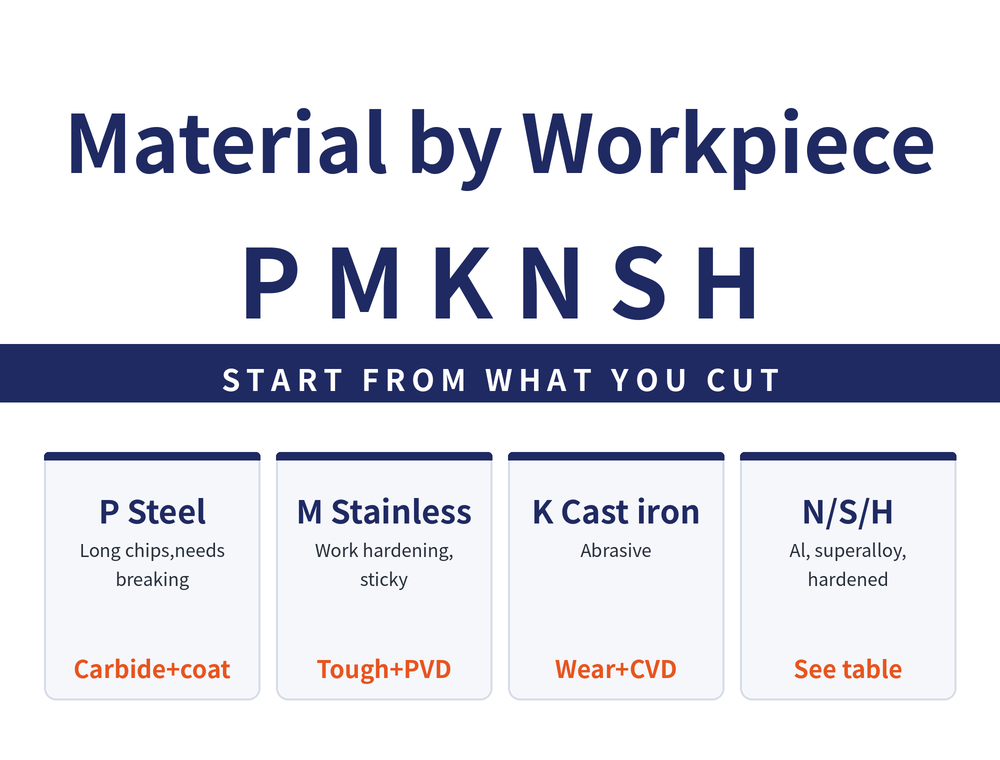
Choosing tool material and coating always starts from the workpiece. ISO sorts materials into six groups, each with a different main machining challenge that then drives the material and coating choice.
| Group | Representative material | Main machining challenge |
|---|---|---|
| P | Steel | Long chips, chip breaking needed |
| M | Stainless steel (mostly austenitic) | Work hardening and built-up edge |
| K | Cast iron | High abrasiveness |
| N | Aluminium and non-ferrous | Sticking and built-up edge |
| S | Superalloys and titanium | Concentrated cutting heat, high-temperature strength |
| H | Hardened steel (quenched) | High hardness |
For the grouping logic and each group's definition, see the ISO workpiece material classification overview; for the tool-selection thread, see the cutting tool material classification: the P-M-K-N-S-H selection guide.
2. The ferrous three: P steel, M stainless, K cast iron
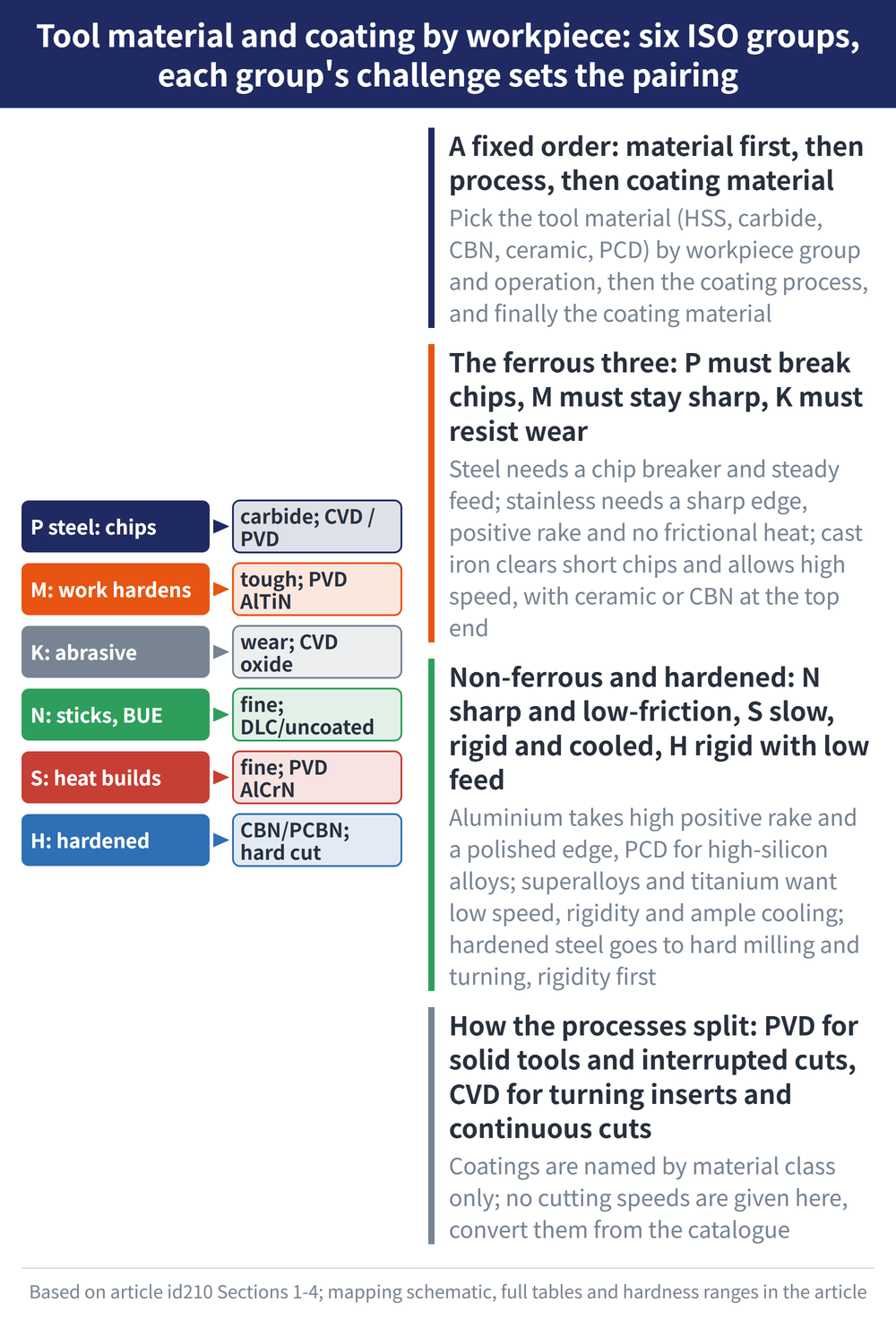
Putting each group's challenge, tool material, coating and machining note in one table is the decision core of this article. Start with the three ferrous groups, where cemented carbide is the main tool material.
| Workpiece group | Machining challenge | Tool material | Coating | Machining note |
|---|---|---|---|---|
| P steel | Long chips, chip breaking needed | Cemented carbide (P-class grade) | Turning CVD (with aluminium-oxide layer); milling PVD AlTiN family | Chip breaker and steady feed |
| M stainless | Work hardening, sticking, cutting heat | Tough-grade cemented carbide | PVD AlTiN / AlCrN | Sharp edge, positive rake, avoid frictional heat |
| K cast iron | High abrasiveness, short chips | Wear-resistant-grade cemented carbide | CVD (thick aluminium-oxide layer); ceramic / CBN at high speed | Short chips clear easily, allows high speed |
3. Non-ferrous and hardened: N aluminium, S superalloys, H hardened steel
These three groups have different challenges and trade-offs from the ferrous three; the columns are the same, so the two tables read together.
| Workpiece group | Machining challenge | Tool material | Coating | Machining note |
|---|---|---|---|---|
| N aluminium & non-ferrous | Sticking, built-up edge | Fine-grain carbide, sharp edge; PCD for high-silicon alloys | Low-friction film (DLC) / uncoated / PCD | High positive rake, polished edge |
| S superalloys & titanium | High-temperature strength, concentrated cutting heat | Fine-grain carbide; ceramic for nickel-based | PVD AlTiN / AlCrN | Low speed, rigidity, ample cooling |
| H hardened steel | High hardness (quenched, typically about HRC45–65) | CBN / PCBN, fine-grain carbide | Carbide tool with AlTiN | Hard milling, hard turning, low feed, rigidity first |
The grades, coating pairings and HRC range above are typical values in general terms; follow the catalogue or standard for the actual case. Cutting speed is not given here — convert it with the drilling formula guide: vc, spindle speed, feed and cycle time. Coatings are named by material class only and do not refer to any brand or product name.
4. Two selection steps: material first, then coating
Selection follows a fixed order: first pick the tool material (HSS / carbide / CBN / ceramic / PCD) by workpiece group and operation type, then pick the coating process, and finally match the coating material.
| Step | Decision | Note |
|---|---|---|
| 1 Material | Pick tool material by workpiece group and operation type | HSS / carbide / CBN / ceramic / PCD |
| 2 Process | Pick the coating process | PVD for solid tools and interrupted cuts; CVD for turning inserts and continuous cuts |
| 3 Material class | Match the coating material | AlTiN / AlCrN / aluminium-oxide layer / DLC, per workpiece group |
For the PVD versus CVD difference and how to choose, see the PVD versus CVD coating guide; for material by tool type, see how to choose tool material by tool type.
Last updated: 2026-08-08
5. Frequently Asked Questions (FAQ)
Q: Why is aluminium often run uncoated or with a low-friction film instead?
Aluminium's main challenge is sticking and built-up edge, so the priority is a sharp edge and low friction, not wear resistance. Fine-grain carbide uncoated or with a DLC (low-friction) film reduces adhesion; high-silicon alloys often use PCD.
Q: Can one tool handle all six groups?
Not advisable. The main challenge differs by group and the material-coating trade-offs are opposite (N wants sharp, K wants wear-resistant). A universal tool covers some conditions, but critical parts should still be matched to the workpiece group.
Q: Why does stainless need a sharp edge rather than the most wear-resistant one?
Austenitic stainless work-hardens easily, and a dull edge's frictional heat accelerates hardening and sticking. A sharp edge with positive rake cuts cleanly and cuts frictional heat, which beats chasing wear resistance alone.
Q: Must quenched hardened steel always use CBN?
Not always. CBN / PCBN is the first choice at high hardness, but in general terms fine-grain carbide with AlTiN can cope at lower hardness or in interrupted cuts. The actual applicable range follows the catalogue or standard.
This article is part of Tool Materials and Coatings: The Complete Guide - Separate Substrate From Coating, Then Work Back From the Workpiece; that guide shows how the whole topic fits together.









