
Regrinding CBN Turning Tools: Never Along the Rake Face, Flank Meets the Wheel First
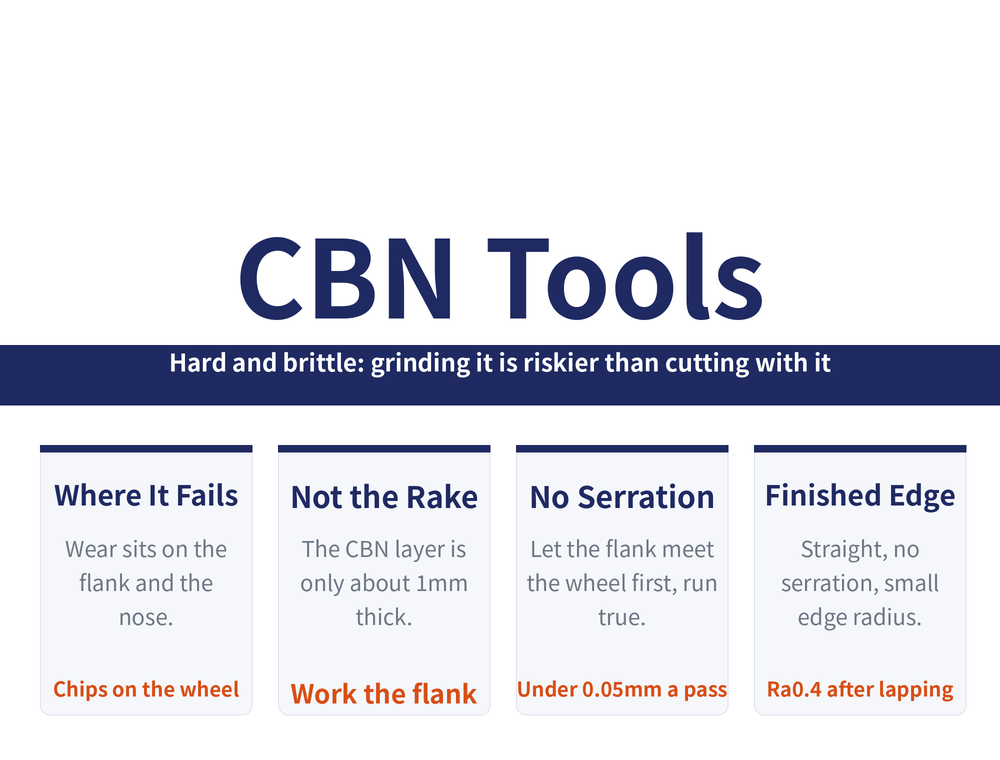
CBN turning tools exist for finishing hardened material, and being hard and brittle they chip on the grinder at the slightest provocation. This guide covers four things: why they always fail on the flank and the nose, what the edge must look like afterwards, why the rake face is off limits, and how wheel direction and depth of cut are set so the edge does not come off serrated.
1. Where a CBN tool fails
CBN turning tools are used for finishing hardened and other difficult materials. Cuts are light, so the wear concentrates on the flank and the nose while the rake face comes off relatively unharmed. That much matches carbide indexable inserts — for those, see Can a Worn Indexable Insert Be Reground?.
What CBN adds is its own problem: hard and brittle. It survives the cut and chips on the wheel. The source gives two examples of tools before regrinding: number 1 carried a 2mm × 0.5mm notch in the edge; number 2 had a chipped nose, shown only as a figure with no dimensions given — not estimated here.
2. The rule: do not grind along the rake face
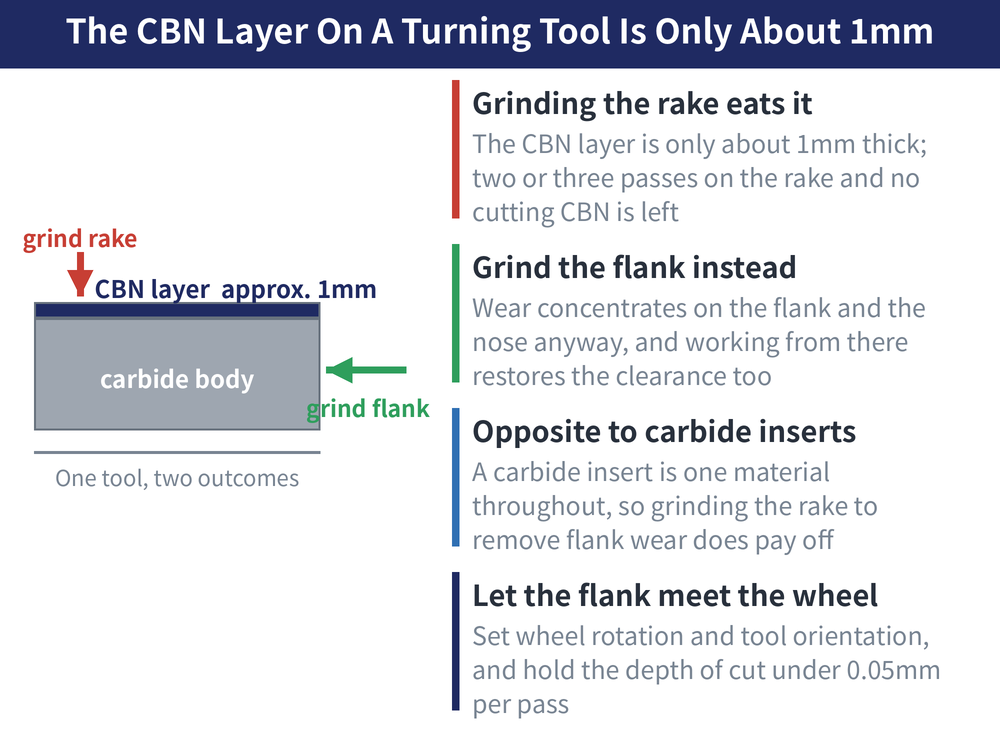
The CBN layer on the rake face is only about 1mm thick. Grinding along that face eats the usable thickness directly, and two or three passes later there is no CBN left to cut with. To keep the number of regrinds and the tool life, stay off the rake face.
This is the opposite of the carbide insert in the previous article. A carbide insert is one material all the way through, so grinding the rake face to carry the flank wear away is a good trade. CBN is a thin composite layer and the rake face must be preserved. Same word "insert", different structure, opposite direction.
3. Avoiding a serrated edge: flank first
The risk in regrinding CBN is not that it will not grind but that the edge comes off serrated. The source controls that through contact order and vibration:
| Where to act | What to do |
|---|---|
| Contact order | Set wheel direction and tool mounting so the flank meets the wheel first |
| Machine and fixture | Both must be rigid, and the wheel must run true, so nothing vibrates during the pass |
| Type of grinder | Makes little difference to quality; rigidity and smooth running are what count |
| Depth of cut | Diamond wheels are fine grit, so keep it light — the source takes αp < 0.05mm per pass |
| Wheel upkeep | Dress and clean the working face often to keep the wheel sharp |
For choosing and truing the wheel itself, see Diamond or CBN Wheels and Truing and Dressing Superabrasive Wheels.
4. What the finished edge must look like
| Requirement | How it is judged |
|---|---|
| Straight edge, no serration | Judged under a microscope; the naked eye cannot call it |
| Small edge radius, sharp edge | This is what finishing runs on; a dull CBN tool has lost its point |
| Low finish on both faces | The source measured Ra0.4μm after grinding and lapping |
Note the wording: after grinding and lapping. There is a lapping step after the wheel work, and CBN edge quality comes from that step rather than from the grinding. For edge preparation on ordinary turning tools, see Edge Preparation After Regrinding.
5. Frequently Asked Questions (FAQ)
Q: Is a CBN wheel the same thing as a CBN tool?
No, and they point in opposite directions. A CBN wheel uses CBN as the abrasive to grind other tools; a CBN tool is CBN made into an insert to cut the workpiece. This article is about the second one — and what grinds it is a diamond wheel.
Q: Why is the rake face off limits?
Because the CBN layer on it is only about 1mm thick and that layer is the cutting body of the tool. Grinding along the face consumes it directly, and after a few passes no usable CBN remains. Working the flank restores clearance and keeps the layer intact.
Q: Can a serrated edge be recovered?
It takes another lapping pass. The source's acceptance is "after grinding and lapping, the edge is straight and free of serration under a microscope, with finish down to Ra0.4μm" — the lapping is not optional. Better still, prevent it: flank to the wheel first, depth under 0.05mm per pass.
Q: Does this need a high-end grinder?
The source states plainly that the type of grinder makes little difference. What it does require is a rigid machine and fixture with a wheel that runs smoothly. Sort out holding rigidity and wheel balance before considering a new machine.
This article is part of Tool Regrinding: The Complete Guide — Decide Whether to Grind, Then Look Up How, With What, and How to Check; that guide shows how the whole topic fits together.
Published: 2026-08-18|Last updated: 2026-08-18