Designing Self-Centring and Indexing-Table Fixtures: Centring Mechanism, Internal and External Gripping, Multi-Face Machining in One Setup
A part is clamped but its centre does not line up with the fixture centre; or a single part has to be re-clamped three times before every face is cut. Each problem has its own answer. A self-centring fixture uses linked jaws that move together to find centre automatically; an indexing-table fixture mounts the fixture on an indexing table so one setup covers several faces. This guide covers how both work — and marks where no reliable figures exist.
1. What Each Fixture Type Actually Solves
An ordinary fixture holds the part still. These two designs add one more layer of function on top of that.
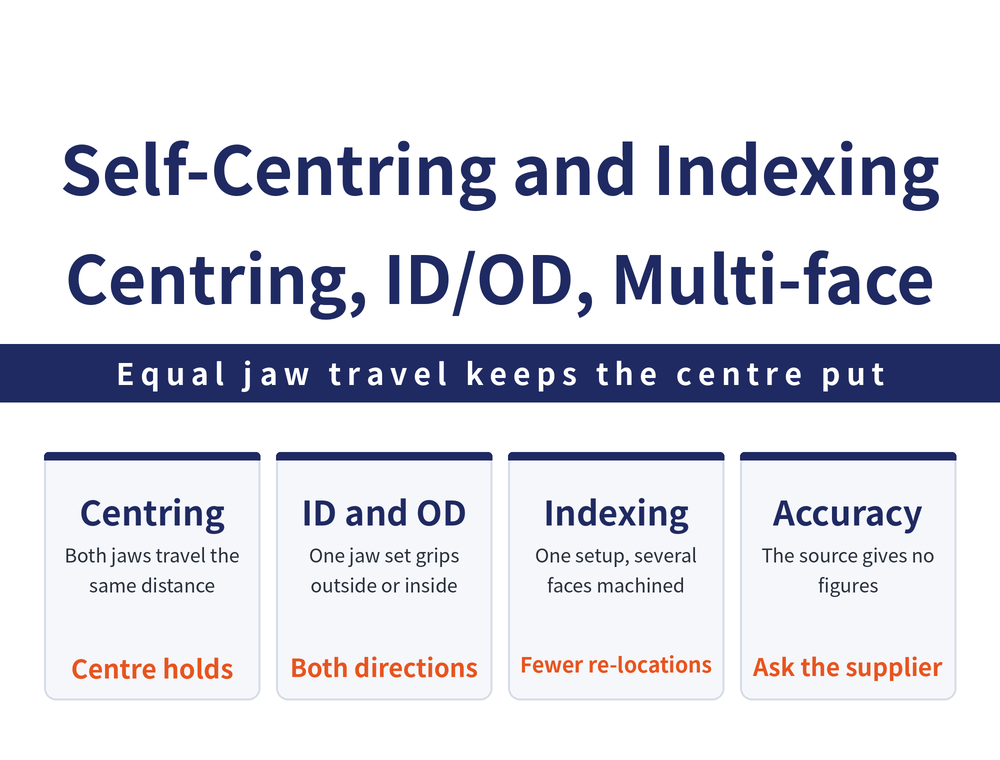
A self-centring fixture solves the centring problem: a round or symmetrical part goes in and its centre lands on the fixture centre by itself, with no separate dial-indicating step. An indexing-table fixture solves the re-clamping problem: when a part needs three or four faces cut, every flip means clamping again, touching off again, and stacking one more set of errors.
Neither replaces the basics. Locating faces, locating points and clamping force still have to be right first — see What Is a Jig and Fixture and How to Locate a Workpiece.
2. Self-Centring: Two Jaws Moving the Same Distance
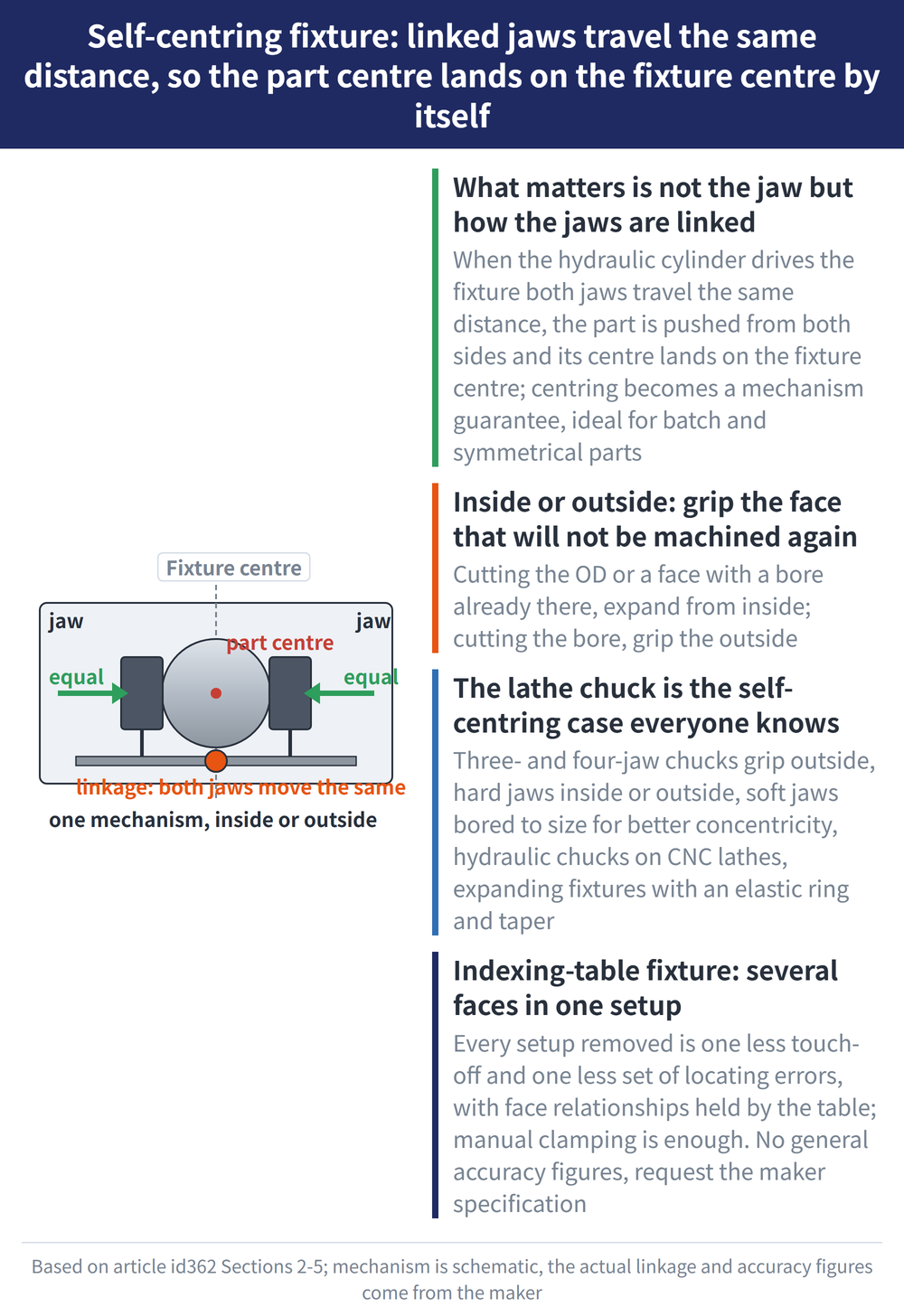
What matters in a self-centring fixture is not the jaw itself but how the jaws are linked.
The principle: within the constraints of the mechanism, when the hydraulic cylinder drives the fixture the two jaws travel the same distance, and that produces the centring action. The jaws do not move independently — they are linked so both sides displace by an equal amount, the part is pushed from both sides at once, and its centre ends up on the fixture centre without a separate centring step.
That is what decides where it fits: batch parts, symmetrical parts, or any job that must land on the same centre every time. Centring stops being an operator step and becomes something the mechanism guarantees. Equal travel is a principle-level description; which linkage realises it is not reliably stated, so this article does not infer one.
3. Inside or Outside: One Mechanism, Two Ways to Use It
A self-centring fixture can grip internally as well as externally. The same jaw mechanism will close on an outside diameter, or expand outwards from a bore.
The practical rule is straightforward. If the outside diameter or the face is being cut and a bore already exists, expand from inside; if the bore is being cut, grip the outside. The deciding question is which surface will not be machined again — that is the one to grip.
4. The Lathe Chuck Is the Self-Centring Case Everyone Knows
The most familiar self-centring device on the floor is the lathe chuck. It is the same idea in a different implementation, and its selection logic reads across.
| Element | Grip direction | Key point |
|---|---|---|
| Three-jaw / four-jaw chuck | External | The basic way a lathe holds a round part |
| Hard jaws (manual) | External / internal | Grip directly; suit varied diameters, ID or OD |
| Soft jaws (manual) | External | Bored to size on a jaw former first; better concentricity |
| Hydraulically driven chuck | External | Mainly on CNC lathes; two-, three- and four-jaw designs |
| Manual expanding fixture | Internal | An elastic outer ring and a taper generate the grip |
For the soft-jaw and hard-jaw detail, see How to Use a Lathe Chuck.
5. Indexing-Table Fixtures: Several Faces in One Setup
The design intent is one sentence: to machine several faces in a single setup. The fixture is mounted on an indexing table, and on a vertical machining centre that setup covers the multiple faces.
The saving is more than time. Every setup removed is one less touch-off and one less fresh set of locating errors. The relationship between faces is then held by the rotation of the table rather than by an operator lining the part up again.
The example is an NC indexing table carrying a manually clamped fixture, where one setup completes three faces — the table rotates in sequence and each angular position gets its face cut. Note what that implies: manual clamping is enough. An indexing-table fixture changes the machining approach, not necessarily the clamping method.
6. Accuracy Figures: Not Given, So Not Stated
The first question in selection is usually numbers — centring accuracy, indexing accuracy, repeatability.
Only qualitative principles and case photographs are available for these fixtures. It provides no accuracy, clamping force or load figures, so this article quotes none. Those values are tied to the specific model, the drive method and the grade of indexing table; borrowing a figure from elsewhere is worse than having no figure. Request the specification sheet from the fixture and indexing-table suppliers, and follow the maker specification.
7. What to Confirm Before You Buy
The table below lists items have no general figures and must be confirmed with the supplier. They are not source-quoted specifications.
| Item to confirm | Why it matters |
|---|---|
| Centring accuracy | Sets concentricity; no general figure |
| Indexing accuracy and repeatability | Sets the angular error between faces |
| Drive method and clamping force | Manual or hydraulic; affects consistency and cycle time |
| Indexing table load capacity | The fixture counts as load, not just the part |
| Distortion under clamping | Centred does not mean undamaged |
That last row deserves attention. A mechanism that puts the centre where it belongs says nothing about whether the part has been crushed getting there; the two are separate problems, covered in Why Vise Clamping Distorts the Workpiece.
Frequently Asked Questions (FAQ)
Q: Why does a self-centring fixture find centre by itself?
Because the jaws are linked. When the hydraulic cylinder drives the fixture, the mechanism constrains both jaws to travel the same distance, so the part is displaced equally from both sides and its centre lands on the fixture centre with no separate centring step.
Q: Can a self-centring fixture only grip an outside diameter?
No. Self-centring fixtures can grip internally as well as externally: the same jaw mechanism closes on an outside diameter or expands outwards from a bore. Choose the side whose surface will not be machined again.
Q: How many faces can one setup on an indexing table cover?
The example is an NC indexing table with a manually clamped fixture completing three faces in one setup. The real count depends on part shape, tool access and table travel; there is no general upper limit.
Q: Can I assume a rough figure for centring or indexing accuracy?
No reliable accuracy figures are available, so none are quoted here. Such values vary widely with model and drive method — request the specification sheet from the fixture and indexing-table suppliers and follow the maker specification.
This article is part of Workholding and Fixtures: The Complete Guide - Locate First, Then Clamp; How Much Force and Where It Comes From; that guide shows how the whole topic fits together.