
Turning Depth of Cut and Finish Allowance: One Pass or Two?
The stock leaves 4 mm of allowance per side. Does rough turning take it in one pass or two? If two, how deep is the first one? And how much should be left for finishing? This guide covers only the numbers specific to turning: the one-pass rule ap=A, the split ratio ap1=(2/3~3/4)A and ap2=(1/4~1/3)A, the reference values of 0.05~0.08 mm for finish turning and 1~2 mm for semi-finish turning, and the separate figure of 0.2~0.5 mm for finishing allowance. General machining sequence principles and allowance terminology are out of scope here and are covered in their own articles.
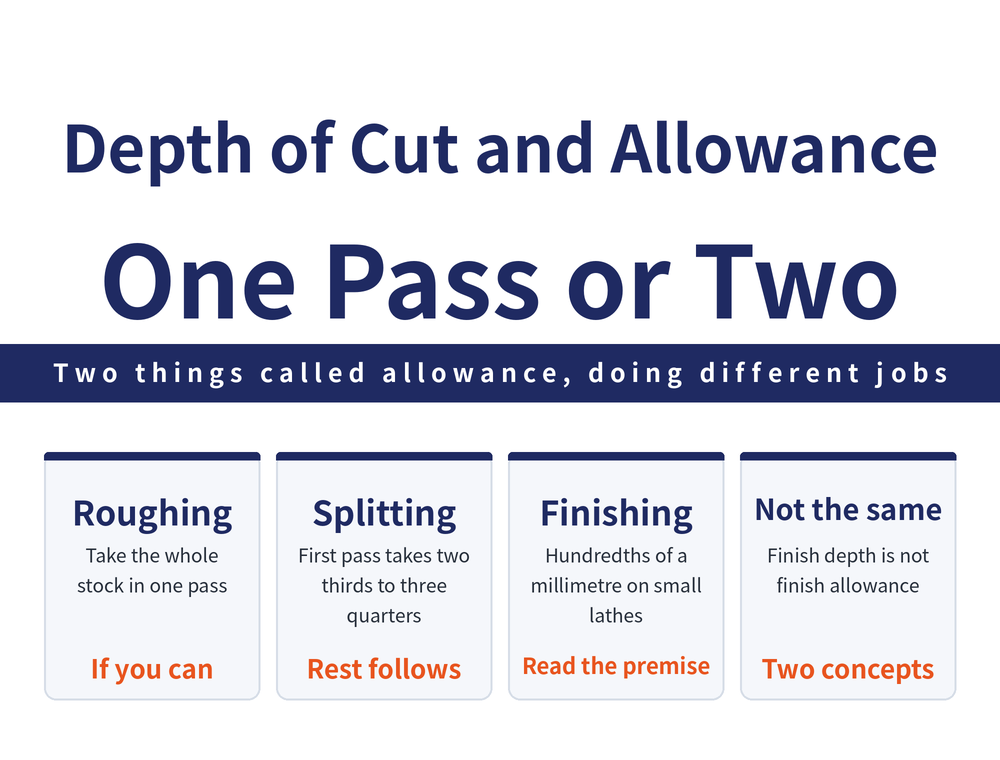
A boundary first: general machining sequence principles and machining allowance terminology are covered in How to Plan the Machining Sequence and How Much Machining Allowance to Leave, and are not repeated here; this article deals only with the set of numbers specific to turning.
Also separate two quantities that are often mixed up: depth of cut ap is how deep this one pass goes, finishing allowance is how thick a layer is still left before finishing. The two sets of figures each address one of them and cannot be substituted for one another — see sections 7 and 8.
1. The Rough Turning Rule: One Pass If One Pass Will Do
The first rule of rough turning is plain: remove the entire machining allowance in a single pass wherever possible, written as ap = A, where A is the unilateral machining allowance.
The reason is that the number of passes multiplies directly into cycle time. To remove 3 mm per side, one pass at ap=3 mm against two passes at 1.5 mm each doubles the cutting travel and adds a retract and repositioning move in between.
So "two passes is safer" is not the default; it is the exception, and it needs a reason. The three reasons are in the next section. For how the rough path itself should run, see Three Rough Turning Path Types.
2. When to Split into Two Passes: The Three Conditions in the Source
Rough turning is split into two or more passes only in the following three situations:
| Condition | What it looks like on the floor |
|---|---|
| A is too large | The allowance per side exceeds the power of this lathe or the load capacity of this insert |
| The allowance is uneven | The stock runs out or is irregular, so depth of cut swings within a single revolution |
| System rigidity is insufficient | A slender part, long overhang, or weak workholding, where a heavy cut causes deflection and chatter |
The right column is added so the conditions can be judged in practice. The three conditions in the left column are qualitative only, with no quantitative threshold for any of them, and none is invented here.
3. If Two Passes Are Needed, How Deep Is Each
These are ratios, not absolute values: first pass ap1=(2/3~3/4)A, second pass ap2=(1/4~1/3)A.
The two are complementary: 2/3 pairs with 1/3, 3/4 pairs with 1/4, and the two passes add up to A. The point is that the first pass is the heavy one and the second is light — most of the allowance comes off while rigidity is still intact, leaving a thin layer for the second pass to steady the result.
Worked example: unilateral machining allowance A=4 mm, and A is too large for a single pass.
Taking 2/3: ap1=2.67 mm, ap2=1.33 mm.
Taking 3/4: ap1=3.00 mm, ap2=1.00 mm.
Both satisfy the formula; which one to take depends on whether power, insert or rigidity reaches its limit first.
The change on diameter is twice the depth of cut, so do not drop that step when converting to an X value at the lathe; for the related conversions see Turning Calculation Formulas.
4. Castings and Forgings: Keep the First Pass Out of the Skin
When turning cast or forged stock, one more condition applies: the first pass should keep the cutting edge out of the hard skin on the metal surface.
The skin layer is hard and carries embedded sand, so an edge skimming across it is being dragged over abrasive; chipping and abnormal wear start there.
There is no given figure for skin thickness and no corresponding lower limit for ap, only this directional requirement. How deep the first pass has to go to get under the skin is judged from the actual stock, and no number is supplied here.
5. Reference Depth of Cut for Finish and Semi-Finish Turning
Rough turning is about getting the allowance off; finish turning is about how thin a layer is left to true it up. The reference values are:
| Operation | Depth of cut ap | Stated premise |
|---|---|---|
| Rough turning | ap=A (allowance per side); when split, ap1=(2/3~3/4)A and ap2=(1/4~1/3)A | No lathe size specified |
| Semi-finish turning | 1~2 mm | Small and medium lathes |
| Finish turning | 0.05~0.08 mm | Small and medium lathes |
The premise "small and medium lathes" has to be remembered along with the numbers. These are reference values under that condition; they are not a universal specification and not an acceptance standard. Large lathes, heavy turning and high-rigidity gang-tool machines fall outside the range of that table.
6. A Smaller Finishing Cut Is Not a Better One
The intuition is that the thinner the finishing cut, the better the surface. That intuition is wrong: the depth of cut for finish turning should not be chosen too small either.
The mechanism is that a turning tool edge always has a certain rounding radius. Once ap is down to the same order as that radius, the rounding effect becomes pronounced, chip formation is difficult, and the edge passes over the machined surface by squeezing and rubbing instead.
The result is greater squeezing and frictional deformation of the machined surface, so surface quality drops rather than improves. The lower end of the 0.05~0.08 mm band exists precisely to stay out of that region; it is not a case of "as small as possible".
7. Finishing Allowance: A Different Concept, a Different Number
Finishing allowance means the thickness of the material layer removed during finishing, normally taken off in a single finishing cut. It is an independent definition from a different framework, and it is not the same quantity as the ap above.
Too much allowance raises cutting force and cutting heat, affecting accuracy and surface quality. Too little fails to clear the surface defects and errors left by the previous operation and cannot absorb the workholding error of this one, which easily produces scrap.
There are three methods of determining it:
| Method | How it works and where it applies |
|---|---|
| Empirical estimation | Estimated from experience, usually on the generous side to avoid scrap; one-off and small-batch work only |
| Table lookup with correction | Look up handbook data, then correct against actual conditions; the most widely used method today |
| Analytical calculation | Combined analysis using formulas and test data; more economical and rational, but requires comprehensive and reliable test data; used only for costly materials or military and mass production |
For turning outside and inside diameters, empirical estimation generally gives 0.2~0.5 mm. The premises of that value are "empirical estimation" and "turning outside and inside diameters"; change the method or the operation and it no longer applies.
8. Why 0.05~0.08 mm and 0.2~0.5 mm Do Not Contradict
The two figures look like they clash, but they measure different things and belong to different frameworks.
| Item | What it measures | Given value and premise |
|---|---|---|
| Depth of cut ap | How deep the finishing pass actually cuts | 0.05~0.08 mm; premise, small and medium lathes |
| Finishing allowance | How thick a layer is still left going into finishing | 0.2~0.5 mm; premise, turning outside and inside diameters by empirical estimation |
The two are not merged into one recommended value here. Each source gives its figure inside its own context, and forcing a compromise produces a number neither of them stated. When planning the actual operations, follow the handbook or process standard your shop has adopted, and decide "how much to leave" and "how deep to cut" separately.
For the full reading guide on this topic, see Turning Toolpaths: The Complete Guide.
9. Frequently Asked Questions (FAQ)
Q: Should rough turning take one pass or two?
One pass is the default, with ap equal to the unilateral machining allowance A. Only when A is too large, the allowance is uneven, or system rigidity is insufficient does it become two or more passes. Those three conditions carry no quantitative threshold.
Q: How deep should the first of two passes be?
The first pass takes ap1=(2/3~3/4)A and the second takes ap2=(1/4~1/3)A, the two being complementary and summing to A. With A=4 mm, the first pass lands between 2.67 and 3.00 mm and the second between 1.00 and 1.33 mm.
Q: Which is right, 0.05~0.08 mm for finish turning or 0.2~0.5 mm of allowance?
Both are right; they measure different things. The 0.05~0.08 mm is the depth of cut of the finishing pass on small and medium lathes. The 0.2~0.5 mm is the finishing allowance thickness for turning outside and inside diameters by empirical estimation. They belong to different frameworks and should not be merged into one number.
Q: Can the finishing depth of cut be reduced further for a better surface?
Not advisable. A turning tool edge has a certain rounding radius, and when ap is too small that rounding effect becomes pronounced, chip formation is difficult, and the edge squeezes and rubs across the surface instead of cutting. Deformation of the machined surface increases and surface quality gets worse, not better.