Ultrasonic Vibration Dry Boring: Pulse Cutting and the Critical Speed
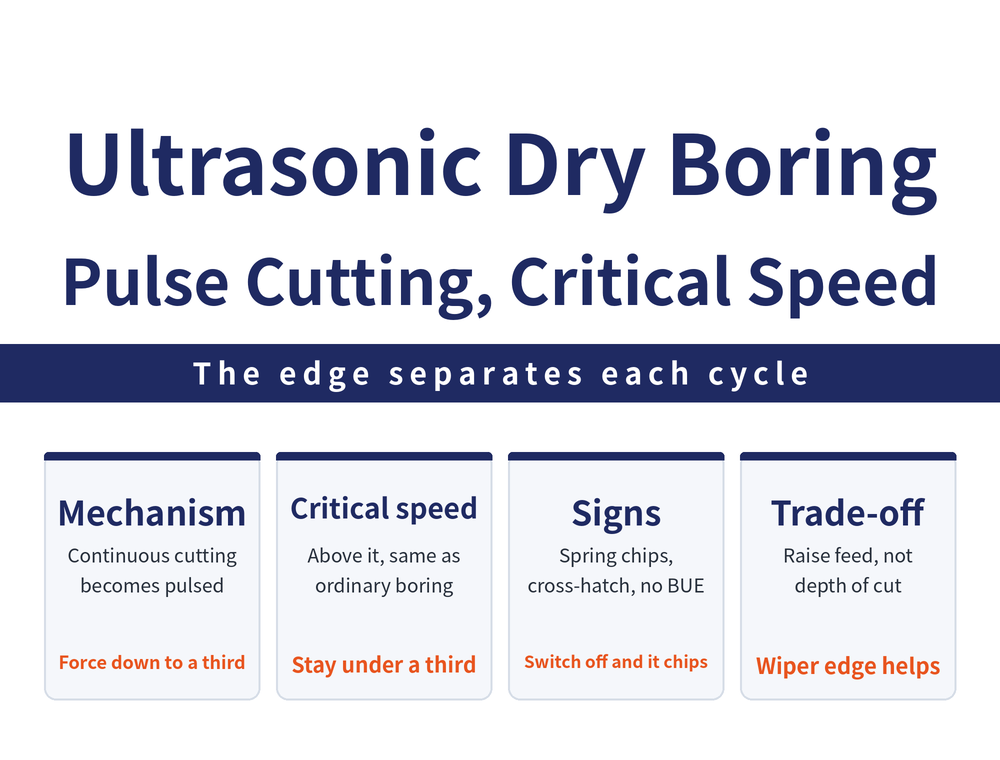
Ultrasonic vibration boring is not "boring while shaking" — it converts cutting itself into a regular pulsed, interrupted process. The edge separates briefly from the workpiece each cycle, and cutting force drops to a fraction of conventional boring. But the whole method has one threshold that must not be crossed: cutting speed has to stay below a critical value, or the effect disappears entirely.
1. It changes the cutting mechanism, not just adds vibration
Ultrasonic energy is applied to the boring bar through an acoustic system, making the tool vibrate torsionally at a defined frequency and amplitude. Tool vibration velocity is υ = ωA·cos(ωt), where ω = 2πf is angular velocity, f the frequency and A the amplitude.
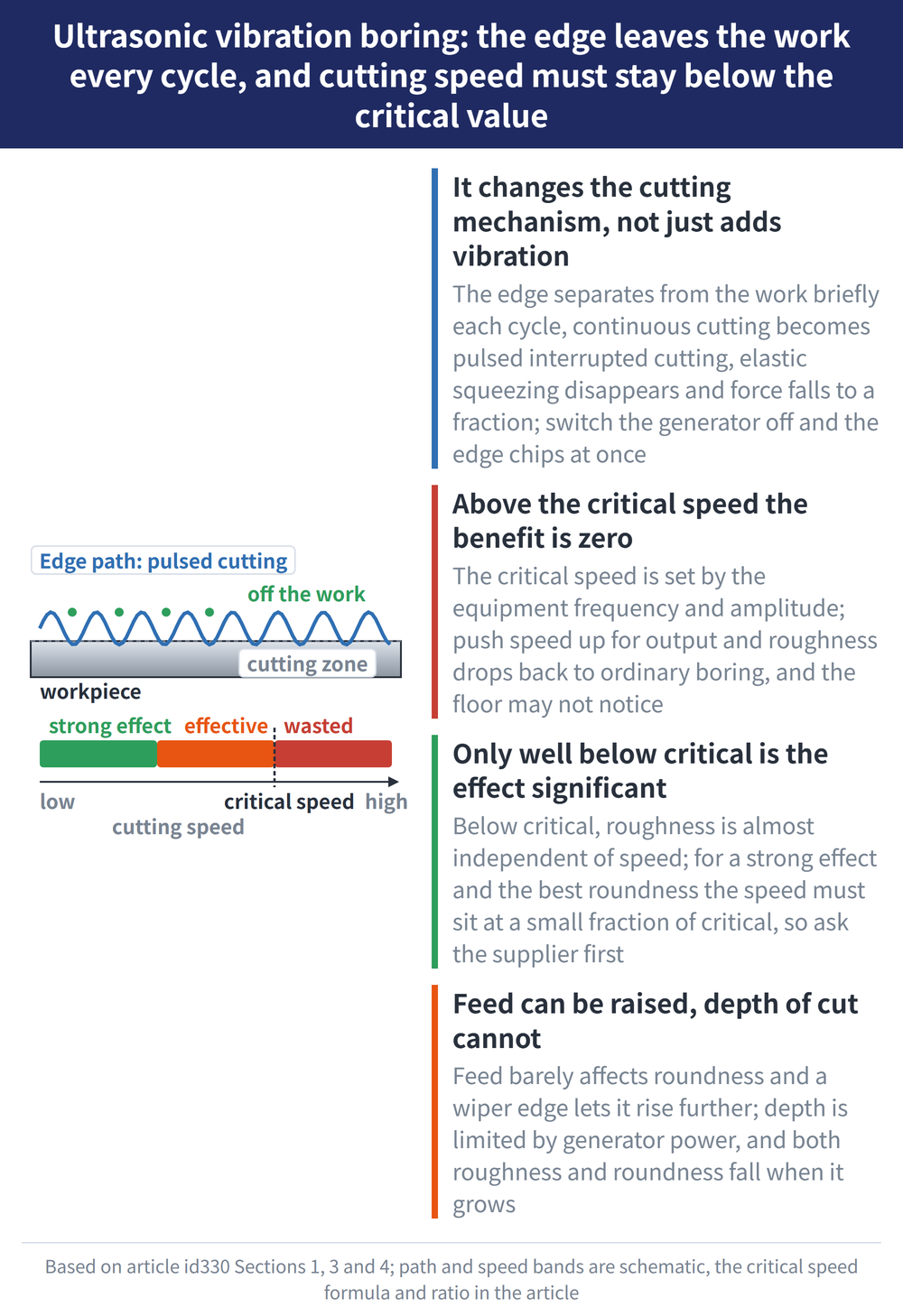
The point is that this creates separated vibration cutting: the edge briefly separates from the workpiece each cycle, so continuous cutting becomes a regular pulsed, interrupted process, and the elastic squeezing vibration of conventional cutting is eliminated. Cutting force falls to between one tenth and one third of conventional cutting, and the system becomes more stable, with effectively greater rigidity.
This is a different "replace grinding with cutting" route from hard turning, which relies on the hardness gap between tool material and workpiece (see the hard turning guide); this method changes the cutting mechanism itself.
2. Five phenomena visible on the shop floor
| Phenomenon | Description |
|---|---|
| Spring-shaped chips | Thin and long, widely spaced coils, even thickness, bright smooth rake contact face |
| Cross-hatched surface | Bore wall covered in an even network pattern, close to a superfinished result |
| Stable at low rpm | Stable boring even with long bar overhang and low spindle speed |
| No built-up edge | None observed across the source speed range, and no scale marks either |
| Chips not hot | No noticeable temperature rise in the chips, indicating a low cutting temperature |
The third item comes with a telling counter-observation: switch the ultrasonic generator off and the edge chips immediately, even at very low speed. Stability comes from the vibration itself, not from conservative parameters. For general principles on overhang and rigidity, see fine boring and tool overhang.
3. The critical cutting speed: the threshold of the method
A critical cutting speed exists at νc = ωA (angular velocity times amplitude). What it means:
| Cutting speed | Result |
|---|---|
| υ ≥ νc | Surface roughness no different from conventional boring — effectively wasted |
| υ < νc | Surface roughness becomes almost independent of cutting speed |
| υ ≤ (1/3) νc | Only here is the vibration boring effect significant, and roundness accuracy is best |
This is the one thing to remember. Ultrasonic vibration boring is not equipment that simply works once switched on; it has a definite speed ceiling. Pushing cutting speed up for productivity drives the benefit to zero, and the shop floor may not notice. νc is set by the equipment's frequency and amplitude, so establish it with the supplier before adopting.
4. Feed can be raised, depth of cut cannot
Given good system rigidity and no self-excited vibration, the three cutting parameters do not behave symmetrically.
Feed has little effect on roundness and can be raised for productivity. Without a wiper edge, roughness rises slightly with feed for purely geometric reasons; with a wiper edge, feed can be increased while holding the roughness requirement — the most practical lever for output.
Depth of cut is the constrained one. As it increases, generator power fails to keep up and roughness rises; larger depth also alters the vibration behaviour of the edge and degrades roundness. The source observes that below a small threshold, roughness is essentially independent of depth. Boring depth should be set by the ultrasonic system's power, not by tool and workpiece alone.
For general chip and coolant principles see boring chip control and coolant, and for vibration-related troubleshooting see boring troubleshooting.
5. Where it earns its place
The typical target is nickel-free low-alloy ultra-high-strength steel used in aircraft landing gear and similar parts: high strength means high cutting force, high toughness makes chip breaking difficult, low thermal conductivity raises cutting zone temperature and tool wear, and the material is notch-sensitive with demanding surface requirements. Precision holes in such materials have traditionally required grinding, honing or superfinishing.
Boring these materials dry with ultrasonic vibration at low speed, small feed and small depth, the source measured roundness and cylindricity in the low single-digit micron range and surface roughness Ra below a fraction of a micron, with limited work hardening in the machined layer (single-source measurement, for order-of-magnitude reference; verify against your equipment and trial cuts). The significance is boring in place of grinding and honing — keeping an operation that would otherwise go to a grinder on the boring machine, and dropping the coolant with it. For reading roughness see surface roughness Ra vs Rz, and for the classification of boring methods see boring basics and methods.
6. Frequently Asked Questions (FAQ)
Q: Why does ultrasonic vibration reduce cutting force?
Because the edge separates briefly from the workpiece each vibration cycle. Continuous cutting becomes pulsed interrupted cutting, the elastic squeezing of conventional cutting is eliminated, and mean cutting force falls sharply.
Q: Can cutting speed be increased?
No. A critical speed νc = ωA exists; at or above it the result is indistinguishable from conventional boring. For a significant effect, keep below one third of the critical speed.
Q: Which parameter should be raised for productivity?
Feed. It has little effect on roundness, and with a wiper-edge tool it can be increased while holding roughness. Depth of cut is limited by ultrasonic generator power and should not be pushed.
Q: Is this the same as ultrasonic grinding?
No. Ultrasonic grinding uses a vibrating tool face to drive abrasive slurry against the workpiece, a special process. This method is a boring tool performing separated vibration cutting by pulse force, a vibration aid to conventional cutting.
This article is part of Dry Machining: The Complete Guide - Losing the Coolant, and How Five Processes and Three Techniques Cope; that guide shows how the whole topic fits together.