Fine Boring and Tool Overhang: Single-Edge Tools and Five Principles
Fine boring brings the hole to its final tolerance and surface finish, and the single-edge fine boring tool is the first choice, adjustable down to the micrometre. What decides fine boring is often not the tool but the holder parameters (entering angle, point angle, nose radius) and how you control tool overhang and rigidity. This guide covers the tool types, the three holder trade-offs, and the five overhang principles.
1. Five fine boring tool types and where they fit
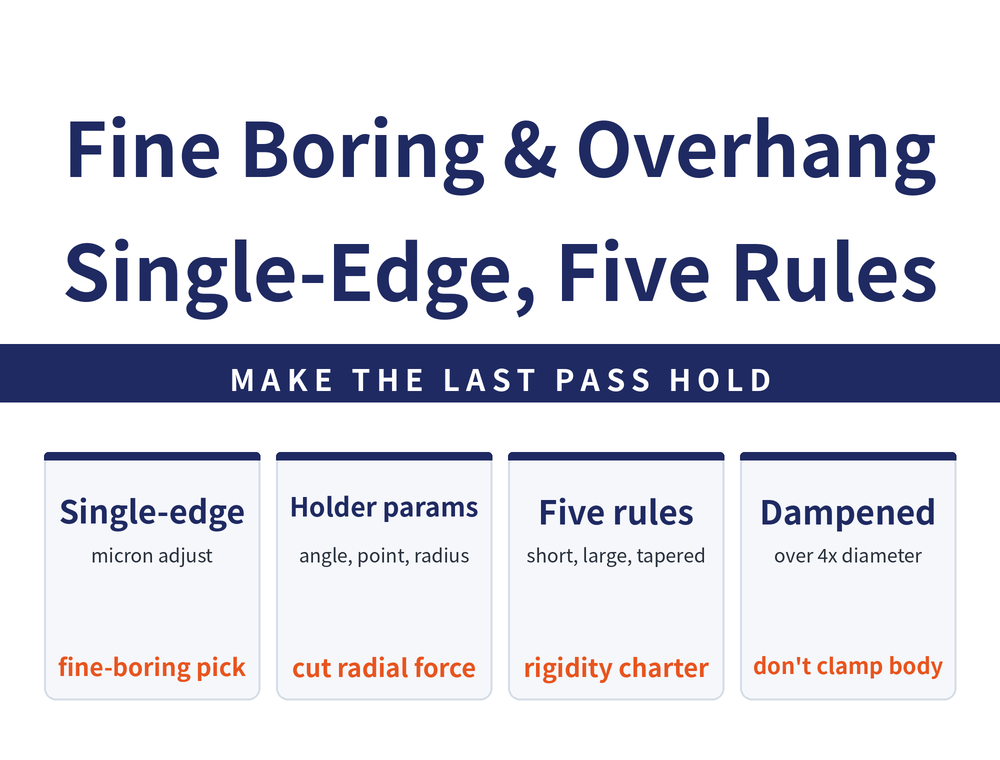
By diameter, overhang and batch size there are five common choices; of these, the single-edge fine boring tool is the workhorse, presetting the cutting edge to micrometre resolution to hold the tightest tolerances.
| Tool type | Where it fits |
|---|---|
| Single-edge fine boring tool | The first choice for fine boring; cutting diameter adjustable to micrometre resolution |
| Lightweight fine boring tool | Lightens spindle load, easy handling, bores large diameters more stably without adding weight |
| Fine boring head with a bar | Needed for small-diameter boring |
| SilentTools dampened tool | First choice once overhang exceeds 4× the interface diameter |
| Multi-edge reamer | High-feed, high-volume finishing |
For rough boring tool selection, see rough boring tool selection: edges, rake and entering angle; for the full rough-to-fine picture, see boring basics: four boring methods and the rigidity-first rule.
2. Three trade-offs for the fine boring holder
The manufacturer generally recommends a positive-rake insert with a 7° clearance angle as the basic shape, then trades off three angles. The common thread: boring is especially sensitive to radial force and deflection, so any choice that raises radial force needs more caution.
| Parameter | Trade-off |
|---|---|
| Entering angle (lead angle) | A larger entering angle raises axial force, favouring boring; a smaller one raises radial force and tends to trigger vibration |
| Insert point angle | A large point angle is stronger but needs more power and engages more edge, vibrating more; keeping it small improves stability and lowers vibration and force |
| Nose radius | A key factor, chosen by depth and feed; a large nose radius deflects the bar more and vibrates more, while a small radius with a free-cutting geometry and thin coating keeps the force low |
3. Deflection and reverse compensation in single-edge fine boring
A single cutting edge deflects radially under cutting force, and both depth of cut and overhang amplify it, so the hole comes out undersize. In practice you handle it with reverse compensation:
Example: target hole Ø25mm H7
Set the tool cutting diameter to Ø25.021mm, 0.021mm above nominal, allowing for the deflection; take a trial cut after the final adjustment to confirm.
For how tolerance passes from tool to hole, see how to improve hole accuracy: IT tolerances and the drill / ream / bore route.
4. Five tool overhang principles
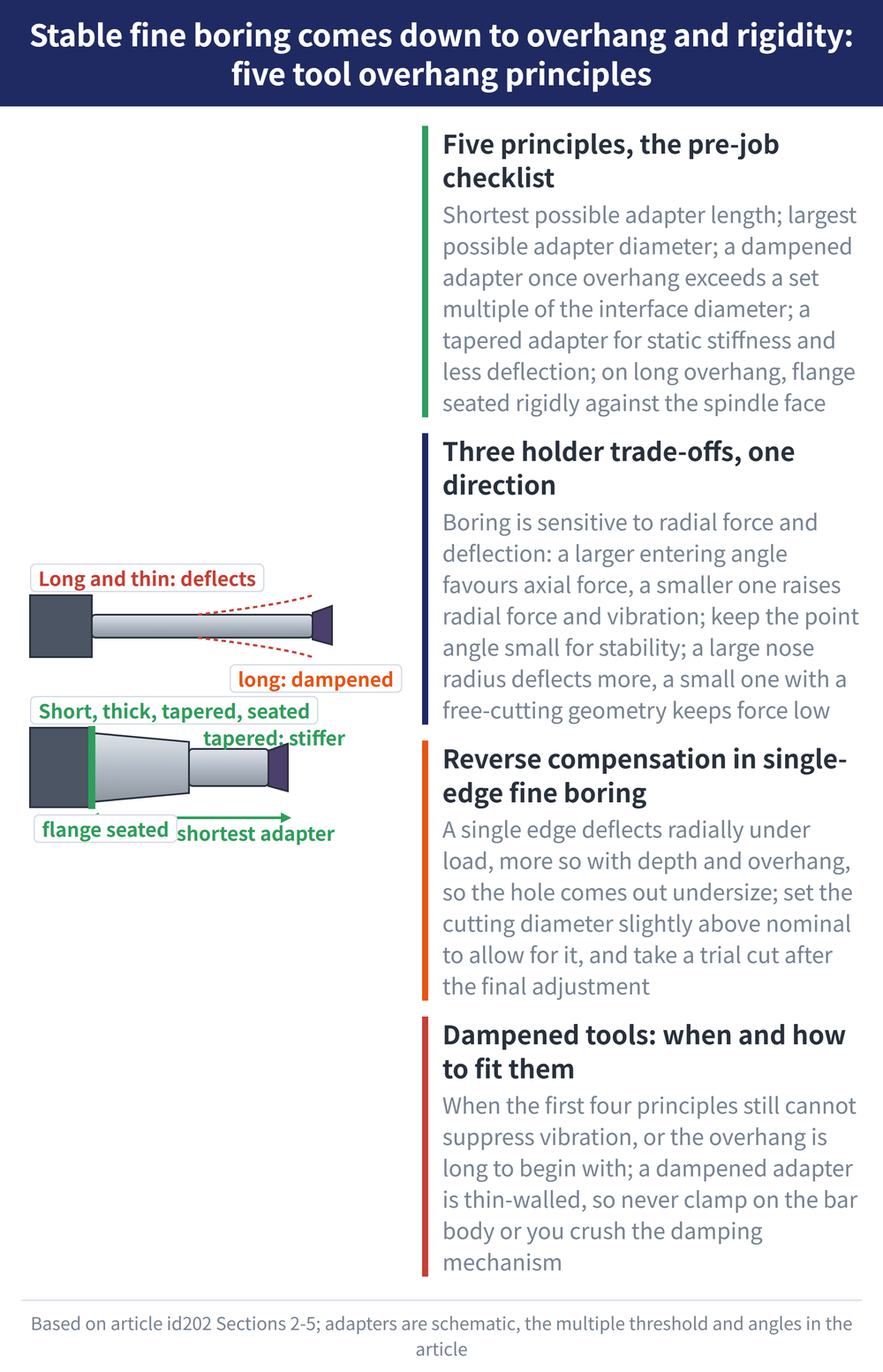
Stable fine boring comes down to overhang and rigidity. The manufacturer condenses its advice into five points — the most useful pre-job checklist:
| # | Principle |
|---|---|
| 1 | Choose the shortest possible adapter length |
| 2 | Choose the largest possible adapter diameter |
| 3 | For long overhang (over 4× the interface diameter), switch to a dampened adapter |
| 4 | Use a tapered adapter where possible to raise static stiffness and reduce deflection |
| 5 | For long overhang, aim for a rigid flange-to-spindle face clamp |
5. SilentTools damping: when to reach for it
When the first four principles still cannot suppress vibration, or the overhang is long to begin with, reach for a dampened tool — the rule is overhang exceeding 4× the interface diameter. A dampened tool is a thin-walled structure, so during fitting you must not clamp on the bar body itself, or you crush the damping mechanism and lose its effect. For choosing the boring bar and head, see the boring bar model guide: ISO boring bar selection and specifications.
The "positive-rake insert with a 7° clearance angle" and the "switch to a dampened tool once overhang exceeds 4× the interface diameter" threshold are the manufacturer (Sandvik) handbook's general recommendation, not measurements by this site; actual parameters follow each brand's catalogue and trial cuts.
Last updated: 2026-07-26
6. Frequently Asked Questions (FAQ)
Q: Why is the single-edge tool the first choice for fine boring?
Because it presets the cutting edge to micrometre resolution, which is the key to holding the tightest tolerances. One tool covers a range of diameters and can be micro-adjusted right after measuring to compensate for deflection, suiting especially tight tolerances or low-volume high-mix holes.
Q: Is a larger nose radius always better for fine boring?
No — a large nose radius deflects the boring bar more and vibrates more, while a small nose radius with a free-cutting geometry and a thin coating keeps the cutting force low. Choose it by depth of cut and feed.
Q: What overhang principles can I apply directly?
Five: the shortest possible adapter length; the largest possible adapter diameter; for long overhang over 4× the interface diameter switch to a dampened adapter; use a tapered adapter where possible to raise static stiffness; and for long overhang aim for a rigid flange-to-spindle face clamp.
Q: What should I watch when fitting a dampened boring bar?
Never clamp on the bar body itself; a dampened tool absorbs vibration through a thin wall, and clamping the body crushes the mechanism, so it loses its effect. The trigger for using one is overhang exceeding 4× the interface diameter.
For the full reading guides on this topic, see Vibration and Chatter: A Complete Reading Guide and Hole Accuracy: A Complete Reading Guide.