
The Cost of Dry Cutting: When Not to Run Dry
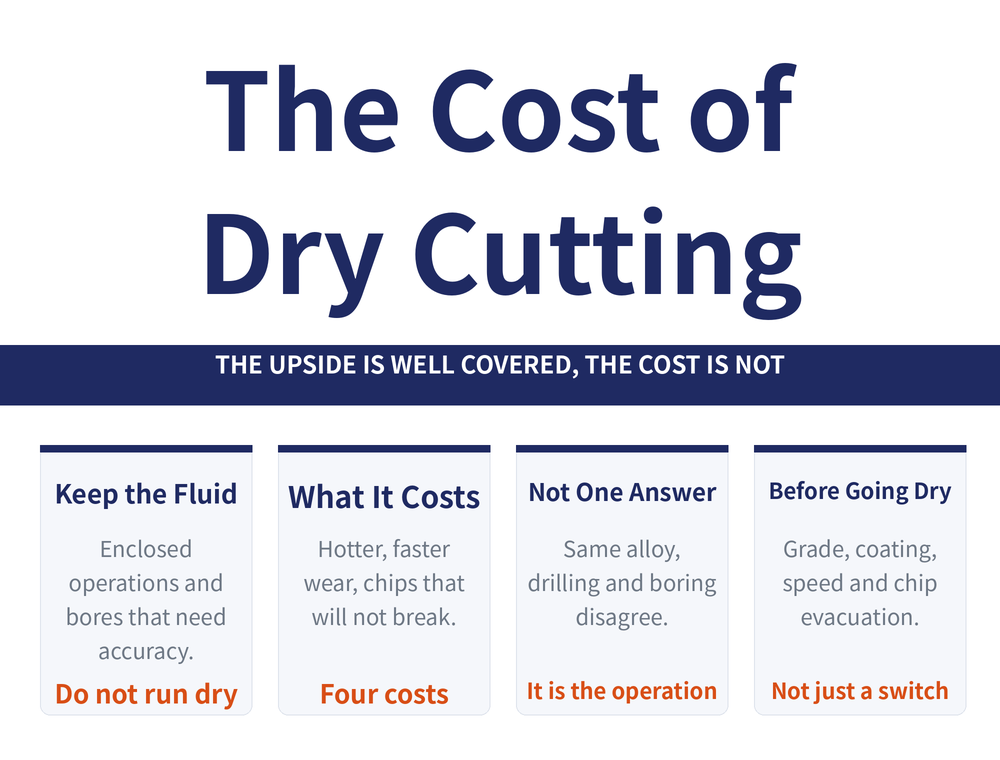
The benefits of dry cutting get plenty of coverage; the cases where it does not work get very little. This article covers only the negative side: which operations should keep their cutting fluid, what running dry actually costs, and one result that is often misread — in the same aluminium alloy, drilling and boring point in opposite directions. Read this before deciding to go dry.
1. Dry cutting is not simply switching the coolant off
Turn the coolant off and the cut still happens and the part still comes out. The question is whether you have replaced the jobs the fluid was doing. Cutting fluid cools, lubricates, breaks chips and flushes them away at the same time. Remove it and those four jobs do not disappear; they are simply handed to something else. Heat goes to the tool grade and coating and leaves with the chip, evacuation falls back on gravity or air, and lubrication usually has no substitute at all.
So "can this run dry" is not a yes or no question. It is "with no fluid present, do those four jobs still get done in this operation". Where they do not, the cost shows up directly in bore size, surface finish and tool life. For choosing the fluid itself, see how to choose a cutting fluid.
2. Five measured comparisons, and the answer is not one-sided
A set of comparative cutting trials from Michigan Technological University (MTU) covers five items. Two of the five run against intuition:
| Item | Measured result |
|---|---|
| Tool life | Against intuition. At the trial's cutting speed of v=130m/min, applying fluid shortened tool life: intermittent supply and uneven cooling produced irregular heating and cooling cycles, cracking the tool tip |
| Surface roughness | Drilling aluminium alloy dry gave a bore roughness value twice that of wet cutting |
| Cutting force and torque | In drilling, fluid clearly reduced both, and the effect is largest in enclosed operations |
| Heat and bore size | Running dry raised the temperature all along the bore, so the bore grew |
| Cost structure | Cutting fluid accounts for a share of total production cost far higher than the share taken by tooling |
⚠ The cost row states the direction only: the underlying percentage ranges could not be verified, so this site does not list them. For an investment case, run your own cost calculation.
3. Four cases that should keep their fluid
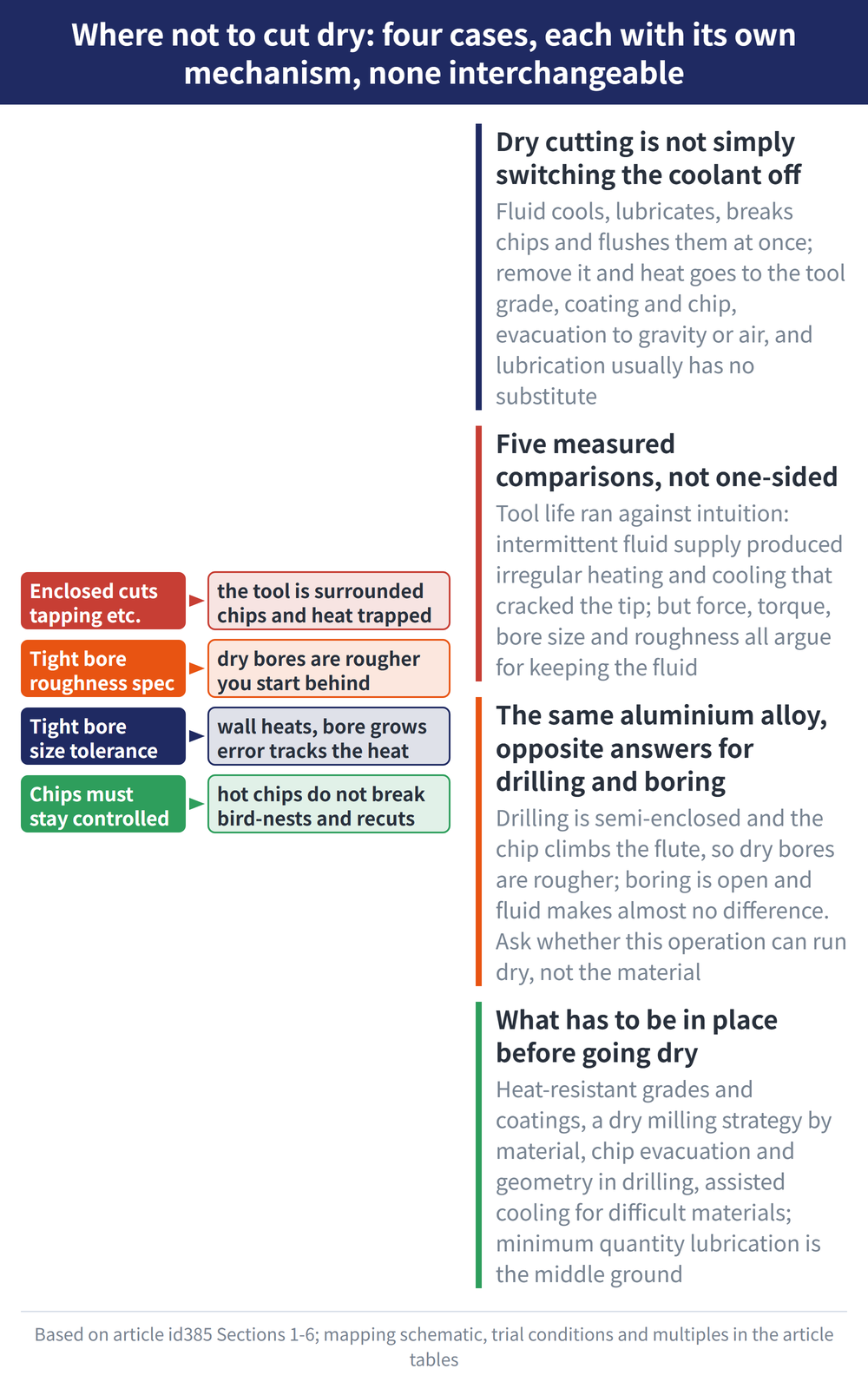
Invert the section above and you get the cases where dry cutting does not belong. Each has its own mechanism and they are not interchangeable:
| Case | Why not |
|---|---|
| Enclosed operations (tapping, deep hole drilling, broaching, sawing) | The tool is surrounded by the workpiece, so neither chips nor heat can get out. This is exactly where fluid reduces force and torque most, so removing it raises the load directly |
| Bores with a tight roughness requirement | The drilling trial measured twice the roughness value when dry. On a demanding bore, going dry starts you two steps behind |
| Bores with a tight size tolerance | Running dry raises wall temperature and the bore grows. That error tracks temperature rather than sitting at a fixed offset, so it cannot simply be compensated |
| Operations where chips must stay controlled | With no fluid to flush them, higher thermal plasticity makes chips harder to break, and the risk of bird-nesting and recutting rises with it |
Read the other way, the conditions that favour dry cutting are these: non-enclosed operations without demanding size or roughness requirements can go dry outright. Demanding non-enclosed work has to buy the difference back with higher speed and lighter feed, and the extra cost of those measures works out about level with the fluid savings.
4. The four costs that remain
Even where the case is suitable, dry cutting still costs something. The difference is that these costs can be managed:
| Cost | What you see on the floor |
|---|---|
| More energy, more heat | Both deformation and friction energy rise, and cutting temperature rises with them |
| Faster tool wear | Friction conditions and the wear mechanism at the tool and chip interface both change. It is not the same wear curve |
| Chips that will not break or clear | Higher thermal plasticity makes chips hard to break, and collecting and clearing them gets harder |
| Surface quality degrades | The sum of the three above, and usually the first place it shows |
For identifying wear patterns, see the guide to tool wear analysis.
5. The result that is most often misread
One finding in the same body of work is worth remembering: in the same aluminium alloy, drilling and boring gave opposite answers.
Drilling aluminium alloy dry doubled the bore roughness value, and fluid clearly reduced cutting force and torque. But in the comparative boring trials on aluminium alloy, the presence of fluid made almost no difference to bore roughness and essentially no difference to force and torque.
The difference is how enclosed the cut is and how the chips get out. Drilling is semi-enclosed and the chip has to climb the flute; boring is open, so chips fall away and heat escapes. Which means the question "can aluminium alloy be cut dry" is itself the wrong question. The question is whether this operation in aluminium alloy can be cut dry. Carrying a result from one operation to another is the most common misuse of this subject.
6. What has to be in place first
Going dry is not a change you make at the coolant switch; it asks for a matched set of conditions. Dry cutting became viable because new tool materials and high speed machining filled the gap the fluid left, not because the fluid was unnecessary to begin with.
| What to put in place | Where to read it |
|---|---|
| Heat resistant tool grades and coatings | Choosing tool materials for dry cutting |
| Dry milling strategy by material | How to run dry milling |
| Chip evacuation and geometry in drilling | Why dry drilling is hard |
| Assisted cooling for difficult materials | Two assisted cooling routes |
If the goal is less fluid rather than none, MQL is the middle ground; see the low-fluid section of how to choose a cutting fluid.
7. Frequently asked questions
Q: Does dry cutting really make tools last longer?
That result did appear under the MTU trial conditions, at a cutting speed of v=130m/min, because intermittent fluid supply created irregular heating and cooling that cracked the tool tip. But it is a measured value under specific conditions, not a general rule. Change the speed, the material or the delivery method and the answer can invert. Treat it as evidence that dry cutting does not always cost tool life, not as evidence that it always saves tooling.
Q: Why is tapping such a poor candidate for dry cutting?
Because tapping is an enclosed operation. The tool is surrounded by the hole wall, the chips have no open route out and the heat cannot escape, and reducing force and torque is exactly where cutting fluid does most for enclosed work. Take it away and torque climbs, and with it the risk of breaking the tap. Deep hole drilling, broaching and sawing sit in the same group.
Q: Why does drilling say no and boring say it makes no difference, in the same alloy?
Because the operation decides it, not the material. Drilling is semi-enclosed and the chip has to climb the flute, so heat and swarf stay trapped in the hole. Boring is open: chips fall clear and heat escapes, so fluid makes almost no difference to surface finish or to cutting force. This is where the subject is most often misused. Quote the result together with the operation it came from, not the material alone.
Q: To cut fluid costs, what is the first step?
Sort the operations into enclosed and non-enclosed, then look at the accuracy requirement. The non-enclosed work with modest requirements is the easy group to change; leave the enclosed work and the tight bores alone for now. Even in the group you do change, the step is not simply shutting the supply off — it means heat resistant grades and coatings, adjusted speed and feed, and confirming the chips can get out. MQL also exists as a middle option, so the jump to fully dry need not happen at once.
This article is part of Manufacturing Process: The Complete Guide - Set the Datum First, Then Sequence, Allowance and Dry Cutting; that guide shows how the whole topic fits together.
This article is part of Dry Machining: The Complete Guide - Losing the Coolant, and How Five Processes and Three Techniques Cope; that guide shows how the whole topic fits together.
Published: 2026-08-30|Last updated: 2026-08-30