
Dry Machining: The Complete Guide - Losing the Coolant, and the Three Routes That Carry the Load
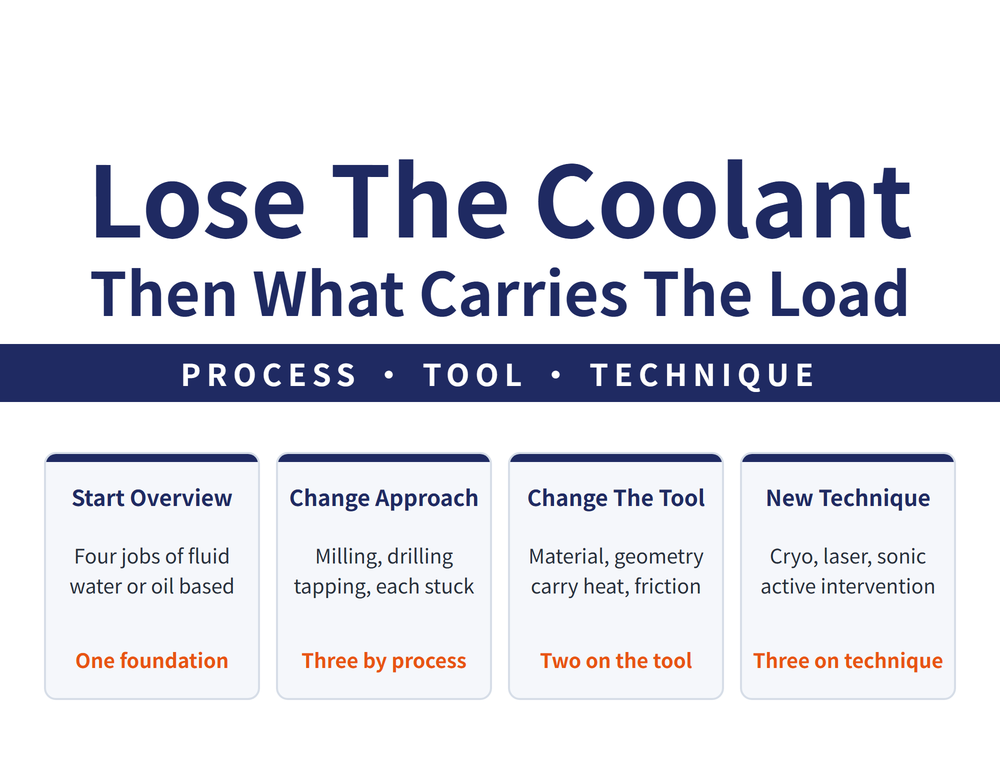
Dry machining is one line spread across five categories, 10 articles in total, all answering the same question: once the coolant is gone, what carries the load instead. Three kinds of answer exist - change the approach for the process (milling, drilling and tapping each differ), change the tool (material and geometry both move), or change the technique (cryogenic cooling, laser assist, ultrasonic vibration, electrostatic cooling). The last article argues the other side: where dry should not be tried at all. This guide gives the overview first, then strings the 10 together by the three kinds of answer.
1. Start With the Foundation: What Coolant Does, What Dry Means
Before deciding whether to lose the coolant, know the four jobs it does that conflict with each other: cooling, lubrication, chip evacuation, rust prevention. No single fluid is strong at all four, and that is exactly why dry machining has room to work - as long as something else can cover a few of those jobs, there is room to take the fluid away.
| Article | When to read it |
|---|---|
| Cutting Fluid Selection | The entry point for the line. Water-miscible, neat oil, MQL and a dry overview side by side |
After this one, dry machining stops looking like an on-off switch: minimum quantity lubrication (MQL) is the middle ground - a tiny mist of oil covering only lubrication, not cooling or chip evacuation, and it comes up again in several articles below.
2. Change the Approach: By Process, Where Milling, Drilling and Tapping Each Get Stuck
The same act of "losing the coolant" gets stuck in a different place for every process, so one fix does not transfer.
| Article | When to read it |
|---|---|
| Dry Milling by Material | The most mature of the three - read this one to set the baseline. Four different tactics for cast iron, steel, aluminium and stainless |
| Why Dry Drilling Is Hard | When the hole gets deeper and chip evacuation becomes the real problem |
| Is Dry Tapping Viable | When weighing tapping without coolant. The cleanest route is producing no chips at all |
The three rise in difficulty: a milling edge enters and leaves the cut with good access to heat loss; a drilling or tapping edge is buried in the hole, where neither heat nor chips can get out easily. That is also why dry milling is already routine while dry drilling and tapping still need case-by-case judgement.
3. Change the Tool: Material and Geometry Both Move
Once the coolant is gone, the tool alone has to carry the heat, friction and chip control the fluid used to share, so the logic for choosing material and shape is not quite the same as for wet cutting.
| Article | When to read it |
|---|---|
| Choosing Tool Materials for Dry Cutting | Before deciding which material to run. Five requirements against seven workpiece materials |
| Tool Geometry for Dry Cutting | Once the material is set, when deciding how the edge and rake face should be shaped |
The two divide the work cleanly: the first decides which material to run, the second decides what shape that same material should be ground into. Details like the rake-face reinforcement land only become the next question once the material choice is settled.
4. Change the Technique: Active Intervention in the Cutting Zone
When changing the approach and the tool are still not enough, there is one more route: intervene in the physical state of the cutting zone itself - not passively enduring the absence of coolant, but actively swapping in a different way to cool or break the chip.
| Article | When to read it |
|---|---|
| Cryogenic Cooling vs Laser Assist | Choosing between two opposite routes for difficult-to-machine materials |
| Ultrasonic Vibration Dry Boring | When cutting force in boring will not come down and coolant is not an option |
| What Is Electrostatic Cooling | Looking for a compromise that is small and low-power |
The three solve different problems: cryogenic cooling and laser assist change how hard or soft the material itself is, ultrasonic vibration changes how the cutting force is applied, electrostatic cooling changes the friction at the tool-workpiece interface. None excludes the others, but each has its own threshold - a critical speed, an equipment cost, a material fit - none is simply plug-and-play.
5. When Every Option Fails to Pay: Read the Other Side First
| Article | When to read it |
|---|---|
| The Cost of Dry Cutting | Read it before you decide to go dry. It only argues where not to |
It holds a counter-example easy to misread: in the same aluminium alloy, drilling and boring point the opposite way - one material does not carry a single dry-or-not conclusion across every process; the process itself has to be checked each time. Whether to run dry is a question to ask again for every job, not something settled once and reused on the next one.
6. Frequently Asked Questions (FAQ)
Q: Where should I start in these 10 articles?
Start with Cutting Fluid Selection in section 1 for the foundation, then read whichever process in section 2 matches your job - milling, drilling or tapping. If the process is fixed and the question is which tool, jump to section 3. Already tried changing the tool and it is still not enough, or wondering about active techniques, read section 4. Not sure whether to go dry at all, read section 5 first - it is the fastest way to save time.
Q: These 10 span five categories - why do they count as one line?
Because the first decision, the judging criteria and the range of fixes are all the same set: decide whether to lose the coolant, then pick one or stack several ways to cope, judged against the same criteria - how hard the material is to machine, what process is involved, and how much heat and chip build-up the job can tolerate without coolant. The categories are organised by product line (end mills, drills, taps, tool materials, turning, boring), but the reader's problem is one and the same - which is exactly why tags and reading guides exist: categories serve product lines, guides serve the reader's problem.
Q: Are cryogenic cooling and laser assist the same thing as ordinary "dry machining"?
They extend the same decision rather than being something separate. Both start from the same premise - conventional coolant has already been ruled out - and differ only in how they cope: ordinary dry machining leans on tool material and geometry alone, while cryogenic cooling and laser assist actively intervene in how hard or soft the material itself is. The judging criteria trace back to the same set: how hard the material is to machine, and what the biggest risk becomes once the coolant is gone. That is why this guide places them in section 4 of the same line rather than opening a separate one.
Q: Does minimum quantity lubrication (MQL) count as dry machining?
It counts as the middle ground, not strictly dry, but it is usually discussed alongside it. MQL uses a tiny mist of oil for lubrication only, without the cooling and chip-evacuation capacity of conventional coolant, so it addresses much the same problem as dry machining - finding a substitute when coolant cannot deliver its full set of jobs. Both the cutting-fluid overview in section 1 and the dry-drilling article in section 2 cover how far MQL can help, and where it stops.
Published: 2026-09-10|Last updated: 2026-09-10









