
Choosing Tool Materials for Dry Cutting: Five Requirements and Seven Workpiece Materials
Whether dry cutting works is decided largely by the tool material. Without coolant the tool has to withstand higher temperature, greater friction and harder chip evacuation at the same time, which makes the selection logic differ from wet machining. This article covers the five requirements dry cutting places on tooling, a roughing and finishing table for seven workpiece materials, and how the four carbide classes and cermets divide the work.
1. Five requirements dry cutting places on tooling
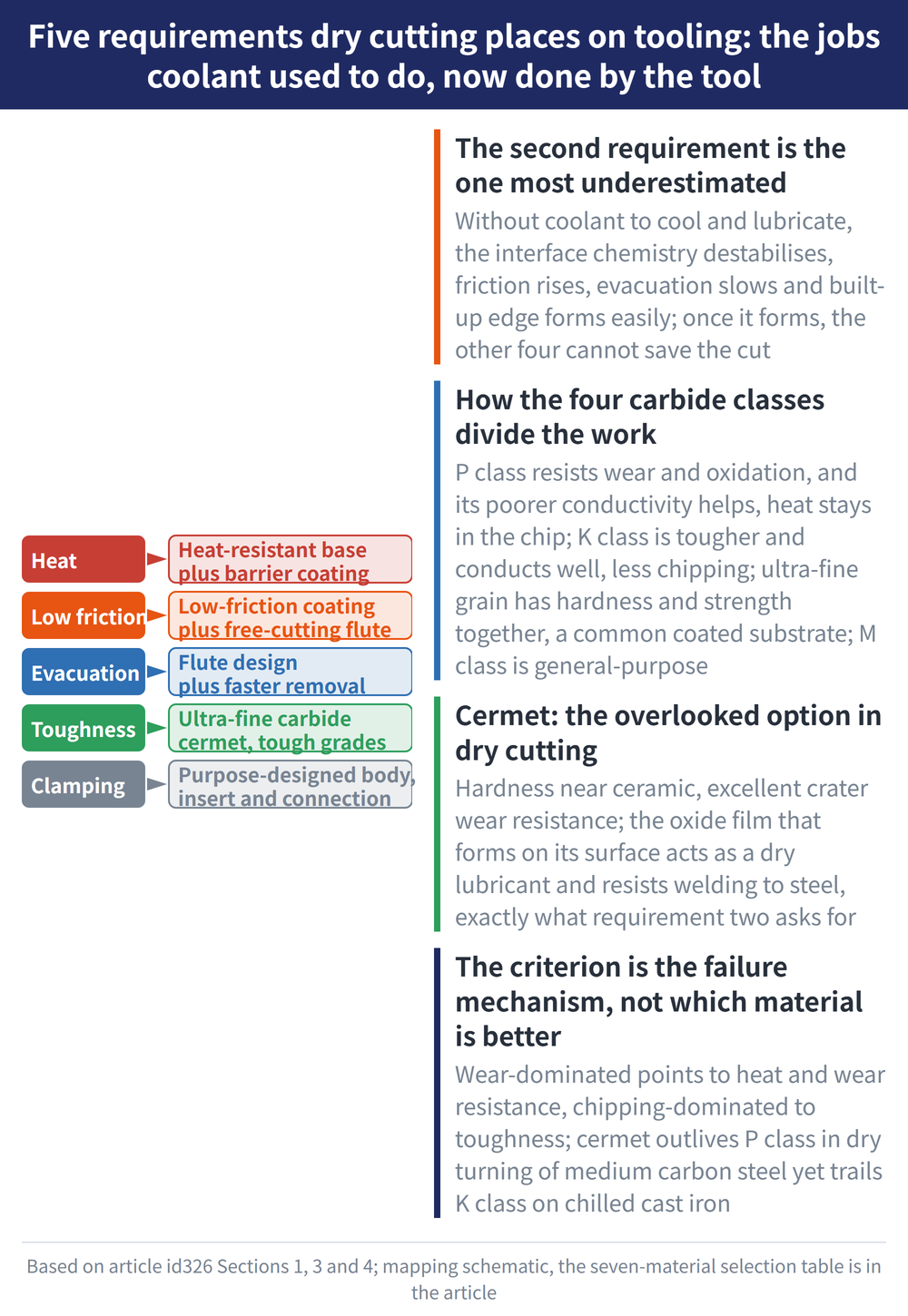
These five are not a stricter version of the wet requirements. They exist because the functions previously carried by coolant now have to be provided by the tool itself:
| Requirement | What coolant used to do | What replaces it |
|---|---|---|
| Heat resistance | Lower cutting zone temperature | Heat-resistant substrate plus a coating as thermal barrier |
| Low friction | Lubricate tool–chip and tool–work interfaces | Low-friction coating plus a free-cutting structure |
| Chip evacuation | Flush chips away | Flute design plus higher removal rate to shorten contact |
| Strength and toughness | Moderate thermal shock | Ultra-fine grain carbide, cermet and similar tough materials |
| Secure clamping | (risk amplified at high speed) | Dedicated design of body, insert seat and interface |
The second item is the most underestimated. Without coolant to cool and lubricate, high temperature makes the interface chemically unstable, raises friction and slows chip flow, and built-up edge forms very readily — once it does, the other four count for nothing.
2. Selection table for seven workpiece materials
| Workpiece material | Roughing | Finishing |
|---|---|---|
| Wrought / cast aluminium | K10, K20 (silicon nitride also for castings) | PCD, diamond coating (silicon nitride for castings) |
| Copper alloys | K10, K20 coated carbide, cermet | PCD, silicon nitride ceramic |
| Structural steel | Cermet, PVD coated, high-TiC carbide with Ta/Nb | CBN, ceramic |
| High strength and hardened steel | High-TiC carbide with Ta/Nb | CBN, cermet |
| Stainless, superalloys, titanium | Ultra-fine grain P class carbide with Ta/Nb | Fine or ultra-fine grain P class carbide with Ta/Nb |
| Fibre reinforced composites | K class carbide | PCD |
| Cast iron | Cermet, K class carbide | CBN, silicon nitride ceramic |
The table gives material directions for dry cutting and is not a recommendation of specific grades; follow the catalogue and confirm by trial cut. For reading ISO material codes see how to read insert material codes. The superhard materials in the table each have their own article: ceramic cutting tools, CBN and PCBN, and PCD and diamond coating.
3. How the four carbide classes divide the work
P class (WC-TiC-Co) has better wear resistance and oxidation resistance than K class, but distinctly lower transverse rupture strength and impact toughness; it suits annealed tool steels and alloy steels. It has one property that is particularly interesting in dry cutting: poorer thermal conductivity actually helps — heat stays concentrated in the chip and is carried away rather than conducted into the tool.
K class (WC-Co) has higher rupture strength and impact toughness, reducing chipping, and its good thermal conductivity aids heat dissipation and prevents the corner from softening; it suits hardened steel, chilled cast iron, cast iron, non-ferrous metals and superalloys.
Ultra-fine grain carbide brings the tungsten carbide grain down to the sub-micron range so hardness and strength can be had together — at the same cobalt content both hardness and rupture strength clearly exceed ordinary carbide, which is why it is commonly used as the substrate for coated carbide. M class (with TaC/NbC) raises hot hardness and oxidation resistance, handling cast iron, non-ferrous metals and steel alike, making it the general-purpose class.
4. Cermet: the overlooked option in dry cutting
Cermet, based on TiC or TiCN with nickel as the binder phase, sits further forward in dry cutting than many assume. Its hardness approaches that of ceramic tooling, its resistance to crater wear (the pit that forms on the rake face) is excellent, and the onset temperature for crater wear is roughly two to three hundred degrees higher than carbide, allowing it to keep cutting above a thousand degrees.
More important is chemical stability: during cutting the surface forms oxide and nickel molybdate films that act as a dry lubricant, so it resists welding to steel at several hundred degrees — which is exactly what requirement two in section one asks for. Source measurements show that in high-speed dry turning of medium carbon steel its life can reach around twice that of traditional P class carbide; in dry turning of chilled cast iron, however, it falls slightly behind K class, because the failure mechanism there is brittle fracture rather than wear.
The selection criterion is therefore not "which material is better" but "what is the failure mechanism in this situation" — wear-dominated points toward heat and wear resistance, chipping-dominated points toward toughness. For coating pairing see common tool coating materials and the insert coating chart.
5. Frequently Asked Questions (FAQ)
Q: Does dry cutting require superhard tool materials?
Not necessarily. Roughing is still mostly coated carbide or cermet, with superhard materials concentrated in finishing. The decisive factors are coating and flute design, not switching everything to CBN or PCD.
Q: Why does low thermal conductivity suit P class for dry cutting steel?
Because the heat stays concentrated in the chip and leaves with it instead of conducting into the tool body. When dry cutting steel, removal rate is usually limited by plastic deformation resistance and flank wear rather than crater wear.
Q: Are cermet and ceramic tooling the same thing?
No. Cermet is based on TiC or TiCN with a nickel binder and remains a powder metallurgy hard material; ceramic tooling uses an alumina or silicon nitride base, and the two differ in toughness and application.
Q: Should the grade change between roughing and finishing?
Usually yes. Roughing prioritises toughness and chipping resistance, finishing prioritises wear resistance and surface quality, and the optimum often falls in different classes — which is why the table lists two columns.
This article is part of Tool Materials and Coatings: The Complete Guide - Separate Substrate From Coating, Then Work Back From the Workpiece; that guide shows how the whole topic fits together.
This article is part of Dry Machining: The Complete Guide - Losing the Coolant, and How Five Processes and Three Techniques Cope; that guide shows how the whole topic fits together.
Published: 2026-08-26 | Last updated: 2026-08-26









