
How to Read Insert Material Codes: ISO 513 HW, HC, CA and DP Explained
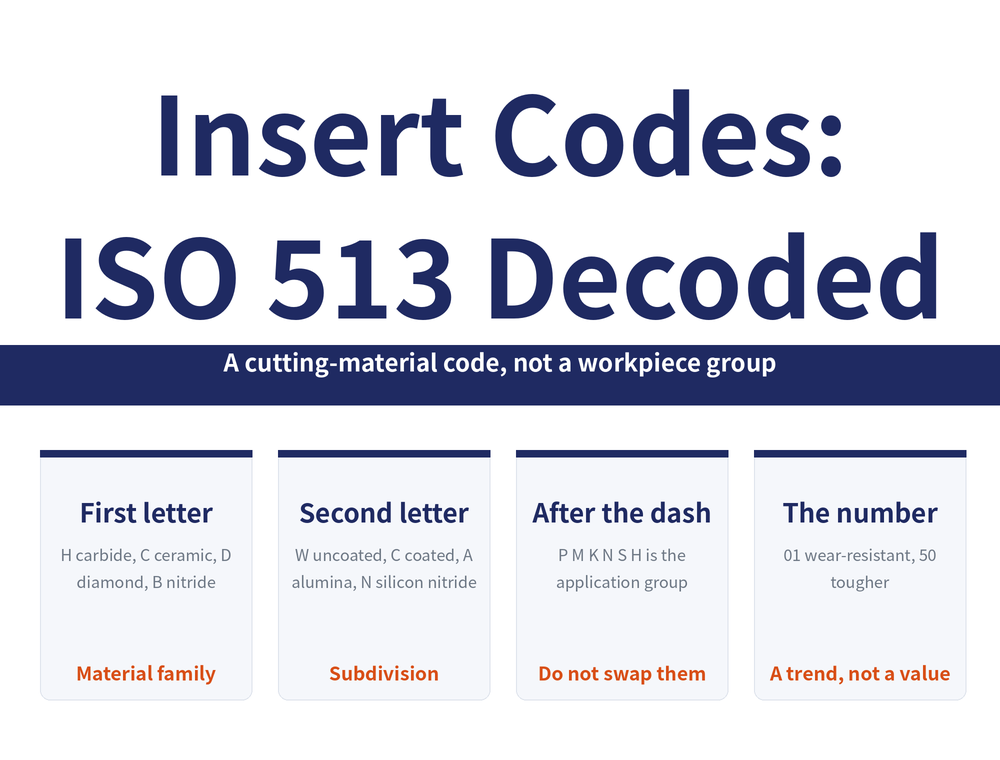
The HW, HC, CA and DP marks on an insert box are not workpiece groups. They are the cutting-material codes defined in ISO 513. The first letter gives the material family (H carbide, C ceramic, D diamond, B boron nitride) and the second letter gives the subdivision, so HW is uncoated tungsten carbide with grain size of 1 micrometre or more, while HC is the same family but coated. The P, M, K, N, S and H application group comes after a dash, as in HW-P10. This guide reads the whole string apart.
1. Why are HW and P10 so often confused?
When a catalogue lists "HC-P25", many readers look only at the second half, P25, and assume the whole string says "this insert turns steel". In fact these are two different classifications that ISO 513 (classification and application of hard cutting materials) strings onto one line.
The first half is the cutting-material code, answering "what is this insert made of". The second half, P, M, K, N, S or H, is the workpiece application group, answering "what is it intended to cut". One material can span several application groups, and one application group contains very different materials. The workpiece side has its own article, see Cutting Tool Material Classification; this article covers only the material half.
2. How is the code built? What each letter controls
ISO 513 writes it as material letters, a dash, the application group letter, then the application group number. Examples given in the standard itself include HW-P10, HC-K20 and CA-K10.
HC-K20 = HC (coated carbide, that is coated tungsten carbide) + K (mainly cast iron) + 20 (application group number).
Down at letter level the rule is consistent. The first letter is the material family: H for carbides, C for ceramics, D for diamond and B for cubic boron nitride. The second letter is the subdivision inside that family. And whenever the second letter is C it means "as above, but coated", which is why HC, CC and BC all follow the same pattern.
3. The four carbide (tungsten carbide) codes
Carbides are the group you meet most often. The four codes differ in substrate composition and grain size, while coating status is carried separately by HC.
| Code | ISO 513 definition | Meaning of second letter |
|---|---|---|
| HW | Uncoated carbide, main content WC, grain size ≥ 1 µm | W = tungsten carbide, regular grain |
| HF | Uncoated carbide, main content WC, grain size < 1 µm | F = fine grain |
| HT | Uncoated carbide, main content TiC or TiN or both | T = titanium based, noted as cermets |
| HC | Carbides as above, but coated | C = coated |
HW and HF differ only at the 1 micrometre grain threshold, and that line drives the hardness against transverse rupture trade-off, detailed in Carbide Grade Decode Guide. HT is what the market calls cermet, see Cermet Cutting Tool Guide. Note that HC only says a coating exists; its composition and process must be looked up separately, starting from the Carbide Insert Coating Chart.
4. Reading the ceramic, diamond and boron nitride codes
The three non-carbide families use the same two-letter family plus subdivision structure.
| Family | Code | ISO 513 definition |
|---|---|---|
| Ceramic C | CA | Ceramic, main content alumina Al₂O₃ |
| Ceramic C | CM | Mixed ceramic, Al₂O₃ plus non-oxide components |
| Ceramic C | CN | Silicon nitride ceramic, main content Si₃N₄ |
| Ceramic C | CR | Ceramic, main content Al₂O₃, reinforced |
| Ceramic C | CC | Ceramics as above, but coated |
| Diamond D | DP | Polycrystalline diamond (P = polycrystalline) |
| Diamond D | DM | Monocrystalline diamond (M = monocrystalline) |
| Boron nitride B | BL | Cubic boron nitride, low cBN content |
| Boron nitride B | BH | Cubic boron nitride, high cBN content |
| Boron nitride B | BC | Boron nitride as above, but coated |
For cBN, watch L against H: they state how much cubic boron nitride the grade contains, not a hardness class, and the selection logic is in CBN and PCBN Cutting Guide. The differences among the four ceramic codes are covered in the Ceramic Cutting Tool Guide, and practical use of DP and DM is in PCD and Diamond Coating Guide.
5. After the dash: application group, number and colour
With the material code read, the second half turns to the workpiece. ISO 513 splits the application groups into six letters, each with an identification colour.
| Group | Colour | Workpiece material |
|---|---|---|
| P | Blue | Non-stainless steel and cast steel |
| M | Yellow | Austenitic and austenitic/ferritic stainless steel |
| K | Red | Grey, spheroidal graphite and malleable cast iron |
| N | Green | Aluminium, other non-ferrous and non-metallic materials |
| S | Brown | Heat-resistant special alloys, titanium and its alloys |
| H | Grey | Hardened steel, hardened and chilled cast iron |
The two digits after the letter rank grades inside one application group, and how far each group runs differs, so go by the catalogue: towards the low end wear resistance and usable cutting speed rise, towards the high end toughness and usable feed rise. This is a relative ranking, not a parameter set, so actual values still come from the tool catalogue. To converge workpiece, material and coating together, compare against Material and Coating Selection by Workpiece.
6. Three common misreadings
| Common misreading | What it actually means |
|---|---|
| Reading H as "for hardened steel" | The leading H is the carbide family; only the group H means hardened work |
| Assuming HC identifies the coating | HC only says coated; composition and process need a separate check |
| Treating P25 as a maker's grade | P25 is an application group and ranking; grade names are vendor defined |
| Expecting the code to cover insert shape | Shape and size sit in the ISO 1832 insert designation, kept separate |
In short, an ISO 513 code confirms whether the material family is right, but landing on a single grade still means going back to the vendor catalogue. Different tool types weigh these codes differently, and the contrast across end mills, drills and taps is in Tool Material Selection by Tool Type. For how to compare grades from different brands, see Comparing Cutting Tool Brands: Which Spec Fields Line Up, and Which Only Count Within One Catalog.
7. Frequently Asked Questions (FAQ)
Q: What exactly separates HW from HC?
HW is uncoated carbide whose main content is tungsten carbide with a grain size of 1 micrometre or more, while HC is that same carbide family after coating. The difference is the coating, not a substrate class.
Q: Is the H in the material code the same H as the application group?
No. The H before the dash marks the carbide material family, while the H after the dash is the application group for hardened steel and hardened cast iron.
Q: Does ISO 513 contain a code called HN?
The published ISO 513 carbide table lists only HW, HF, HT and HC, with no HN. If a catalogue shows something similar, ask the supplier whether it is an in-house code or a reference to another standard.
Q: Who defines the blue, yellow, red, green, brown and grey colours?
The colour identification comes from the ISO 513 application group table: P blue, M yellow, K red, N green, S brown and H grey. It flags the workpiece group in catalogues, not the tool material.
For the full reading guide on this topic, see Insert Selection: A Complete Reading Guide.
This article is part of Tool Materials and Coatings: The Complete Guide - Separate Substrate From Coating, Then Work Back From the Workpiece; that guide shows how the whole topic fits together.
Published: 2026-08-08 | Last updated: 2026-10-28









